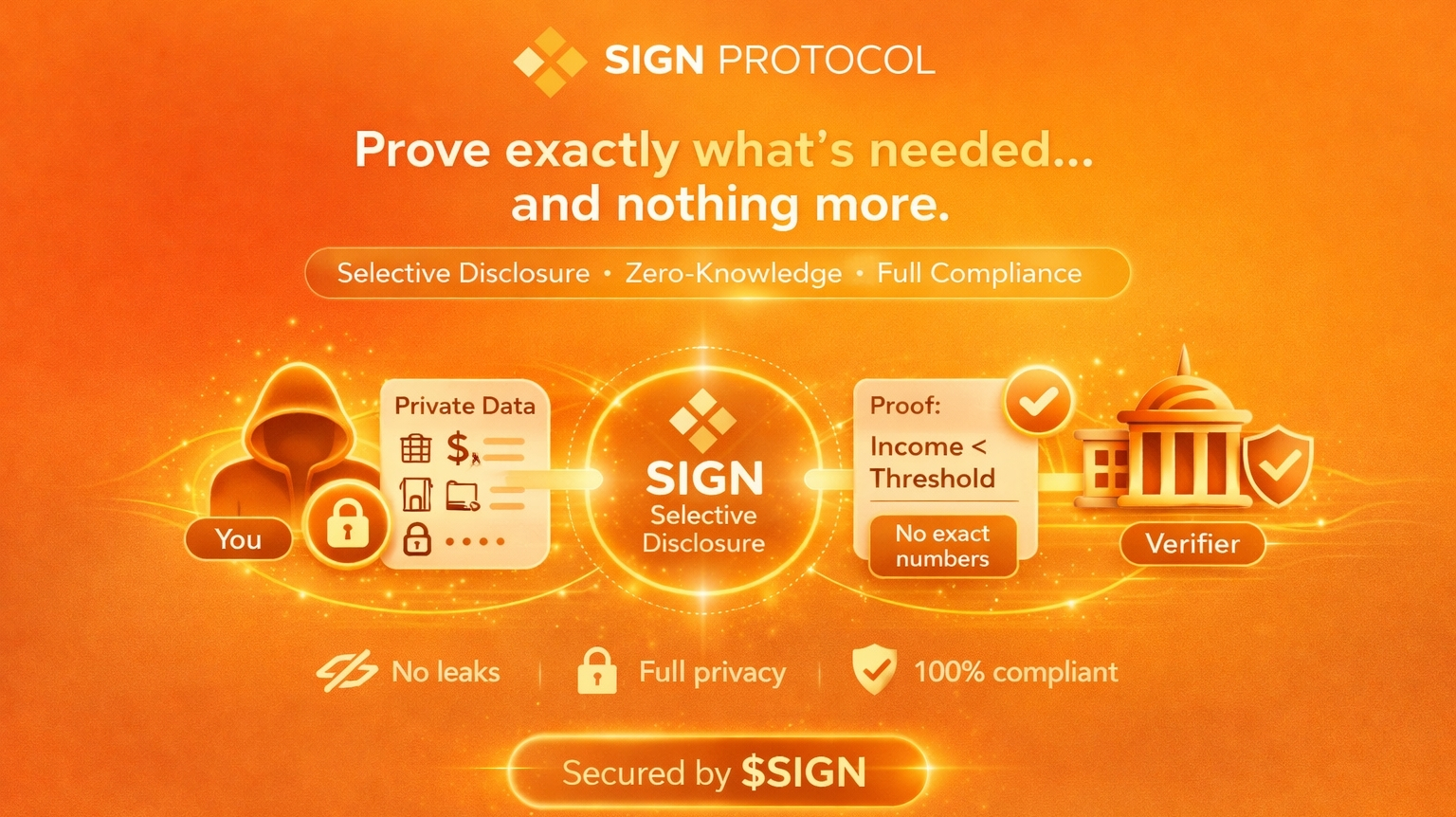

I was up late one night, mind wandering through crypto stuff as usual when this idea from @SignOfficial
really stopped me.Most projects push you to pick a side either full privacy (and good luck with real use) or total transparency (and watch people run away). But Sign Protocol does something way smarter.It lets you prove exactly what’s needed...
and nothing more.Imagine this simple scenario:
You’re applying for some government aid or a service.
Instead of handing over your full income details, bank statements
or personal history.you just share a clean signed attestation.
Using selective disclosure (backed by zero-knowledge tech) you prove
“yes my income is below the threshold”
without revealing the actual number.
The verifier sees the proof is real and valid but your private data stays private.
No leaks.
No over-sharing.
Yet full compliance is satisfied.
That’s the magic.
Sign Protocol makes this practical with easy schemas and attestations that work across chains. Governments
or projects can issue these claims, and users control what gets shown each time.It feels perfect for real life opening accounts accessing services joining communities
or handling regulatory checks without the usual privacy nightmare or endless paperwork.
SIGN plays its role by securing the whole evidence layer behind these attestations.
I used to think balancing privacy and real-world rules would always be a messy compromise. After thinking about how selective disclosure works here it feels like @SignOfficial
found a clean middle path that actually makes sense for everyday digital interactions at scale.
This quiet feature might end up being one of the most important parts of the whole stack in 2026.
Anyone else starting to see how this could change the way we share info with systems without losing control?