Honestly, the first time I saw @Pixels I had the same question. Farming is not a new game. Plant seeds, water, plant crops, decorate the land - we have seen many such games. Why are you talking about the pixels? Why do people see it not just as a game, but as a great example of Web3 gaming?
I took some time to watch, play, and try to understand. It seemed that the Pixels were actually trying to do more than a farming game. It may be an attempt to correct old mistakes and reinvent the play-to-earn model.
The problem with many previous play-to-earn projects was very simple. They have brought earnings before gameplay. People didn't go to play games, they went to earn tokens. The results? Hype for a while, then the token dump, the reward decreases, the player's interest ends. Because if people don't have fun, they can't just be rewarded.
The pixels are a little different here.
The first impression here is very calm. The graphics are simple, the gameplay is fast, and the vibe is light. But on the inside, the system is layered. Here there is not only crop growth, there is resource management, there is time efficiency, there is crafting, there is social coordination, there is market logic.
I mean, soft on the surface of the game... but smart on the structure.
One of the most interesting things for me - I want to value the Pixel's effort.
Two players play at the same time. One worked in vain. what was put forward. Another one made a plan, made a crop cycle, reduced energy waste, optimized resources, and moved the market.
They both play the same game. But the result will not be the same.
Here's the difference.
A lot of games just reward the time spent. But Pixels seems to want to reward smarter participation. It may seem like a small difference, but it's a huge difference in economy design. Because if you just reward time, bot and grinder will dominate. But if you reward the strategy, the real players survive.
Another important thing is the sense of ownership.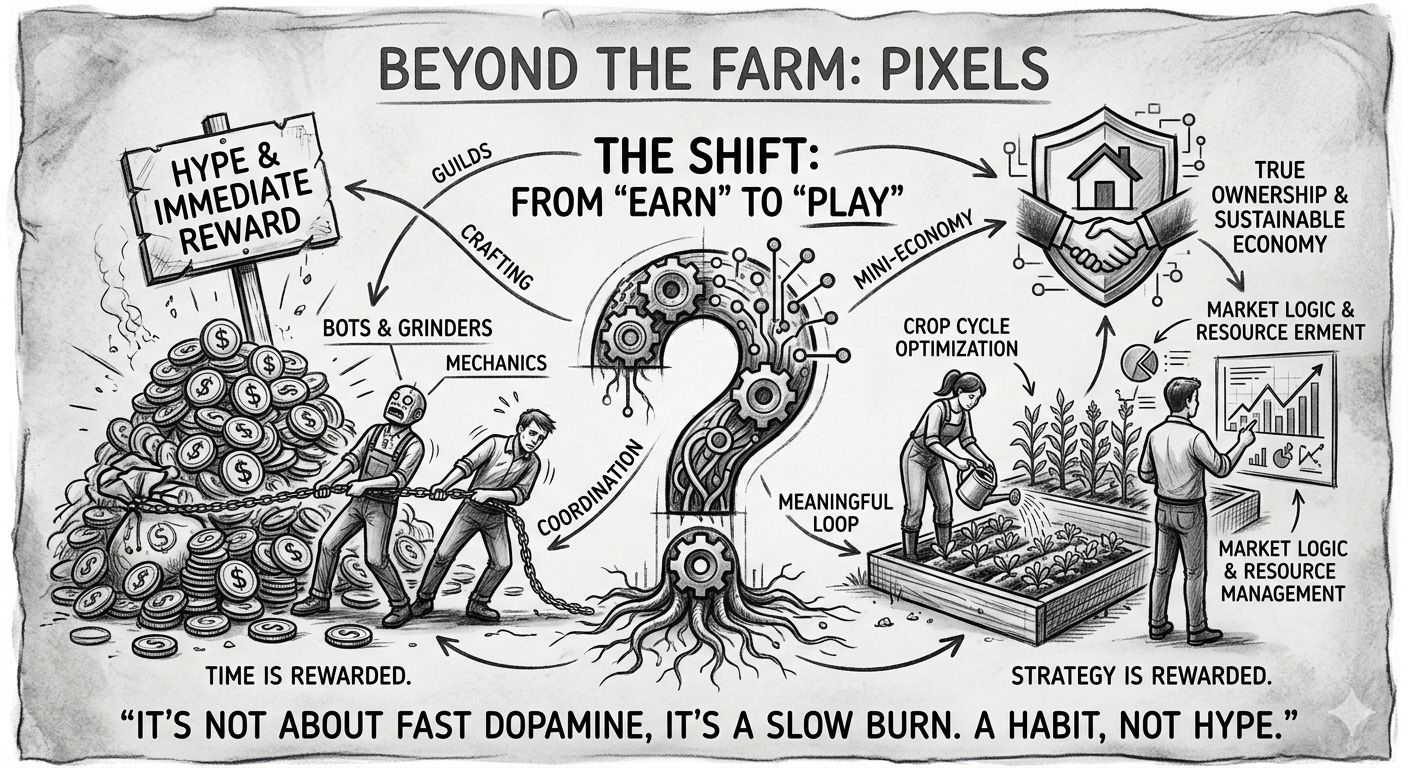
In the simple game, you have given thousands of hours, built, collected... all locked inside one closed system. Pixels provides this ownership narrative using the blockchain. I know many people cringe when they hear the word "ownership," because it's overused in Web3. But honestly, from the player's perspective it's still meaningful.
When people think that their effort is not only temporary, then the engagement changes.
There is another social layer that is underrated. Guilds, teamwork, coordination - these are not just community features. They create a mini-economy. Some are better at farming, some are better at crafting, some understand the market. Roles are slowly being created.
That's what I find interesting. Because then the game is not just a solo grind, but a living system.
The big crash of the play-to-earn model happened because earning came first, economy came later. Pixels do the opposite. First the game loop, then the participation, then the value layer. It's a healthier approach.
I'm not saying everything is perfect. There's a risk.
The token economy is difficult to maintain. Demand may be weak if there are no new players. Frustration increases when the reward balance is lost. If the gameplay becomes stale, the economy alone will not be able to save. These are all real challenges.
But atleast Pixels look like they know the problems.
They understand that it's not just a game. It's not just the ecosystem. A community is not just a road map. Daily reason to return. Small progress is required. I need a social cause. You need a meaningful loop.
And honestly, this is the beginning of the sustainable model.
Let me tell you another personal observation - Pixels are not a fast dopamine game. It's not a game where you get a wow moment in 10 minutes. It's a slow burn. The more time you give, the more layers you will understand. Those who look with patience will understand the value more. Those who are just looking for a quick reward, they may miss it.
That's why I can't just call it a farming game.
Is it possible to have fun + ownership + economy at the same time?
If the answer is yes, then Pixels can be an example not only for yourself, but for the entire Web3 gaming sector. Because the industry is still looking for that perfect balance where it's fun to play games, the economy is also healthy.
It's my honest opinion?
Pixels are not guaranteed to succeed. But it's the right question. And where many projects launch with the wrong question, there it is a big advantage.
The old play-to-earn saying goes: "How much will you earn? "
Pixels seem to be asking: Why play, how to play, why come back? "
This mindset shift-tie can be a real reset.
So for me, Pixels is not just another farming game. It may be trying to prove - quietly - that sustainable play-to-earn is made of habit, not hype. 🤝

Artikel
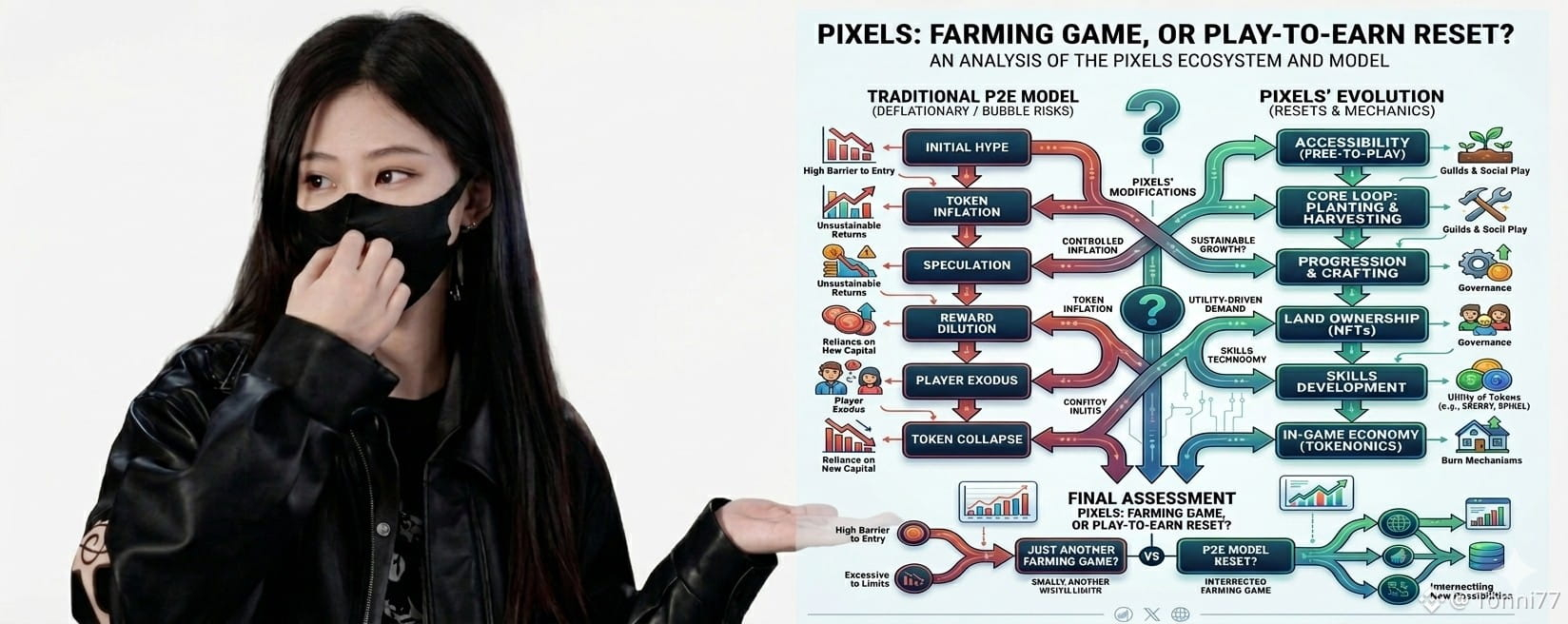
Pixels: Another farming game, or a reset of the play-to-earn model?
--
Haftungsausschluss: Die hier bereitgestellten Informationen enthalten Meinungen Dritter und/oder gesponserte Inhalte und stellen keine Finanzberatung dar. Siehe AGB.