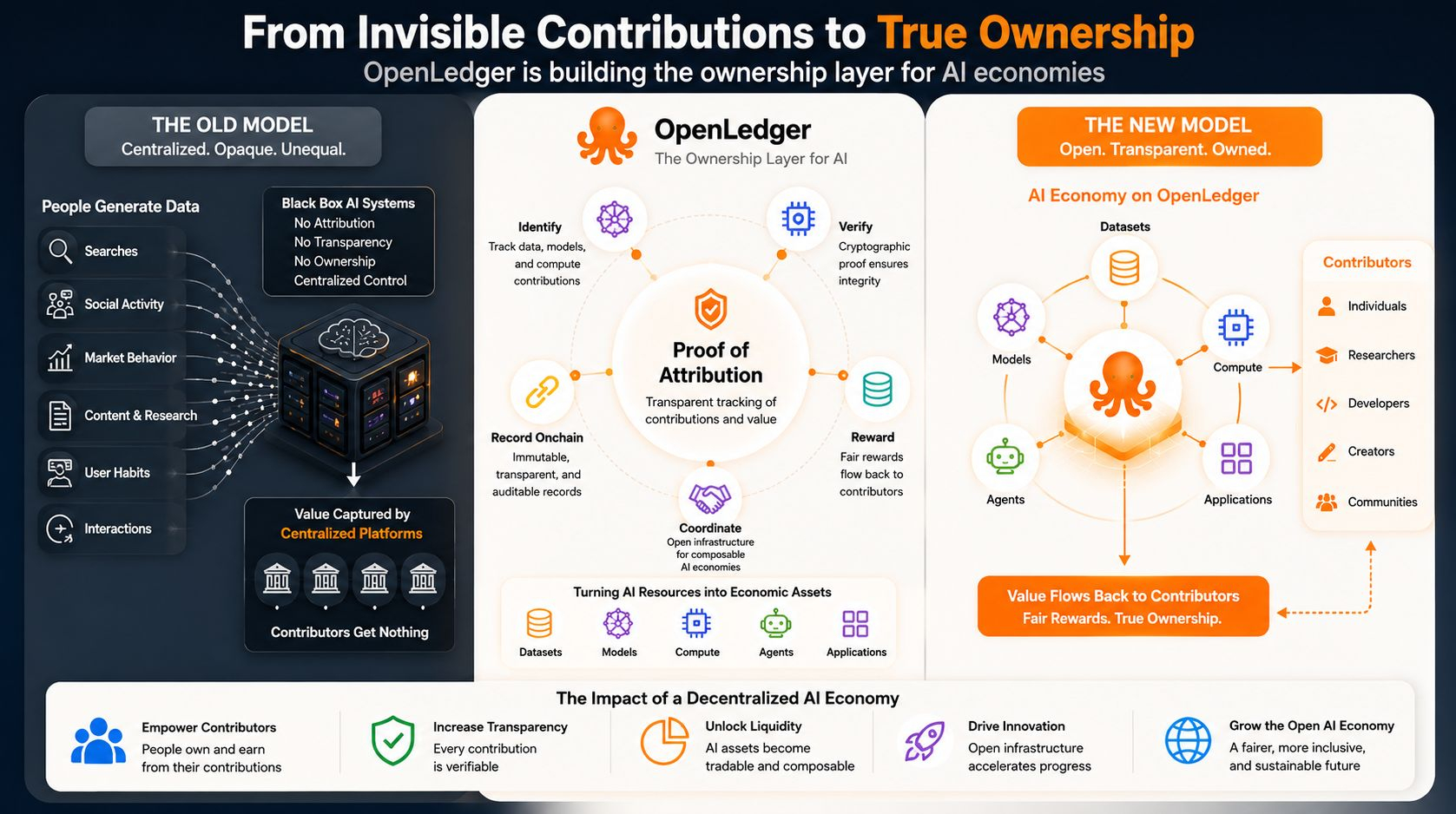
Billions of people generate valuable data every single day, and that data has quietly become the foundation of modern AI systems. Every search, every market activity, every online habit, every post, and every interaction contributes to training and improving AI models in one way or another.
But the people creating that value rarely benefit from it.
Instead, most of the economic upside flows toward a small group of centralized companies controlling the infrastructure, platforms, and distribution layers of AI.
That is the reason OpenLedger feels different from most AI narratives emerging in crypto right now.
Many projects are simply using AI as a marketing keyword, but OpenLedger appears focused on a much deeper issue: how AI-generated value can become transparent, monetizable, and owned onchain.
That completely changes the conversation.
The idea behind “Proof of Attribution” is especially important because today’s AI systems operate like black boxes. Nobody truly knows which datasets shaped an output, where the most valuable contributions came from, or how rewards should be distributed fairly across contributors.
If AI becomes a core layer of the future digital economy, then ownership around contribution cannot remain invisible forever.
Right now, the biggest issue inside AI may not even be the technology itself — it may be value distribution.
Datasets create enormous economic value while contributors receive almost nothing. Developers and researchers help build the ecosystem, yet most of the long-term upside remains trapped inside centralized platforms. As AI infrastructure becomes more powerful, ownership becomes more concentrated.
OpenLedger seems to be questioning whether that structure can change.
The timing of this narrative also matters.
The crypto AI sector in 2026 is becoming extremely crowded. Almost every project now claims to be building decentralized intelligence, autonomous agents, or AI infrastructure. But when you look deeper into many of these ecosystems, the long-term economic design often feels weak.
OpenLedger at least appears focused on a more important question:
How will value actually flow through future AI economies?
Of course, the challenges are real.
Centralized AI companies move incredibly fast because they control capital, infrastructure, computing resources, and distribution. Competing against those systems through decentralized coordination will not be easy.
Data quality is another major challenge.
Open contribution models can accelerate innovation, but they can also create spam, manipulation, and low-quality participation. Attribution alone is not enough. Sustainable AI ecosystems will require strong verification systems, reputation layers, and carefully aligned incentives.
Still, the direction itself feels important.
AI will eventually expand far beyond chatbots. It will become deeply integrated into finance, digital labor, autonomous systems, and internet economies. And when that happens, the biggest question may no longer be who builds the most powerful AI model —
but who owns the value created around it.
That is why OpenLedger stands out to me.
Not because it simply uses AI as a narrative, but because it is attempting to rethink how value flows through AI ecosystems themselves.
It is still early.
The risks are real.
But from an infrastructure perspective, this feels like one of the more thoughtful and meaningful AI narratives currently developing in crypto.
@OpenLedger
#OpenLedger #AI #crypto #DeAI $OPEN