


The AI industry spent the last two years teaching people how to talk to machines.
But the next phase may not be about conversation at all.
It may be about execution.
Most people still think of AI as a chatbot: something that answers questions, writes content, or summarizes information.
But a deeper transition is beginning to emerge beneath the surface.
AI systems are slowly moving from passive interfaces into active infrastructure.
The difference sounds subtle.
It isn’t.
An assistant waits for instructions.
An agent operates continuously.
And once AI begins operating instead of waiting, the entire economic model around intelligence starts to change.

This is why projects like @OpenLedger and $OPEN are becoming increasingly important in the evolution of AI infrastructure.
Not because they are simply building “AI + blockchain.”
But because they are exploring something much larger: how intelligence itself becomes executable, attributable, and economically coordinated.
That framing matters.
Most AI platforms today still function through extraction.
Users generate data.
Models learn from it.
Platforms capture the value.
Contributors disappear.
The intelligence improves… but the economic attribution layer barely exists.
OpenLedger is attempting to push AI toward a different structure.
A system where contribution can be measured.
Specialized knowledge can be tracked.
Model influence can become attributable.
And AI interactions themselves can evolve into economic events.
That changes the role of AI completely.
Because the future AI economy may not be dominated by whoever owns the biggest general-purpose model.
General intelligence is already starting to commoditize.
What becomes scarce instead is specialized intelligence: high-quality domain expertise, niche data environments, context-aware agents, and systems capable of executing inside real workflows.
This is where OpenLedger’s architecture becomes interesting.
The idea behind Datanets, attribution layers, and specialized AI infrastructure points toward a future where intelligence is no longer treated as static software.
It becomes an active economic primitive.
A living system of contributors, models, agents, workflows, and incentives operating together.
That shift becomes even more important once AI agents enter the equation.
Because agents fundamentally change what software is.
Traditional software waits for users.
Agents interact with environments.
An AI assistant generating text is useful.
But an AI agent capable of monitoring markets, coordinating workflows, managing execution logic, or interacting with financial infrastructure behaves very differently.
It starts resembling autonomous labor.
And that is exactly why the launch direction around OctoClaw and trading agents matters conceptually.
The real significance is not the interface itself.
It is the transition toward executable intelligence.
AI systems capable of: using tools, executing operations, interacting with protocols, processing specialized data, and continuously adapting without constant human prompting.
That is a completely different economic category than chatbots.
And once execution enters the system, infrastructure suddenly matters far more than interface design.
Because autonomous systems require coordination layers.
They need: trusted data environments, economic attribution, cross-system interoperability, specialized model routing, and incentive structures capable of rewarding contribution.
Without those layers, AI agents remain isolated tools.
With them, they begin evolving into networked economic actors.
This is where OpenLedger feels directionally different from many AI narratives currently dominating the market.
The project is not only asking: “How do we build smarter AI?”
It is also asking: “How do we build economic systems around intelligence itself?”
That may become one of the most important questions of the decade.
Because the internet monetized attention.
But AI may monetize contribution.
And in a world where agents execute transactions, coordinate workflows, allocate capital, and interact autonomously with digital infrastructure, contribution becomes far more valuable than passive usage.
The long-term winners may not simply be the companies with the largest models.
They may be the ecosystems capable of coordinating intelligence at scale: humans, agents, data, execution, and attribution operating together.
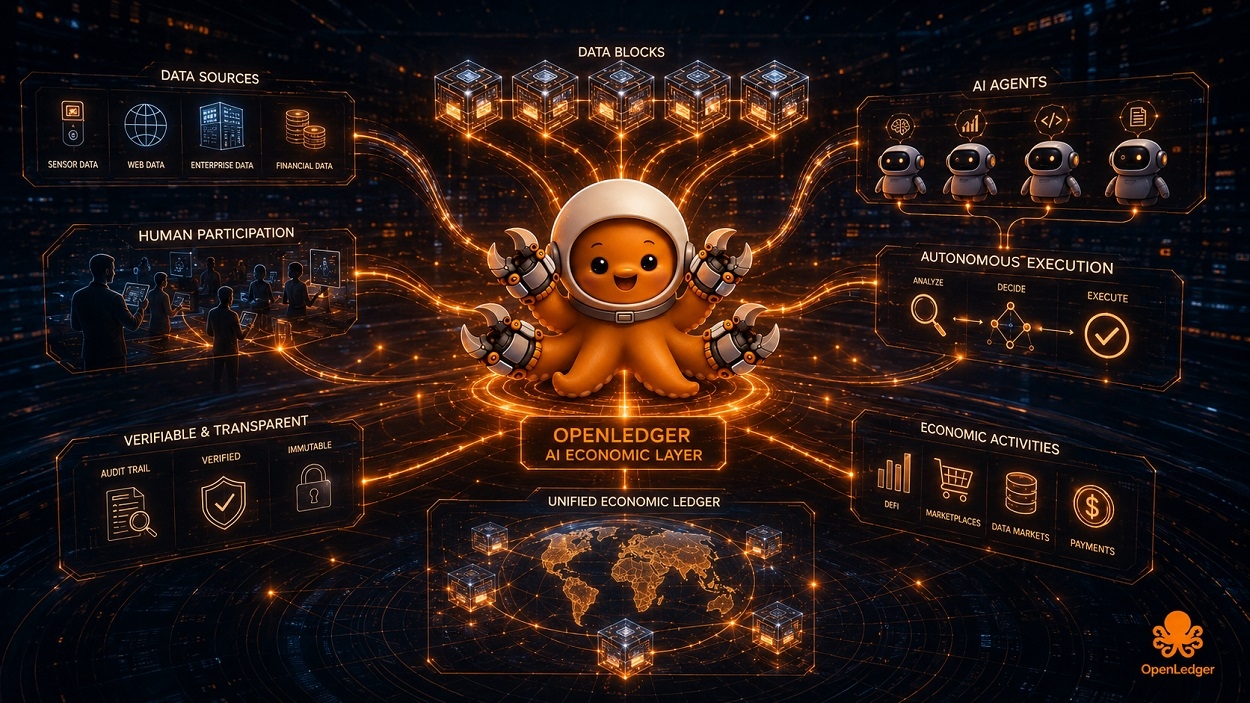
That is why the next AI wave may look very different from the last one.
Less conversation.
More coordination.
Less prompting.
More execution.
Less passive software.
More autonomous systems.
The biggest AI shift may not be machines that talk better.
It may be machines that no longer wait for human input.