

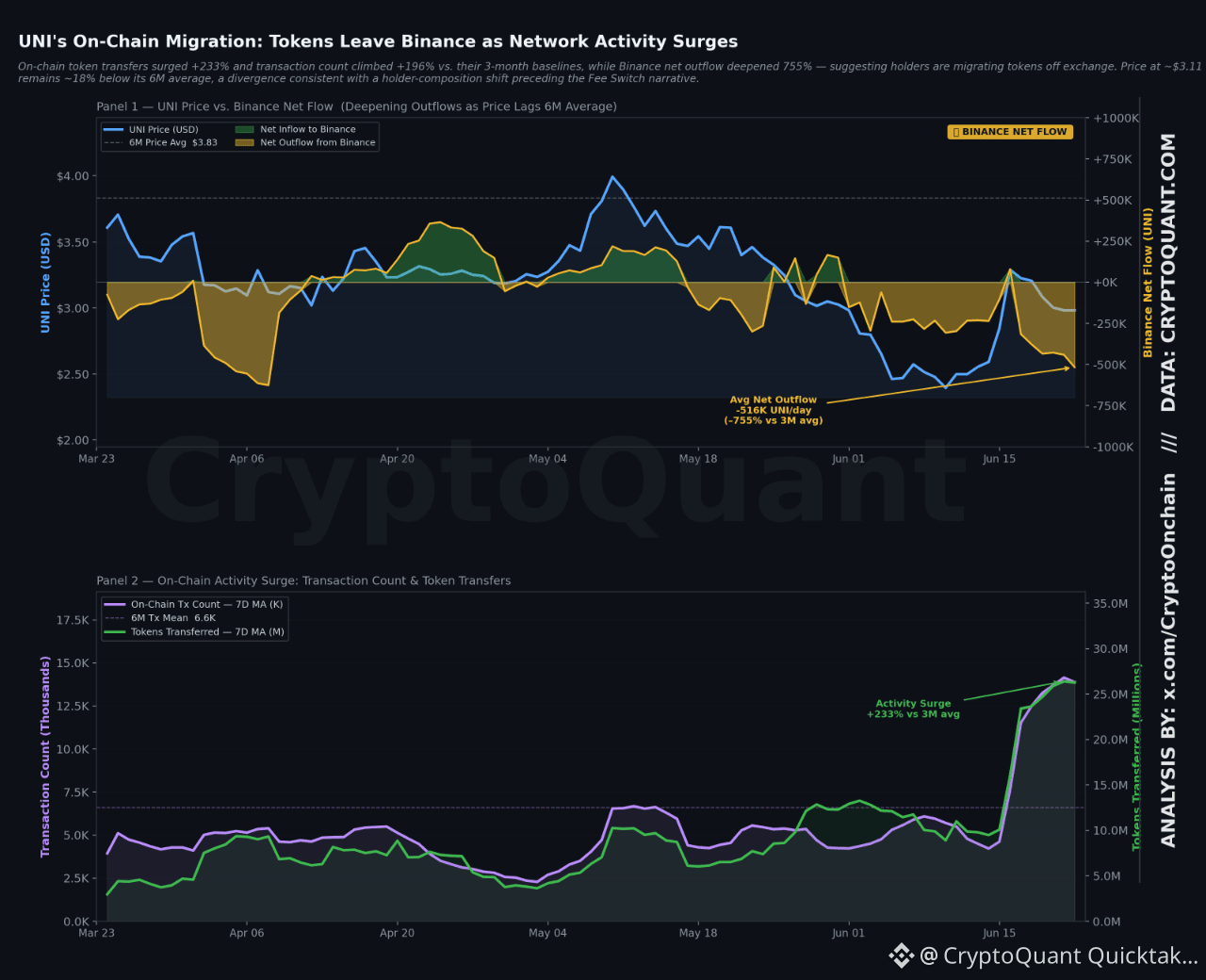
Uniswap’s on-chain data is displaying a structural shift that appears disconnected from its spot price. Over the past three months, total tokens transferred on the network expanded by 233%, and transaction count climbed 196%. Simultaneously, Binance’s 7-day average net outflow has deepened to -516,112 UNI — a metric that has moved 755% more negative versus its 3-month baseline — while Binance reserves declined approximately 6.8% over the same window.
The timing of this divergence coincides with Uniswap’s Fee Switch activation, which introduced a buy-and-burn mechanism that effectively transforms UNI from a pure governance token into a cash-flow generating asset. When a structural change of this nature occurs at the protocol level, it typically alters holding behavior: participants who previously kept tokens on exchanges for speculative trading may instead withdraw to self-custody in anticipation of fee-related utility.
Comparison
What makes the current setup noteworthy is the sequencing. On-chain transfer volume and transaction counts are both tracking well above their 6-month means, yet price at approximately $3.11 remains roughly 18% below its 3-month average of $3.80. The Binance net outflow accelerating while reserves compress suggests supply is migrating away from the venue most associated with short-term selling. Historically, sustained exchange outflows combined with rising on-chain activity have preceded periods where reduced exchange supply meets renewed demand.
Takeaway
The data suggests UNI may be undergoing a holder composition shift rather than a straightforward price rally. Whether the Fee Switch narrative translates into sustained demand absorption remains open — but the combination of deepening Binance outflows and surging on-chain activity creates conditions that may reduce available sell-side supply at precisely the moment the asset’s fundamental story is attracting fresh attention.
Written by CryptoOnchain