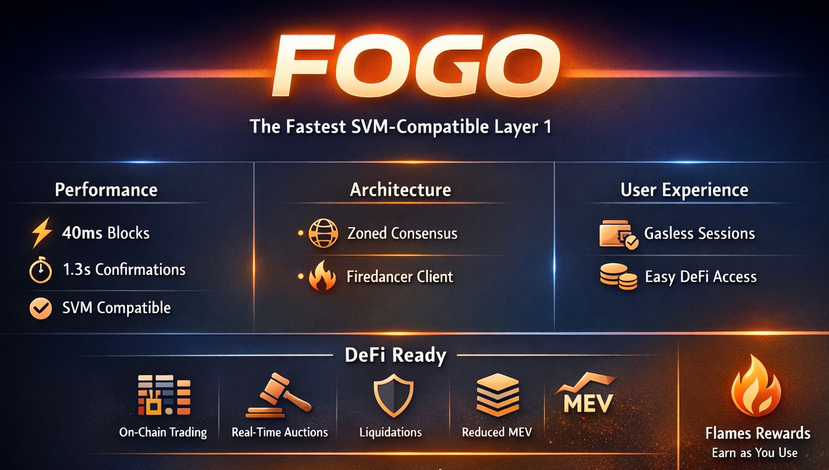
If you’re still judging L1s by “TPS screenshots” you’re missing what actually decides who wins in DeFi: latency + tail latency (the slowest few % of nodes/packets that dominate real user experience). That’s exactly why I’m paying attention to @Fogo Official
Fogo is a purpose-built SVM Layer 1 (Solana Virtual Machine compatible) designed around a simple truth: blockchains run on a planet-sized network governed by physics. Light in fiber isn’t instant, routes aren’t straight, and consensus has to wait for a quorum so the “average” doesn’t matter, the slowest links do. Fogo tackles this directly instead of pretending it away.
Why Fogo feels like “modern finance infrastructure”
• 40ms blocks: blocks tick fast enough to feel like a realtime system, not a batch processor.
• ~1.3s confirmations: the gap between intent and settlement shrinks, which is the whole game for trading, liquidations, and market-making.
• Built to stay responsive under congestion, not only in demos.
The two big architectural bets (the real differentiators)
1. Zoned / multi-local consensus
Fogo introduces validator zones and activates only one zone for consensus per epoch. That means the quorum on the critical path is physically closer → less WAN delay → faster, more consistent confirmations. Rotation strategies (epoch rotation / “follow-the-sun”) are designed to keep decentralization benefits while still respecting geography.
2. Standardized high-performance validation (Firedancer path)
Most networks get limited by client diversity + uneven hardware/network setups. Fogo’s validator stack is built around Firedancer (currently a production hybrid called Frankendancer) with a tiled pipeline: networking, QUIC, signature verify, dedup, pack, bank execution, PoH, shred/store — each pinned to cores with zero-copy messaging. That’s how you reduce jitter, smooth out tail latency, and make throughput predictable instead of spiky.
UX primitive that actually matters: Fogo Sessions
This is one of the most underrated parts: Sessions let users grant time-limited, scoped permissions with one signature, so apps can feel Web2-smooth:
• less signature fatigue
• potential fee sponsorship (gasless UX)
• built-in guardrails like expiry + spending limits + domain binding
For onboarding and high-frequency app flows, this is a huge unlock.
Economics + chain fundamentals (not hand-wavy)
• Fees mirror Solana-style: base fee + optional priority tips (tips to producer), plus rent mechanics with rent-exempt behavior for normal users.
• 2% fixed annual inflation with rewards to validators + delegated stakers (incentives tied to active participation).
• Built-in programs mirror Solana core (System/Vote/Stake/loaders) + token program modified to work with Sessions.
Ecosystem + infra that makes speed usable
Speed is useless if the tooling lags Fogo is stacking the basics properly:
• Pyth Lazer for low-latency price feeds (critical for perps/real-time DeFi)
• Wormhole for bridging + messaging + NTT
• Metaplex (Token Metadata/Core/Candy Machine), Squads multisig, Fogoscan explorer
• Goldsky indexing + FluxRPC/Lantern for production-grade RPC (because RPC bottlenecks silently ruin “fast chains”)
What this enables (where $FOGO gets real demand)
When confirmations are tight and predictable, you can build:
• on-chain order books that don’t feel delayed
• real-time auctions
• more precise liquidation timing (less chaos, less unnecessary MEV leakage)
• smoother perps + lending flows that don’t punish users during volatility
I’m watching $FOGO because the thesis isn’t “faster marketing” it’s a chain designed from first principles around the real bottleneck: the speed limit of the internet + tail latency. If Fogo keeps execution this consistent as the ecosystem scales, this is the kind of infra that can actually carry modern on-chain finance.