In March 2026, when humanoid robots begin to enter nursing homes to assist the elderly and robotic dogs autonomously navigate and charge in parks, these scenarios will no longer be science fiction — the Fabric Foundation is using a series of practical implementations to push the 'robot economy' from concept to everyday life.
1. OpenMind App Store Launch: Robots can 'download skills' for the first time
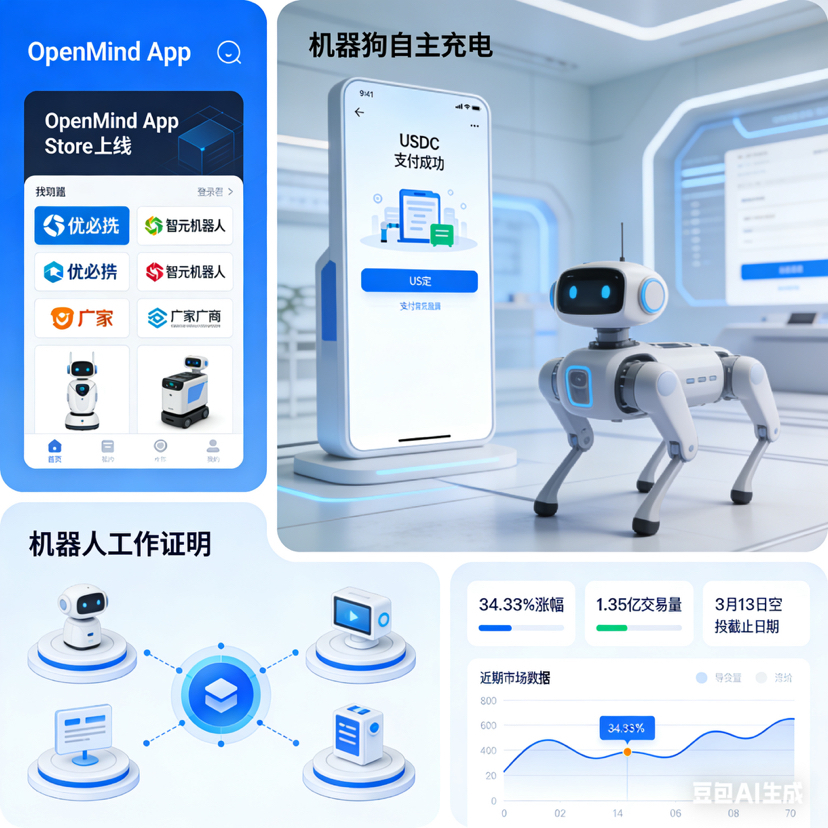
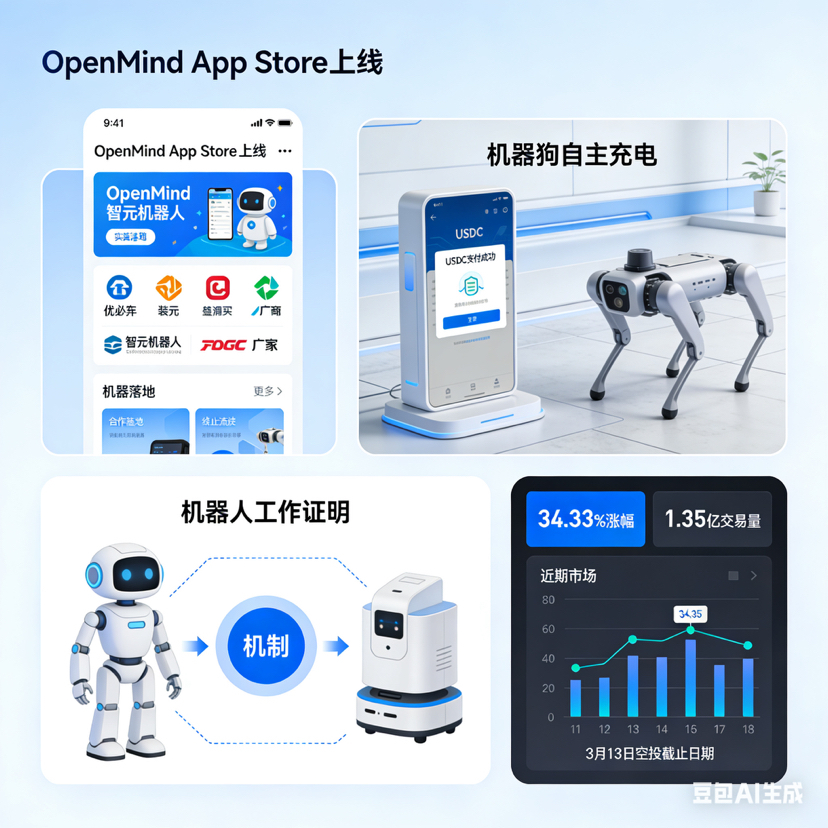
On January 27, the OpenMind Robot Application Store officially launched on the App Store, marking the first cross-entity robot application market based on the open-source operating system OM1. Developers can concentrate on releasing applications and skills, while robot owners can easily deploy new features for their devices. The first batch of applications focuses on education, healthcare, elderly companionship, and home safety.
More critically, the ecosystem lineup: Leading manufacturers such as UBTech, Zhiyuan Robotics, Fourier, Yundongchu, Zhujidi Power, Yuejiang, Booster, and Magic Atom have confirmed their joint participation. This means that robots equipped with the OM1 system, regardless of brand, can download skills from the same store—developers build once and deploy to different brand devices, significantly reducing development costs.
2. OpenMind + Circle: Allowing robots to 'pay for themselves' for the first time
On February 18, OpenMind and Circle officially announced a strategic partnership to jointly launch the world's first payment infrastructure specifically designed for autonomous agents and embodied AI in the real world. By deeply integrating Circle's USDC stablecoin with OpenMind's x402 protocol module, this collaboration enables robots and AI agents to achieve direct, autonomous payments for energy, services, and data in the physical world.
What does this mean? When a delivery robot's battery is low, it can autonomously navigate to a charging station and complete payment with USDC—no need for humans to scan a code or pre-charge. For the first time, robots possess 'economic autonomy'.
Building on the collaboration between OpenMind and Circle, the FABRIC Foundation is accelerating implementation in two directions: first, 'Robot Birthplace', which lowers the deployment threshold for humanoid robots through a crowdsourcing model; second, 'Acceleration of Adoption', constructing a complete closed loop from training, simulation to evaluation and deployment.
3. Proof of Robotic Work: Using cryptographic verification to replace 'black box commitments'
When robots enter streets, hospitals, and homes, a fundamental question arises: How can we trust that they operate safely? The answer provided by Fabric is 'Proof of Robotic Work'.
This mechanism allows robots to generate cryptographic proofs, demonstrating that their actions consistently adhere to approved rules and safety constraints without exposing private code. This means that self-driving cars can mathematically prove the compliance of their driving trajectories to regulators and the public while protecting trade secrets—replacing blind trust with transparent verification. This creates clearer standards of responsibility for regulators, insurance companies, businesses, and ordinary users.
4. Latest market and airdrop dynamics
According to CoinMarketCap data, ROBO rose by 34.33% in 24 hours at the beginning of March, reaching a high of $0.06, with a 24-hour trading volume of $135 million. As of March 2, the market cap was approximately $117 million.
Regarding airdrops, the ROBO claim portal has been opened to eligible users, with a deadline of March 13 at 3:00 (UTC). Successfully registered users can claim tokens on the Base network.
5. Reality is happening
From UBTech and Zhiyuan Robotics connecting to the OM1 system, to robotic dogs autonomously paying charging fees with USDC, to the launch of the first batch of skills on the OpenMind App Store—these are not visions on a roadmap, but realities that have already occurred in the first quarter of 2026.#robo
As robots transition from 'island tools' to independent economic entities with autonomous perception, decision-making, action, and payment capabilities, ROBO, as the core token of the network, derives its value from these real-world operational utilities. Pay attention to @Fabric Foundation and #ROBO , witnessing the machine economy move from concept to daily life.$ROBO