

In the past few days, I've been pondering something: does Cardano's adoption of the Midnight dual-chain structure genuinely meet a demand, or is it just another hype? To be honest, when I first entered the crypto world, I had a rather naive faith in blockchain, believing that decentralization should mean complete transparency. Back then, I could see anyone's wallet address, input it into the block explorer, and clearly observe when they bought high, when they sold low, and how much they had left. I felt quite proud, boasting to everyone that this was the God’s eye view of Web3, far superior to traditional finance. Until one day, the fire burned me too. I tried to cut corners and interacted with a small project using my main wallet, and within two weeks, things started to go wrong. First, I received all sorts of toxic airdrops daily, and then it got even creepier—someone managed to match my real identity and financial situation by tracing on-chain activity through several small transactions of dozens of U, along with some third-party tag tools. The chilling feeling on my back still gives me cold sweats when I think about it. It was only after that that I truly understood: absolute transparency on-chain is not safety; it's like running naked. We retail investors can't bear it, let alone those institutions that genuinely want to go on-chain. This is also why I've been keeping a close eye on @MidnightNetwork ; it makes me feel that the security logic of blockchain finally needs to be upgraded.
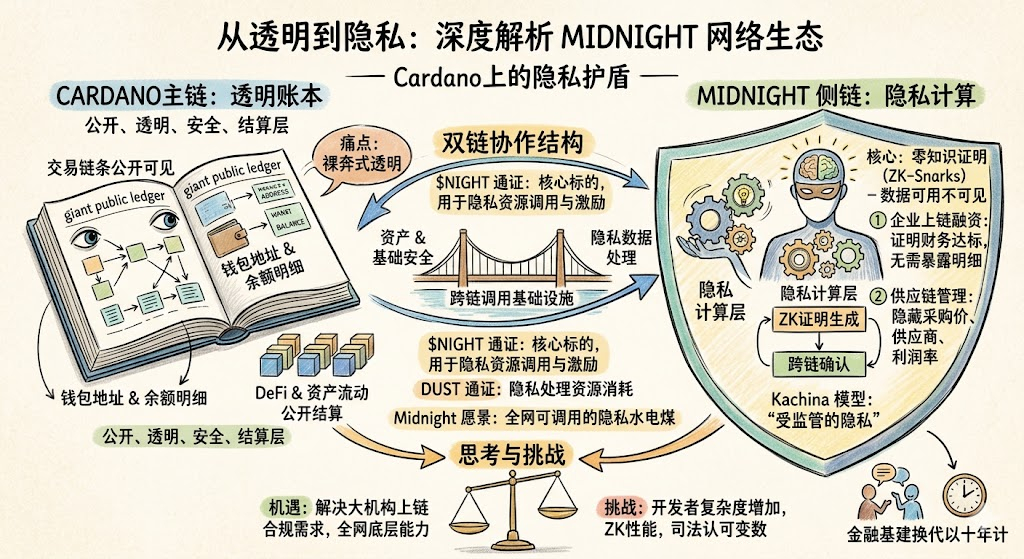
Cardano itself is a typical transparent public chain; transactions, addresses, and capital flows are all public. There are no issues with DeFi or ordinary transfers, but what if you want companies to use it? Just hearing that makes them shake their heads. How much is the purchase price, who the suppliers are, and what the profit margins are, these real monetary data, who is willing to expose them to the entire network? A friend of mine in the supply chain was complaining a few days ago, saying their company researched blockchain but ultimately passed, with just one reason: too transparent. The thinking behind the Midnight project is quite different; it does not simply aim for expansion, but rather focuses on 'privacy computing'. The core is zero-knowledge proof; your data can remain private, but the system can prove it is real and valid. For example, if you have an order of 1 million, the chain does not need to show the specific amount, but it can prove that 'this order exists and the amount meets the standard'. Integrating this capability into the Cardano ecosystem creates a kind of division of labor:
The Cardano main chain manages public settlement and asset flow, like a public ledger;
Midnight manages business data that one does not want others to see, like a privacy shield.
I have imagined a scenario: in the future, when companies raise funds on-chain, lenders only need to verify that financial standards are met without seeing every detail. This is almost impossible on a purely transparent public chain, but adding a layer of Midnight seems to make it feasible. Of course, there are definitely issues as well. The biggest hurdle is actually the developers; applications need to be developed across two chains simultaneously, which will increase complexity and can easily confuse user experience. Many beginners may not be able to distinguish whether they are operating on the main chain or the privacy layer. However, from the trend, the demand for privacy is indeed becoming more and more obvious. Once AI, data, and identity are on-chain, full transparency becomes a ticking time bomb. The more I look, the more I feel that Midnight has big ambitions. It is not just simply creating another privacy chain for everyone to migrate their projects to, but rather aims to make privacy capabilities a kind of infrastructure that can be called upon at any time. In the future, when you run a business on another public chain and encounter a need to protect data, you can directly cross-chain call $NIGHT and DUST resources. It's equivalent to water, electricity, and gas in Web3; you don't notice it usually, but when you really need it, you cannot do without it. This line of thought is indeed quite different from those previous privacy projects that 'compete for users and assets'. It does not create islands but wants to become a fundamental capability that can be connected throughout the entire network.
But speaking of it, when you calm down and think about it, after being in the industry for a long time, you realize that every wave of opportunity is actually quite similar. Find a headache for regulators, wrap it in a Web3 shell, tell a story of 'both privacy and compliance', and in the end, it all turns into a game of chips. Midnight uses ZK-Snarks and the Kachina model to create 'regulated privacy', which sounds beautiful. But if you really ask those large institutions and multinational companies, they might be more accustomed to using private chains, like R3 Corda, where they pursue physical isolation. They simply do not trust putting core positions and counterparty data in an environment that is even encrypted but 'publicly verifiable'. Auditing is a matter authorized by law, not something that code can solve. No matter how great your ZK proof is, if the judicial authorities do not recognize it, it is useless. There are also performance issues brought by sidechain architecture: both ZK proof generation and cross-chain confirmation have computational overhead. In high-frequency settlement scenarios, whether it can withstand institutional-level loads is still a question mark. The so-called 'enjoying the security of the mainnet while maintaining privacy' is likely to become a new compliance bottleneck. Therefore, the true value of Midnight may never be about solving problems for Wall Street, but rather providing a highly private testing ground for technological idealists and developers. It has given the Cardano ecosystem a sufficiently grand narrative outlet, and $NIGHT is the core target of this outlet. However, being at the forefront of research does not equate to commercial landing; financial infrastructure upgrades are measured in decades, while Web3 hotspots cycle through in three months. When the technological dividends are consumed, it is possible that we will find that the institutions on the other side never even considered building a bridge. This field is still in its early stages, with great uncertainties in judicial recognition, ZK performance, and sidechain governance. I am currently both curious whether it can really achieve both 'transparency' and 'privacy', and also quite clear that - if blockchain only solves transparency, many real-world businesses will never come in; and whether Midnight's intermediate path of needing both privacy and compliance will ultimately lead to large banks entering the market, or become an expensive technological self-indulgence, no one can say for sure. (This article is a platform task and does not constitute any investment advice.)#night