
$NIGHT There is actually a more intriguing point to ponder:
If the Midnight ecosystem really takes off, can the DUST I generate from holding NIGHT in the future be rented out for monetization, just like "bandwidth," "electricity," and "computing power"?
This matter is not just a theoretical question. The white paper has actually outlined the direction.
Let's start with the conclusion: there is indeed a design direction, and it is written quite clearly.
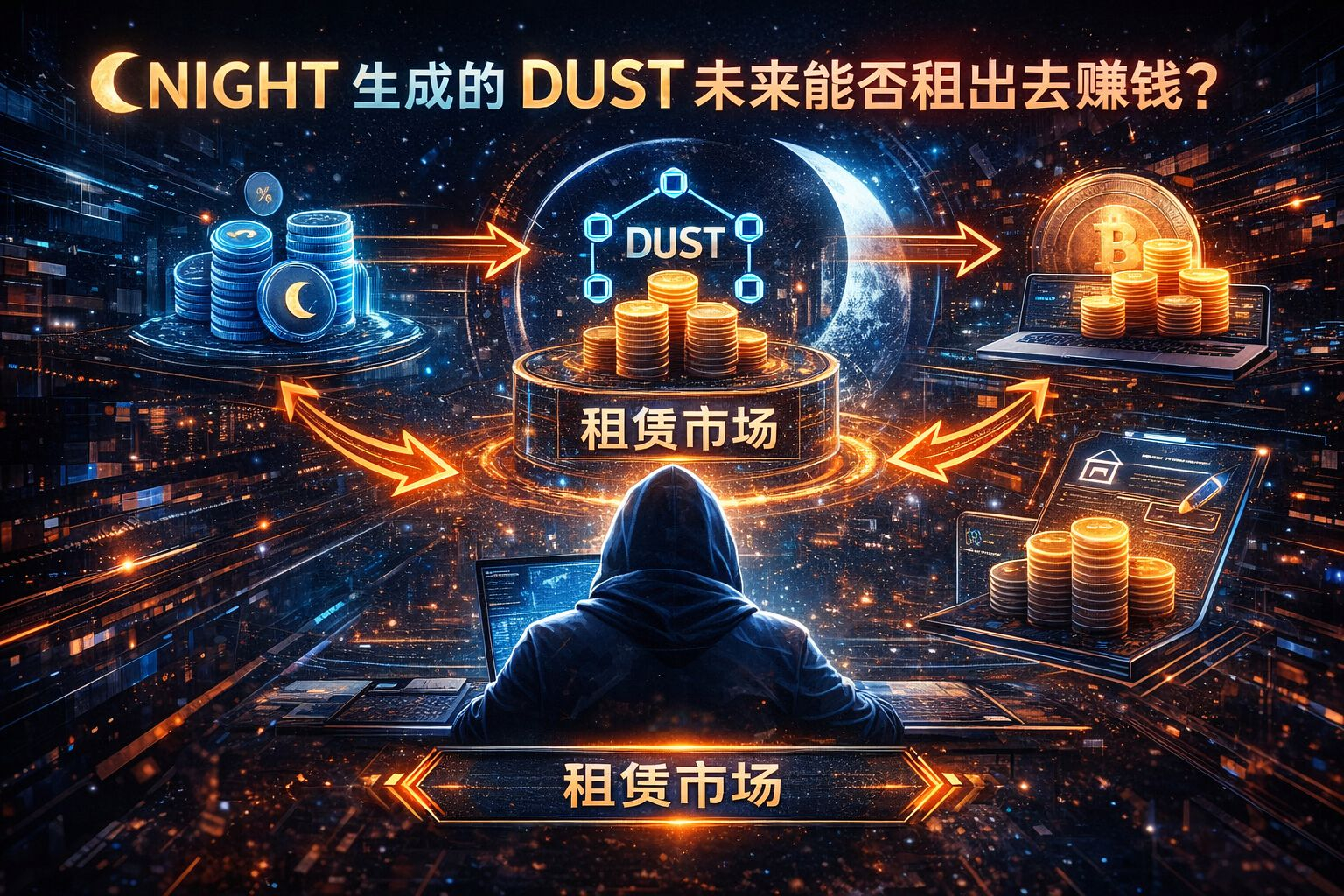
The white paper mentions that NIGHT holders may "potentially earn income in the future by renting or selling unused DUST," and that Midnight plans to develop a capacity marketplace around this idea.
In plain language:
Holding NIGHT is not just about waiting for price fluctuations.
You might also hold an asset that provides 'continuous network usage rights'.
This is getting interesting.
Because the logic of traditional public chains is: you pay Gas every time you make a transaction.
Whereas the logic of Midnight is: if you hold NIGHT, first designate a DUST address, then NIGHT will continuously generate DUST. DUST is a resource specifically used to execute transactions, cannot be transferred, cannot be traded, will decay, and is not meant for value storage. It is more like 'electricity', not 'currency'; more like 'the fuel in a tank', not 'cash in a wallet'.
So, real change is coming:
If you cannot use all these DUST yourself, theoretically, there is an opportunity to let this part of the 'capacity' be used by others.
The white paper outlines several possible paths.
The simplest kind is the peer-to-peer model.
That is, NIGHT holders designate the generation of DUST to an address controlled by another user, and then both parties complete payment settlement offline. This model is very straightforward, but also quite 'informal', as it relies on trust or requires intermediaries for matching.
The next level up is broker-managed leasing, which is the broker model.
You can think of it as the 'DUST sub-landlord system': someone specifically helps match NIGHT holders with DUST users, arranging rentals, payments, and resource distribution, while taking a small service fee. The white paper believes this approach is easier to scale and more likely to foster competition and price discovery.
Interestingly, Midnight even envisions a 'refueling station' model like Babel Station.
Users may not necessarily hold NIGHT, nor understand DUST, and might not even know what Midnight is. Users can directly use other assets, even fiat currency, to purchase the capabilities needed for on-chain operations; the service provider will compensate with DUST.
What does this mean?
It means that if the ecosystem takes off, DUST may not just be a tool for 'saving transaction fees', but has the opportunity to become a sellable network capacity.
It's like having solar panels installed at your home.
Using electricity on your own is, of course, very comfortable.
But if the electricity generated cannot be fully used by you, and can be sold back to the grid, then the entire asset logic changes.
Of course, there are several points that must be viewed calmly here.
First, this is not 'earning interest' in the traditional sense.
It's not just placing NIGHT somewhere and the system automatically gives you more NIGHT every day. More accurately, it is like 'holding an asset that continuously generates capacity', and you might be able to rent out idle capacity for profit in the future. The income is more like rent, service fees, and resource price differences, not interest from bank deposits.
Second, the white paper describes direction, not that it is already fully running today.
The white paper clearly mentions that in the future, it may gradually evolve from off-chain markets to on-chain capacity markets that minimize trust, even supported at the protocol level. This means that this path has been planned, but whether it can actually run smoothly depends on the product, users, matching efficiency, and ecological demand.
Third, the value of DUST lies not in 'hoarding', but in 'using'.
Because it cannot be transferred, cannot be stored, and will linearly decay if separated from NIGHT, this system inherently forces you to think about one thing:
"Am I using it myself, or renting it out to others?"
This is also a very technical aspect of Midnight. It is not creating another coin for speculation, but rather creating a resource tied to network capacity.
So, if you ask me, $NIGHT what is the most worthwhile long-term point to watch?
I would say it's not just about whether it has a privacy narrative, nor is it just about whether it will increase in value.
But rather:
If Midnight really has applications, real users, and real developers, will the DUST capacity held by NIGHT holders actually form a rental market?
Once this process is successful, the logic of NIGHT will transform from 'holding coins to wait for appreciation' to 'owning a device that continuously generates electricity'.
At that time, the question may no longer be:
"How much can this coin increase?"
But rather:
"How much DUST can this NIGHT generator produce in a day, and how much is it worth to rent out?"