

Introduction
I remember when the internet operated purely on trust. You would click on a profile, read a claim, or accept a transaction without thinking about whether it was actually real or not. Gradually, this weakness came to light. Fake identities, manipulated data, and exploitative systems made the digital world messy.
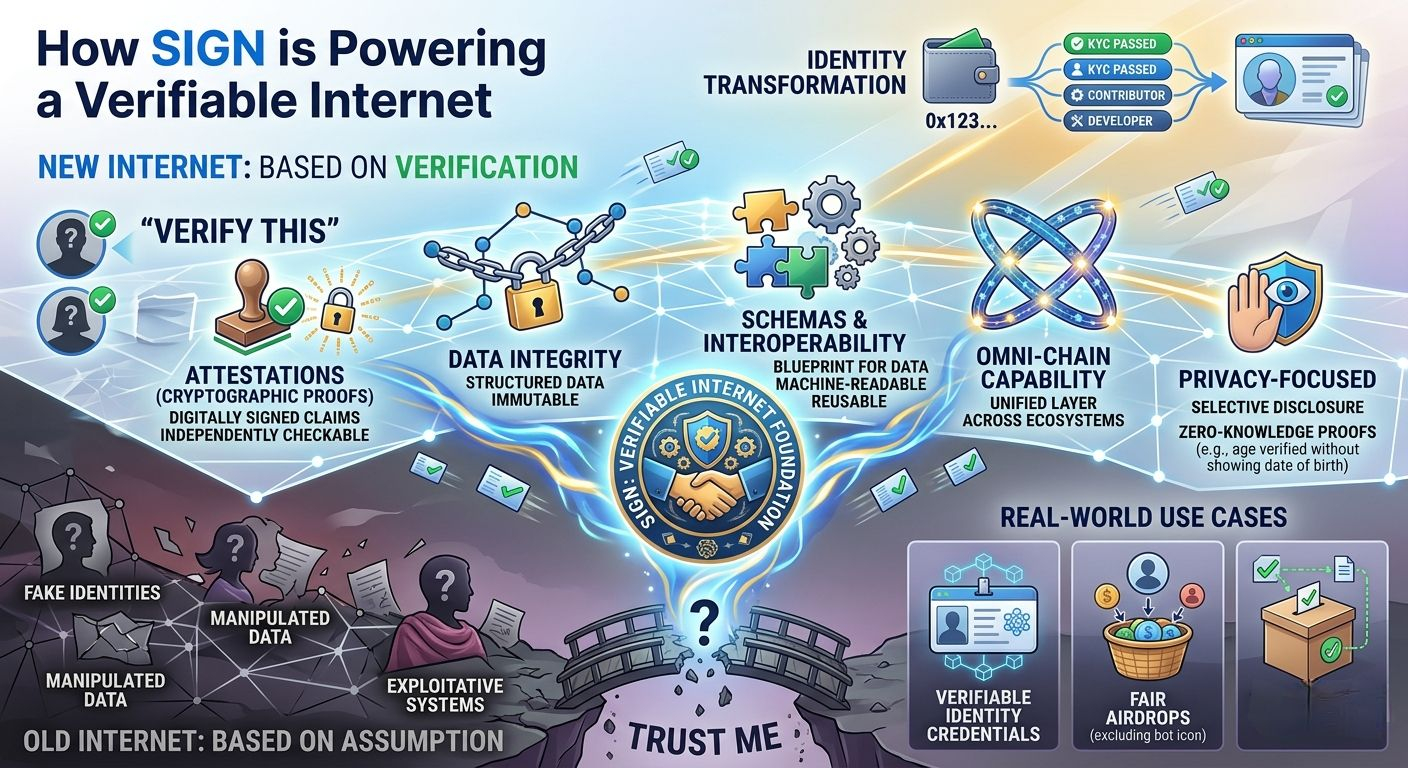
This is where SIGN changes the game. It does not ask users to blindly trust, but rather gives them the power to verify. And this shift, from trust to verification, is becoming the foundation of the next version of the internet.
The traditional internet is based on certain assumptions. Platforms play the role of middlemen and users depend on them for validation. But as scale increases, this system begins to break down. SIGN introduces a new approach through attestations.
An attestation is a cryptographic proof of a claim in simple language. For example, it could be that a wallet has passed KYC, a user has contributed to a project, or a transaction has occurred following the rules. These are not just statements, but digitally signed and verifiable records that anyone can independently check without any central authority.
SIGN converts real-world and on-chain data into verifiable proofs. Each attestation contains structured data, a digital signature, and cryptographic integrity. This means that once a claim is issued, it cannot be changed and can be verified at any time. The system no longer says 'trust me,' but rather 'verify this.'
A big problem with Web3 is data inconsistency. Every platform uses its own format. SIGN solves this issue through schemas. Schemas work like a blueprint that defines the format, rules, and structure of data. This makes the data machine-readable, interoperable, and reusable, allowing it to flow easily between different applications.
Another important aspect is SIGN's omni-chain capability. The internet is not limited to just one blockchain. Different ecosystems exist, and SIGN ensures that attestations can be verified everywhere. This creates a unified layer where data remains consistent no matter where it is used.
Verification does not mean you expose all your information. SIGN supports privacy-focused features like selective disclosure and zero-knowledge proofs. This means you can prove something without sharing unnecessary details. For example, you can prove eligibility without revealing your full identity.
In the case of data storage, SIGN is also flexible. Some data can be stored on-chain for transparency and immutability, and some can be stored off-chain for scalability and privacy. Hybrid models give developers the freedom to create a balance according to their use case.
The impact of this is clear in real-world use cases. Identity systems can shift from passwords to verifiable credentials. Airdrops and rewards can be fair where bots do not benefit but real users do. Reputation systems can become stronger, governance can be transparent, and compliance processes can be simplified without exposing full personal data.
Currently, a major issue with Web3 is that the wallet address does not prove anything by itself. Neither credibility, nor experience, nor authenticity. SIGN fills this gap by attaching verifiable credentials to identities. This can make the internet both anonymous and reliable.
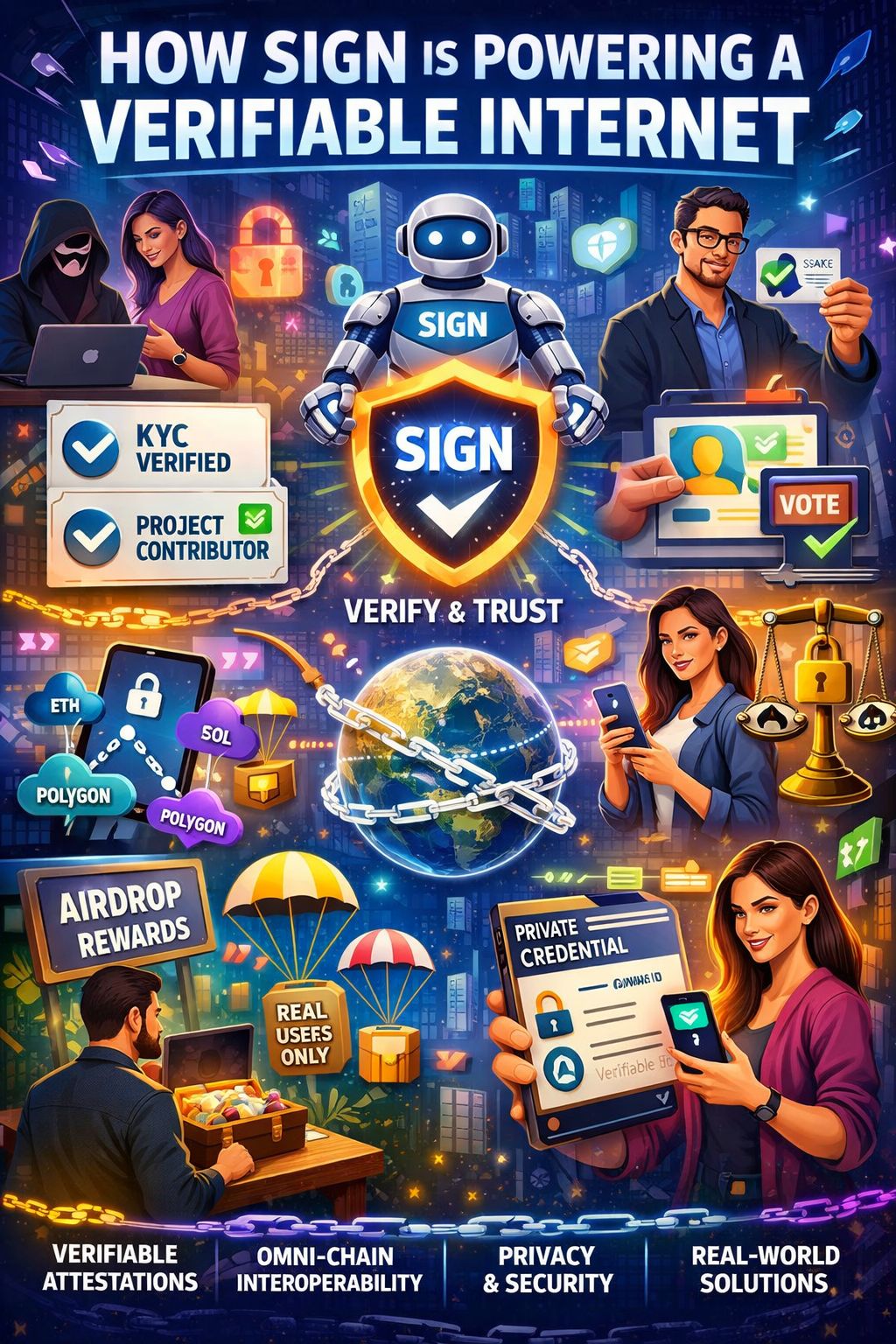
It would be incorrect to understand SIGN as just an app. It is an infrastructure layer that is building the foundation for verification on the internet. It helps answer basic questions like who did what, when, and whether it can be verified. This makes systems more transparent, auditable, and trust-minimized.
The internet is evolving. First came information, then ownership, and now we are entering the phase of verification. SIGN represents this transition where trust is being made measurable and provable.
Final Thoughts
As verification becomes a default part of the internet, identity, governance, and digital interactions will all change. SIGN stands at the center of this transformation and is building the foundation for a truly verifiable internet.
Disclaimer
This content is for educational purposes only and is not financial advice. Be sure to do your research before investing in or engaging with any crypto project or protocol.
#SignDigitalSovereignInfra @SignOfficial $SIGN
