

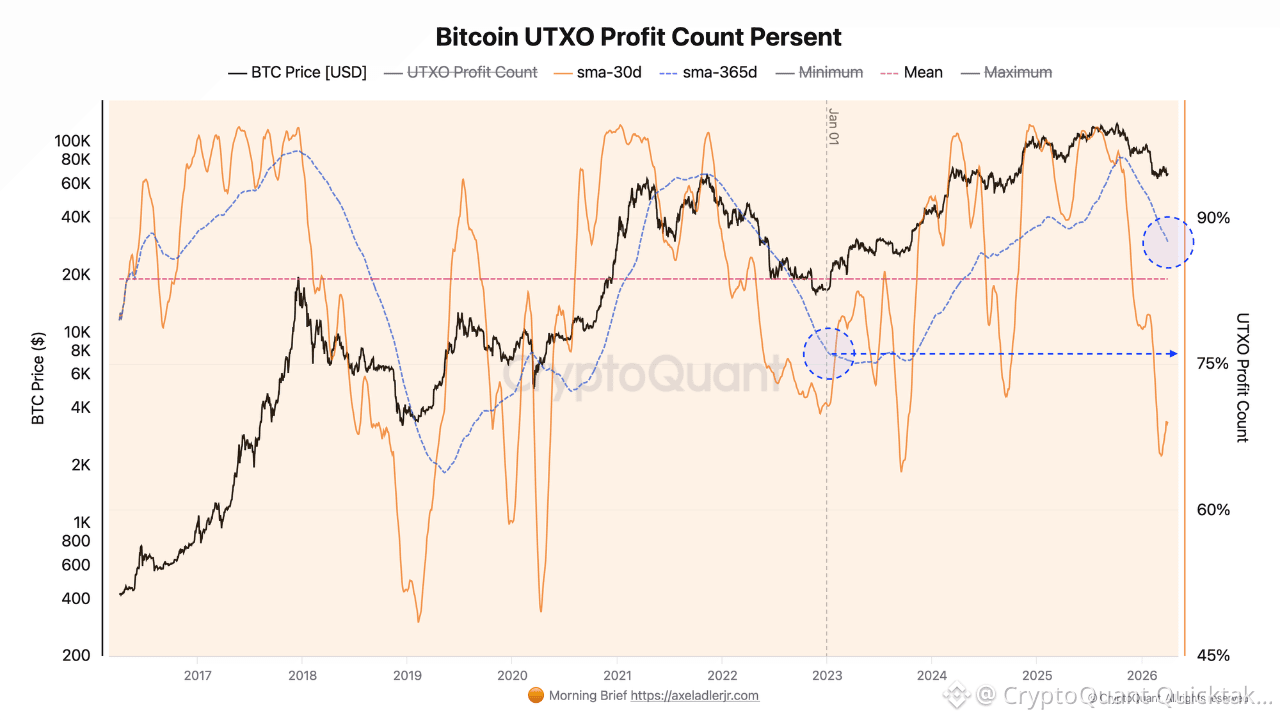
The current situation in the share of profitable Bitcoin coins looks weak, but the market has not yet reached a full reset scenario. As of April 1, 2026, the metric has recovered to 66.4%, while the 30DMA stands at 69.1%. The key reference point here is the 365DMA, which remains at 87.5%. That is what fundamentally separates the current phase from the true structural reset seen in past cycles.
In previous cycles, it was the SMA365 that signaled a full reset in market structure. After peaking in the 96-97% range at the end of 2017, it declined steadily and fell to 63.8% by May 2019. That was a real reset: the average annual share of profitable coins compressed sharply, confirming a deep market cleansing after the end of the bull cycle.
The current picture is different. Despite the sharp decline in the metric itself and weakness in the 30DMA, the SMA365 remains abnormally high at around 87.5%. This suggests that the network’s average annual profit structure has not yet entered a full capitulation regime.
The contrast becomes even clearer when looking at the three drawdowns of this cycle. In September 2023 and September 2024, the market put pressure on short-term profit structure, but did not break the long-term average. The current 2026 drawdown looks deeper in the underlying metric: the low has already reached 55.7%, while the 30DMA fell to 66.7%. However, the SMA365 still remains far above the reset zone of the previous cycle.
The conclusion is straightforward: the market is going through a severe internal compression in profitability, but by the 365DMA standard, it is still far from a true structural reset. As long as the long-term average holds near 87.5%, this is better described as a prolonged cyclical correction with elevated two-way volatility, rather than a full bearish-phase reset.
Written by AxelAdlerJr