
Recently, the impact of quantum computing on the security of crypto assets has once again become a focal point in the industry.
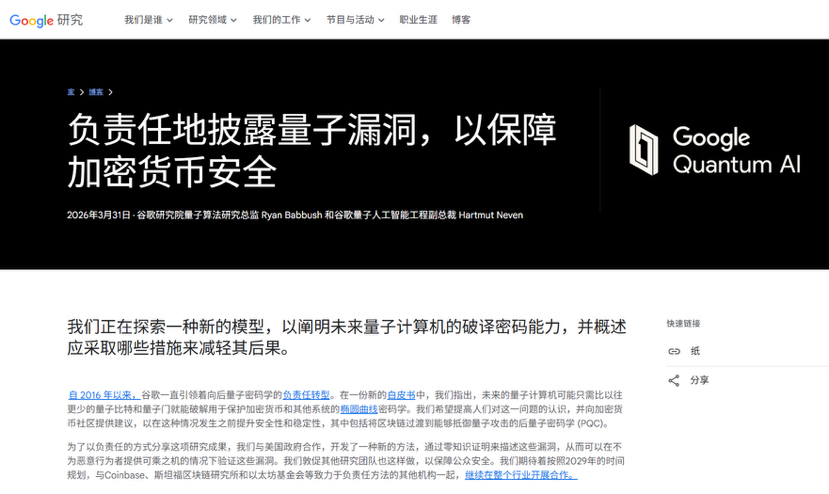
Research from Google Quantum AI indicates that under specific conditions, optimized Shor's Algorithm could enable future quantum computers to derive a Bitcoin private key in about 9 minutes, a time that is close to the average Bitcoin block time.
This means that a problem previously thought to be 'long-term' is gradually entering the realm of real discussion.
Industry consensus: upgrades are possible, but challenges are real.
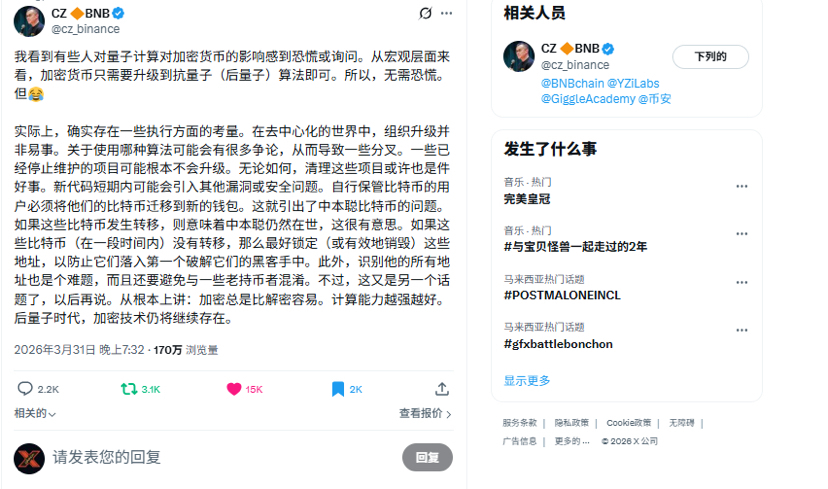 Zhao Changpeng believes that the cryptocurrency system can address challenges by upgrading to 'post-quantum cryptography', so there is no need to panic.
But the reality is:
Upgrading decentralized networks is extremely difficult
Technical routes may trigger forks
Old assets and dormant addresses are hard to upgrade in sync
New algorithms still have uncertainties in the early stages
👉 Clear direction, but the window of opportunity is shrinking.
From 'discussion' to 'implementation': the security system starts to advance
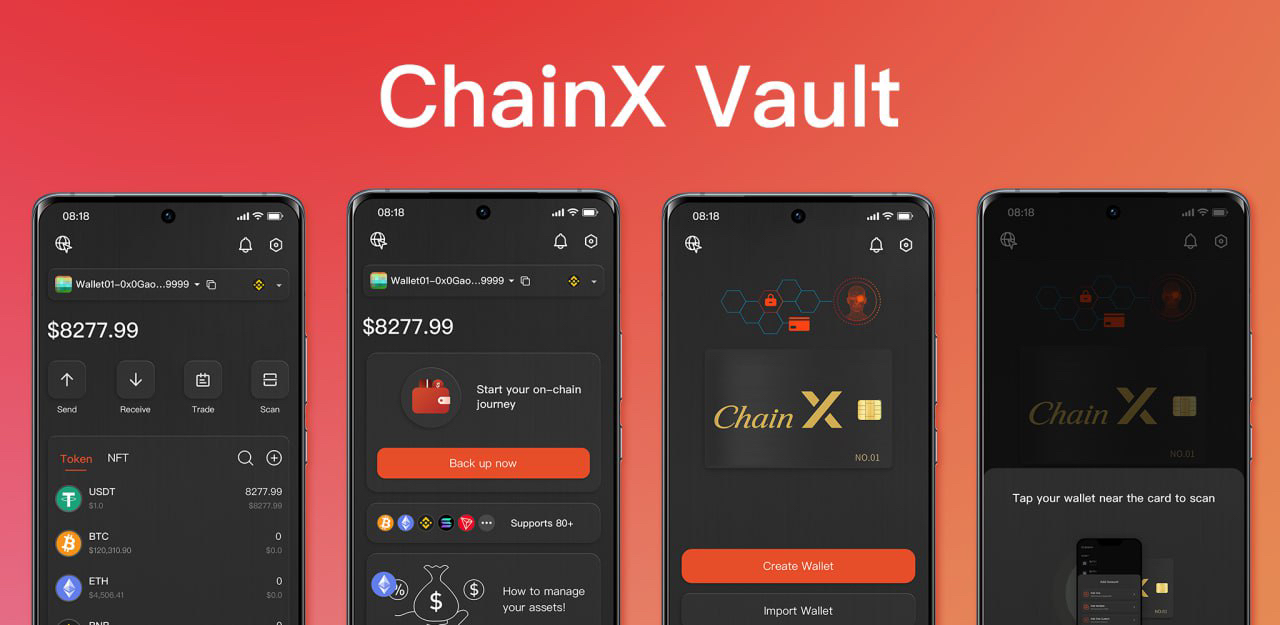 In this context, ChainX Global proposes a more engineering-oriented judgment:
Crypto security can't wait for risks to happen before upgrading; it needs to consider 'post-quantum environments' at the foundational architecture stage.
This also drives some products to start incorporating longer-term security designs.
ByteVault: the technical architecture behind quantum resistance
Different from traditional hardware wallets that only emphasize 'private key isolation', ByteVault introduces a more complete security system in its design, with its 'quantum resistance' not being a concept but built on a specific technical architecture:
1️⃣ Quantum security foundational capabilities
Chip runs on a secure COS system
Supporting the integration of quantum cryptography algorithms and blockchain-related algorithms
Providing foundational support for decentralized identity authentication and asset security
👉 This means: having foundational capabilities to evolve towards post-quantum cryptography systems
2️⃣ Hardware-level encryption systems
Based on ARM 32-bit secure CPU architecture
Integrated hardware encryption processor
Supports multiple algorithm systems:
Symmetric algorithms: TDES, AES, SM1, SM4
Asymmetric algorithms: RSA, SM2, ECC
Hash algorithms: SHA-1 / SHA-256 / SM3
Simultaneously equipped with:
High-performance true random number generator (TRNG)
Multi-sensor protection (voltage / frequency / temperature / light detection)
👉 Ensuring that key generation and computation processes have high security and unpredictability
3️⃣ High-level security protection mechanisms
Uses EAL6+ security standard chips
Supports offline cold storage and multi-signature mechanisms
Built-in:
Storage encryption
Address obfuscation
Data verification mechanism
And has physical attack protection capabilities:
Resistance to SPA / DPA / DEMA / DFA attacks
On the storage level:
EEPROM can be rewritten over 500,000 times
Data can be stored for up to about 25 years (under specific conditions)
Private keys stay off the net the whole time
👉 A multidimensional protection system from the physical layer to the algorithm layer
Key understanding of quantum resistance capabilities
Based on the above architecture, ByteVault's positioning can be understood as:
👉 Not a 'simple hardware wallet'
👉 But a security device system that has already introduced designs aimed at quantum resistance
The focus isn't on 'absolute security', but on:
Supports multiple algorithm systems (leaving room for post-quantum upgrades)
The security architecture is scalable
At this stage, potential attack paths brought by quantum computing have been considered
From devices to applications: the formation of a complete security system
Beyond devices, the ChainXVault application within its ecosystem is also evolving in sync:
Supports asset management and interaction
Reserving mechanisms for future key upgrades
Lowering user migration and usage barriers
👉 Gradually forming: an overall security system of hardware + applications
Written at last
Quantum computing won't overnight break the crypto world, but it's changing one thing:
Security is no longer just for the 'present', but belongs to the 'future timeline'.
Just as Satoshi Nakamoto embodied in the design of Bitcoin:
The system can evolve, but security must be designed in advance.@CZ @Yi He @Justin Sun孙宇晨