

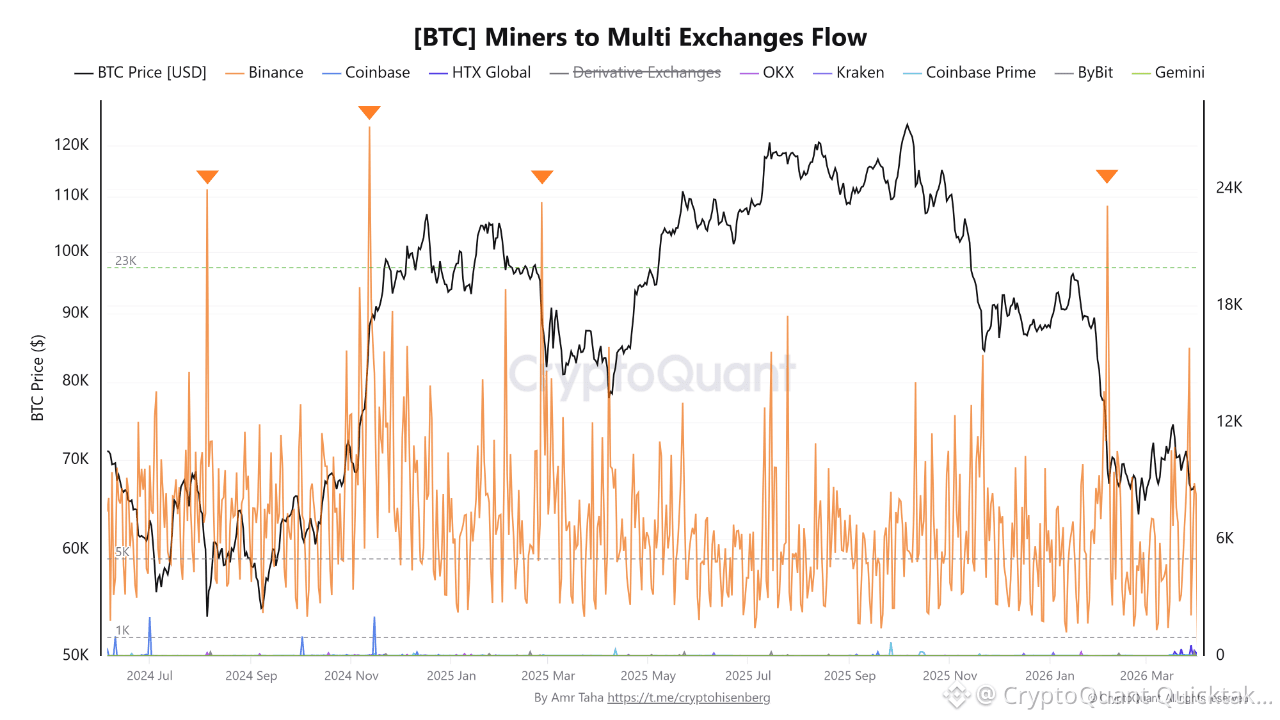
Bitcoin miner transfers to Binance have once again moved above 23,000 BTC, marking the fourth major spike since the second half of 2024.
The largest miner to Binance flow events were:
August 5, 2024: around 24,000 BTC
November 12, 2024: around 27,200 BTC
February 25, 2025: around 23,300 BTC
February 5, 2026: around 23,151 BTC
What stands out is that each of these spikes was followed, after a relatively short period, by stronger Bitcoin prices.
At first glance, large miner inflows to Binance may look bearish because they suggest higher sell-side activity.
But the historical pattern on this chart points to a more balanced interpretation.
In these cases, the market absorbed the added supply without falling into a deeper breakdown.
Instead, Bitcoin often stabilized, defended key levels, and later moved higher.
That reaction matters because miners are not ordinary holders.
They operate like capital-intensive companies with large recurring costs.
Selling part of their mined Bitcoin in phases is often necessary to maintain operations.
When Bitcoin trades above mining cost, miners can realize profits to cover electricity bills, buy newer machines, and expand capacity. During strong market phases, this becomes even more important as they compete to secure more efficient hardware.
In weaker periods, lower hardware prices can also encourage smart miners to upgrade equipment in preparation for the next cycle.
The key signal is the market’s response after the transfer.
Despite these large flows to Binance, Bitcoin did not break into fresh lower levels after those spikes.
Instead, demand was strong enough to absorb miner-related selling pressure and contain downside.
So far, the pattern suggests that miner flows to Binance above the 23K BTC zone have not led to sustained weakness.
Instead, they have tended to mark periods where supply was absorbed efficiently and Bitcoin later regained upward momentum.
Written by Amr Taha