

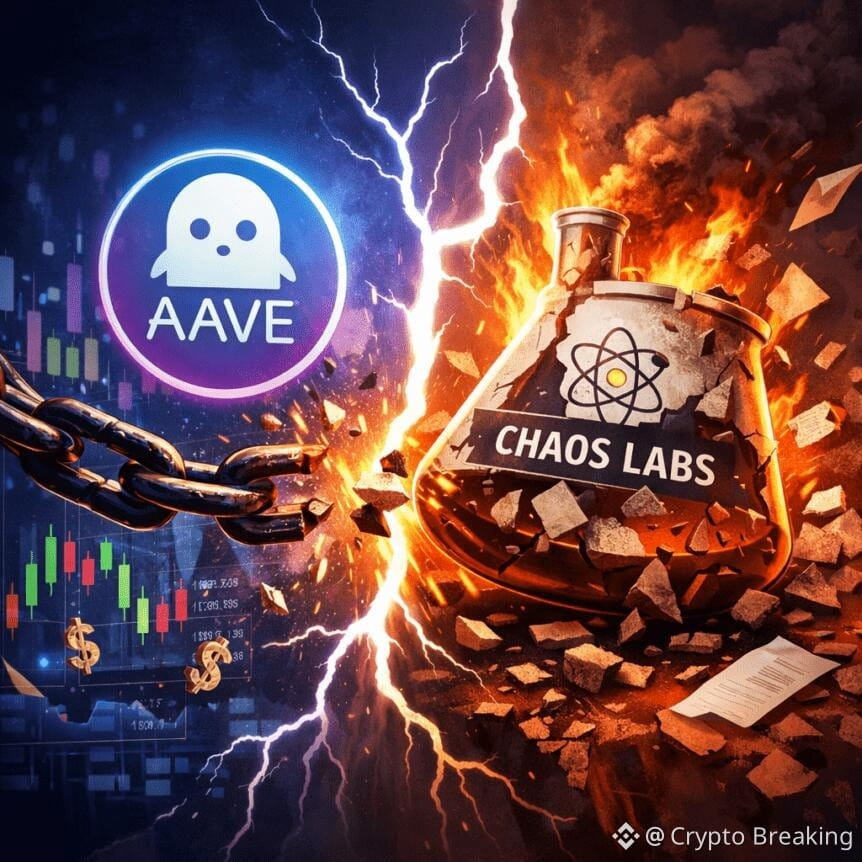
Chaos Labs has parted ways with Aave after three years of serving as the crypto lending protocol’s primary risk service provider, citing a budget dispute and fundamental disagreements over how risk should be managed. The rupture signals a notable inflection point in DeFi risk governance as Aave advances its V4 migration and navigates ongoing governance tensions within its ecosystem.
Chaos founder Omer Goldberg announced the decision on X, stressing that the move was deliberate and not made in haste. He said Aave Labs was willing to raise its budget to $5 million, but that the engagement “no longer reflected how we believe risk should be managed.” Aave Labs CEO Stani Kulechov offered a different framing, describing Chaos’s departure as the result of a push by Chaos to become the sole risk provider and to replace other partner models. Aave’s stance, the two sides said, remains professional; Chaos did not depart on acrimony, but the parties simply could not reconcile their risk-management philosophies.
Key takeaways
Chaos Labs exits after a three-year engagement as Aave’s main risk service provider, citing a budget dispute and diverging views on risk management.
The split underscores tensions between a single-provider model and a two-layer risk framework that Aave maintains, with Chaos allegedly seeking to replace Chainlink’s oracles and other partners.
Aave assures that the departure has not disrupted its protocol, smart contracts, or listings, while signaling it will continue working with LlamaRisk during the transition.
The move comes amid broader governance frictions within Aave Labs over funding and revenue control, and just weeks after a notable risk incident fueled calls for stronger safeguards.
What triggered Chaos Labs’ departure from Aave
Chaos Labs has been a cornerstone of Aave’s risk infrastructure since November 2022, handling pricing, risk assessment, and related guardrails across Aave’s V2 and V3 markets. In that period, Aave’s total value locked expanded markedly, underscoring the centrality of robust risk tooling to the protocol’s growth. By late February, Aave had crossed a historic milestone in lending activity, with cumulative lending volume advancing past the trillion-dollar mark, a milestone the project highlighted as a first for the DeFi sector.
Goldberg framed the decision as one driven by a misalignment over risk management and the scope of Chaos’s duties. “This decision was not made in haste,” he stated in a post to X. “We worked in good faith with DAO contributors. Aave Labs was professional and supported increasing our budget to $5m to retain us. However, we are leaving because the engagement no longer reflects how we believe risk should be managed.”
Aave’s account of the dispute diverges on what Chaos was seeking. Stani Kulechov contended that Chaos sought to become the sole risk manager and to substitute Chaos’s price oracles for Chainlink—an approach that would have effectively sidelined other risk partners and compromised Aave’s established two-layer risk model. Chaos’s proposal, Kulechov suggested, would have forced Aave to abandon its multi-provider framework, a move the protocol did not accept. Chaos later indicated it was examining winding down its risk consultancy, even as Aave reportedly offered to double the compensation to keep Chaos onboard.
Beyond the personnel dynamics, the departure arrives at a moment of heightened sensitivity around risk in Aave’s community. The ecosystem has recently grappled with high-profile events that tested the resilience of its risk tools, including a $50 million loss traced to a user interacting with Aave’s interface on March 12. In response, Aave rolled out a shielded risk feature designed to deter high-risk trading behavior, signaling a public push to bolster user safeguards even as internal governance wrestles with funding and control questions.
Risk architecture at stake: Chaos’s demands vs. Aave’s model
At the heart of the disagreement is Aave’s two-layer economic risk model, which blends on-chain risk pricing with external risk data. Chaos has been integrated into the back end of that risk framework, providing pricing and risk management services that supported V2 and V3 liquidity and lending operations. The move toward a broader, multi-provider risk architecture—anchored by partners like Chainlink—was a core feature of Aave’s design philosophy as it expanded and upgraded to V4.
Goldberg argued that Chaos’s push to become the sole risk provider, coupled with a desire to substitute its price oracles for Chainlink’s, would have undermined the protocol’s diversification of risk inputs. Kulechov, conversely, stressed that Chaos’s demand would displace established partners and thrust Chaos into a governance role that Aave does not appear prepared to concede. The exchange underscores a broader tension in DeFi: how to balance centralized expertise with multi-source resilience in a rapidly evolving risk landscape.
In practical terms, the split leaves Aave poised to continue with LlamaRisk and other risk partners as it advances V4 and maintains its two-layer model. Chaos had suggested it could take on a more centralized risk-management posture, but Aave’s leadership signaled a preference for a governance-driven, multi-vendor approach, particularly as the platform expands its risk surface with new features and markets. The dispute also highlights a broader industry question: what responsibilities do risk managers owe when a protocol experiences a failure, and who bears the blame when risk controls falter?
Operational realities of the migration and broader implications
The timing of Chaos’s exit aligns with Aave’s ongoing transition from V3 toward V4, a process that executives warned could stretch over months or even years as liquidity and markets migrate and the new feature set is absorbed into existing ecosystems. Goldberg noted that ongoing operations would require maintaining both V3 and V4 during the migration window, a workload that can be substantial for any risk provider. He warned that without clear safety harbors or settled legal precedents, risk governance remains an area of ambiguity with real consequences when things go wrong.
Kulechov framed the disruption as manageable and non-disruptive to Aave’s immediate operations. He emphasized that Chaos’s departure did not affect Aave’s smart contracts, token listings, or network integrations, and that the protocol would continue collaboration with LlamaRisk to ensure a smooth transition. The episode sits against a backdrop of ongoing governance debates about funding and revenue allocation within Aave Labs, a debate that has punctuated discussions about how the DAO should remunerate development and risk oversight in a high-growth, capital-intensive ecosystem.
For users and investors watching the DeFi risk space, the episode underscores two distinct strands: the push for diversified risk inputs that mitigate single points of failure, and the practical realities of a multi-year migration that tests the stamina of risk tooling and governance structures. The fact that Aave achieved a meaningful lending-volume milestone while navigating this internal shift demonstrates the resilience of its ecosystem, but it also raises questions about the pace of migration and the potential for further shuffles among risk partners as V4 scales.
Cointelegraph’s coverage of related risk and governance developments provides broader context for these tensions. For instance, Aave’s response to the March incident and the subsequent shield feature was part of a wider market emphasis on user protection and risk-aware design. The departure also sits within the wider narrative of DeFi risk management evolving from boutique, single-provider arrangements toward resilient, multi-provider ecosystems that can weather shocks and governance disputes alike.
As Aave moves forward, the roadmap will hinge on how smoothly LlamaRisk can integrate and how quickly the V4 platform absorbs legacy markets and liquidity from V3. Chaos’s exit, while financially notable—the firm had been engaged at a $5 million level—illustrates the bargaining power that risk providers can wield in a high-stakes DeFi environment and the lengthier arc of governance negotiations that can accompany critical infrastructure changes.
For readers tracking the real-world implications, the key questions are clear: will Aave maintain a diversified, resilient risk framework as V4 expands? How quickly will the migration reduce the operational overlap between V3 and V4? And what lessons will the DeFi community draw about risk governance, budgeting, and partnerships from this high-profile split?
Investors and developers should watch for updates on Aave’s transition timeline, any new risk-partner arrangements, and how the community approaches risk coverage as V4 matures. The coming months will reveal whether the industry’s move toward multi-provider risk management proves more robust in practice, or if further shifts among top risk suppliers test the protocol’s continuity and user protection standards.
In the meantime, Aave’s leadership reiterated its commitment to maintaining its two-layer risk model and to working with partners—including LlamaRisk—to ensure a seamless transition. The episode also reinforces the broader industry takeaway that risk management in DeFi remains a live, evolving discipline—one where governance choices, partner ecosystems, and architectural design all shape the safety and reliability that users rely on every day.
Readers can follow ongoing developments as Aave navigates V4 integration and the evolving risk landscape, including how new safeguards and partner arrangements influence user experience, security, and the protocol’s long-term resilience.
Related coverage: Aave’s shield initiative after a high-profile loss, and discussions around risk provision and governance within DeFi ecosystems, offer useful context for evaluating how this split may influence future risk partnerships and platform upgrades. Aave Shield rollout and ongoing governance debates illuminate the environment in which Chaos and Aave operated.
This article was originally published as Aave Drops Chaos Labs as Risk Provider, Citing Deliberate Decision on Crypto Breaking News – your trusted source for crypto news, Bitcoin news, and blockchain updates.