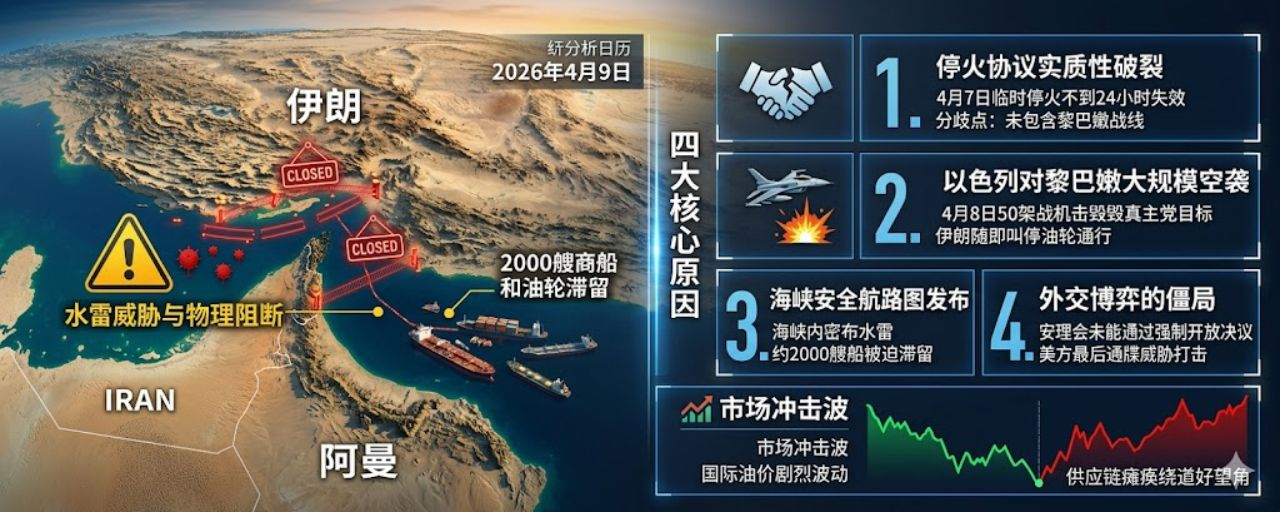

According to the latest real-time situation analysis on April 9, 2026, the Strait of Hormuz has been urgently closed again after a brief expectation of a ceasefire.
This closure is not a one-off incident, but a direct result of the upgraded tripartite game between the U.S., Iran, and Israel. Here are the four core reasons summarized for you:
1. Substantial breakdown of the ceasefire agreement
Just this week (April 7), the U.S. and Iran had reached a two-week temporary ceasefire agreement through mediation by Pakistan. However, the ceasefire was effective for less than 24 hours, as the Iranian side believed the basis of the agreement had been openly violated.
Point of divergence: Iran's proposal to 'stop all frontline wars (including Lebanon)' was not accepted by Israel.
2. Israel's large-scale airstrikes on Lebanon
On April 8 local time, the Israel Defense Forces dispatched 50 fighter jets, dropping about 160 bombs on Hezbollah targets within Lebanon in just 10 minutes.
Iran's response: Iran believes this military action violates the spirit of the ceasefire and, as retaliation and deterrence, immediately announced the suspension of tanker passage through the Strait of Hormuz again.
3. Mine threat and 'safe navigation map'
According to a warning issued by the Iranian Ports and Maritime Organization (PMO), since the conflict erupted at the end of February, various types of anti-ship mines may be densely packed in the main shipping channel of the strait.
Physical blockade: To ensure shipping safety and as a defensive measure, Iran has announced a new maritime route plan. Currently, about 2,000 commercial ships and oil tankers are forced to remain in the Persian Gulf and cannot pass.
4. Stalemate in diplomatic games
Security Council veto: On April 7, due to opposition from China and Russia, the United Nations Security Council failed to pass a resolution on the forced opening of the strait, making it difficult for Western countries to enforce the resumption of navigation under international law.
U.S. pressure: The Trump administration previously issued an ultimatum, demanding the 'unconditional opening' of the strait, or else it would strike key infrastructure such as power plants and bridges within Iran.
📊 Market shockwave
As the Strait of Hormuz accounts for about 20% of global oil and gas transportation, this closure has triggered severe market turbulence:
Energy prices: International oil prices have experienced extreme fluctuations (following a significant drop, there are reports of closures causing further sharp spikes).
Supply chain paralysis: Shipping giants Maersk and CMA CGM have completely suspended this route, being forced to detour around the Cape of Good Hope.
Expert opinion: This closure is not only a military blockade but also an economic bargaining chip in Iran's hands, aimed at forcing the U.S. to make substantive concessions in the upcoming first round of talks with Pakistan (scheduled for the 11th).