
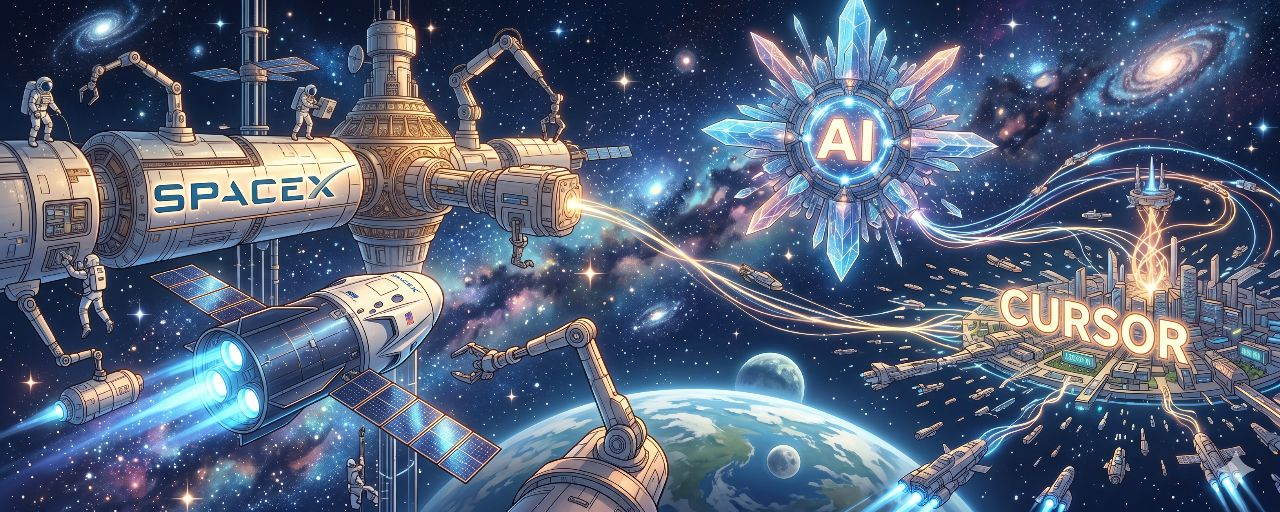
When SpaceX announced the option to acquire AI programming company Cursor for $60 billion, along with a clause stating 'if not acquired, a $10 billion cooperation fee must be paid', this news quickly caused a stir in global tech and capital markets. However, to merely view it as a potential acquisition deal underestimates the strategic depth behind this arrangement. From structural design to resource exchange and industry timing, it resembles a systemic positioning around the 'core entry of the AI era'.
1. From 'acquisition' to 'option control': a meticulously designed transaction structure
The most striking aspect of this deal is not just the amount but its highly flexible dual-path structure, allowing SpaceX to acquire Cursor fully in the future for $60 billion or choose not to acquire but pay $10 billion to continue the partnership. This design gives SpaceX high influence over Cursor's future destiny while bearing limited risk, as either path binds both parties to the same technological and commercial track long-term.
Further, this 'option-style acquisition' essentially serves as a control mechanism that sits between investment and acquisition. It avoids the regulatory and integration risks of an immediate buyout while locking in cooperation through high default costs, thus implementing a strategic layout of 'first binding, then deciding whether to fully acquire'. This also explains why some commentators interpret it as a form of 'quasi-acquisition' or even 'partial control' relationship.
2. The Exchange of Computing Power and Products: The Core Resource Connection of the AI Era
In this deal, what the parties exchanged is not merely simple capital but the two most critical resources of the AI era: computing power and application entry. SpaceX offers its flagship Colossus supercomputing cluster, described as having training capabilities equivalent to hundreds of thousands or even millions of high-end GPUs, making it one of the most powerful AI infrastructures globally. Cursor, in turn, provides its product penetration in the developer community and its accumulated AI programming expertise.
The significance of this combo lies in its direct integration of the complete chain of 'computing power - model - application', enabling Cursor, which initially relied on external models or computing power, to gain stronger training capabilities. It also allows SpaceX and its integrated xAI to secure key positions at the application layer, thus escaping the limitations of merely having models without real-world applications. This complementary relationship is precisely the rarest ability combination in the current AI competition.
3. The Value of Cursor: How a Company Established Just a Few Years Ago Can Reach a $60 Billion Valuation
To understand the rationale behind this deal, one must grasp the uniqueness of Cursor, as it is not a traditional development tool but rather an 'AI-native development environment'. Its core lies in deeply embedding AI into the software development process, enabling AI to act as a collaborative entity that can handle complex programming tasks, thus rapidly expanding among enterprises and developers.
According to publicly disclosed information, Cursor was established in 2022, yet in just a few years, it has seen its valuation leap from several billion to hundreds of billions and has already surpassed $1 billion in annual revenue while being adopted by numerous large enterprises. This growth rate is exceedingly rare in the software industry.
More crucially, Cursor does not represent a single product but rather a 'transformation in software production methods', enabling coding, debugging, and even system design to be automatically completed by AI agents. This means it controls not just a feature but the entry point to how developers will work in the future. Once this entry is controlled, its commercial value will far exceed that of traditional software companies.
4. The True Goal of SpaceX: From a Space Company to an AI Infrastructure Empire
When observing this deal on a larger timeline, one can see it as a continuation of Musk's series of actions in recent years, integrating xAI, building supercomputing power, and advancing chip manufacturing to transform SpaceX from a singular space company into an 'AI infrastructure platform', with Cursor being the missing link in this system.
Previously, SpaceX had integrated xAI, acquiring model research capabilities, yet still lagged behind competitors at the application layer, especially in developer tools. By binding with Cursor, SpaceX can quickly fill this gap, forming a closed-loop system covering computing power, models, and applications. This not only enhances its AI competitiveness but also provides a more attractive narrative foundation for its impending IPO.
In other words, the goal of this transaction is not merely to enhance a specific business but to construct a 'AI + infrastructure' super narrative that can support a trillion-dollar valuation for SpaceX.
5. Changes in the Industry Landscape: AI competition shifting from a model race to an entry race
On a macro level, this deal reflects a shift in the competitive logic of the AI industry, moving from early competition focused on model capabilities to competition centered around 'entry and ecosystem'. As model capabilities become more homogenized, whoever can control user entry will hold the reins of commercialization.
Current main competitors include OpenAI, Anthropic, and Google, each vying for users through products like ChatGPT, Claude, and Gemini. In the developer space, programming tools are among the most critical entry points, as software development itself is the most direct monetization path for AI.
Thus, by binding Cursor, SpaceX is essentially competing for the 'programmer core user group'. Once this group is mastered, it signifies a key position in the future software production ecosystem.
6. Potential Risks and Controversies: Overvaluation and Uncertainties in Strategic Integration
Although this deal is widely viewed as strategically significant, it also carries risks that cannot be overlooked. Firstly, there's the valuation issue: whether Cursor's rapid growth to a $60 billion valuation can be supported long-term is still debated. Secondly, there's the risk of technological integration, as xAI still lags behind some competitors in programming capabilities. Whether this integration with Cursor can lead to breakthroughs remains unproven.
Moreover, the deep integration among multiple companies may raise regulatory concerns, especially in a context where AI and infrastructure are highly concentrated. Balancing expansion and regulation will become a significant variable in the future.
Conclusion:
In summary, the true significance of this '$60 billion acquisition option' lies not in whether the acquisition will ultimately be completed, but in locking in the most critical production entry of the AI era—software development as a core scenario—through structural design, resource binding, and ecosystem integration. In the future, whoever controls the development tools may dominate software production, which is the foundation of the digital economy.
Therefore, rather than saying Musk is betting on an AI company, it's more accurate to say he is wagering on a grander proposition: how to redefine the distribution of technological power through controlling computing power and entry in the process of artificial intelligence reshaping the world.