
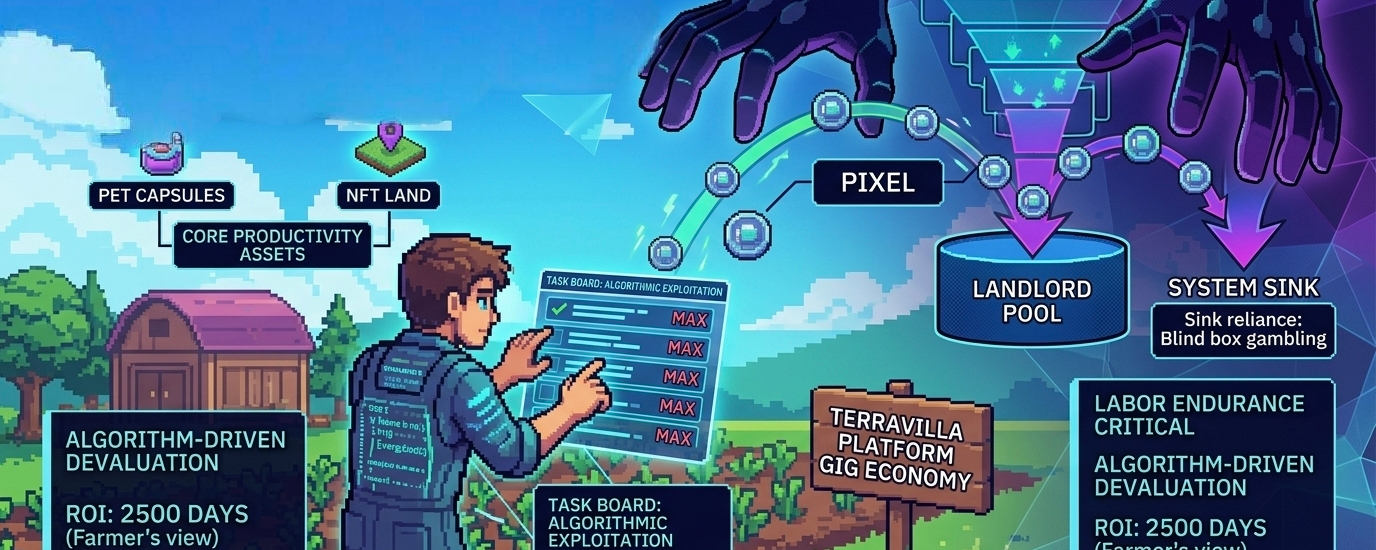

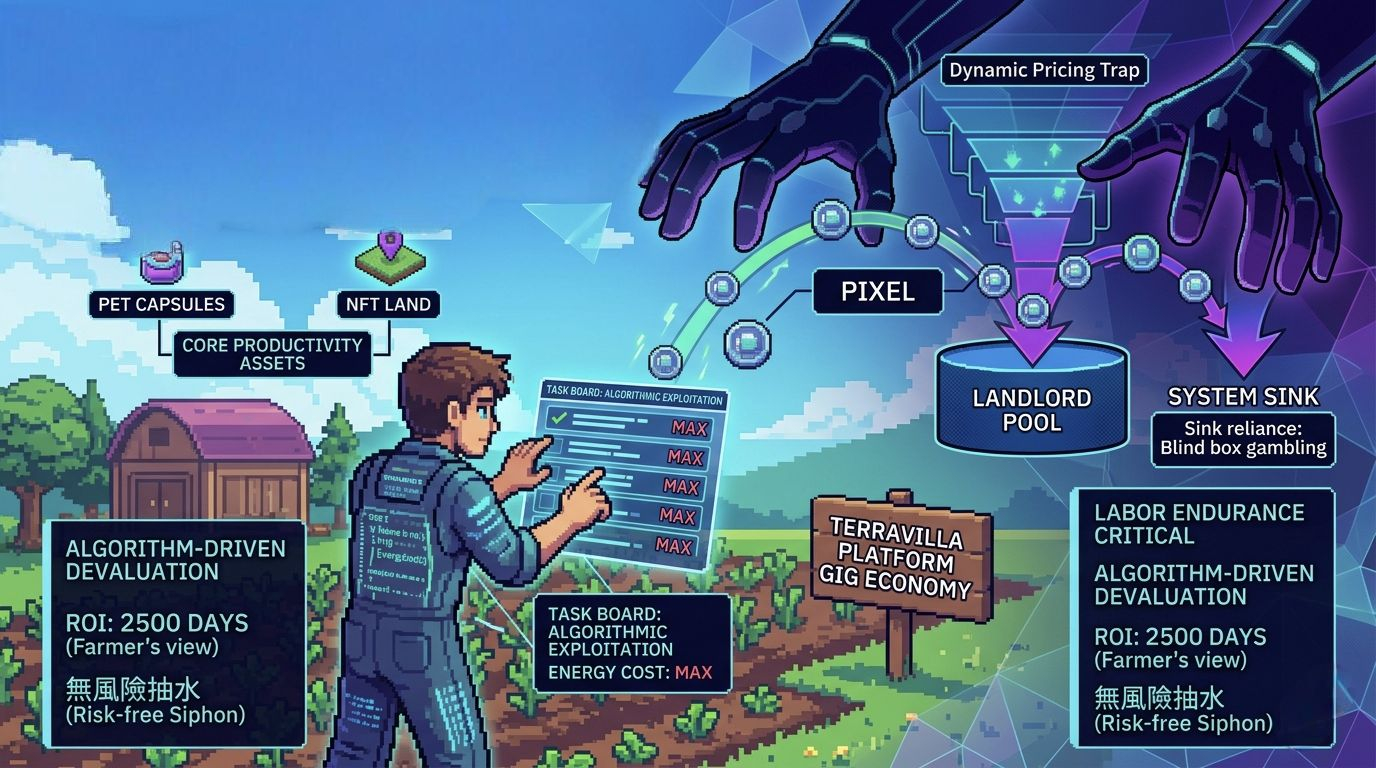
 Since @Pixels the Task Board's dynamic weighting has undergone a complete overhaul, and the VIP mechanism is now deeply tied to core resource output, I no longer view it as a 'Web3 casual farming game.' On the surface, everyone is running around in Terravilla, harvesting crops, chopping trees, and cooking, creating a pastoral scene; but if you flatten out the Task Board's refresh logic, energy consumption model, and the hidden inflation rate of items, this is far from a virtual farm. Essentially, it's a cyber gig economy platform heavily controlled by 'dynamic algorithms.'
As a data junkie who’s used to running models on Excel and monitoring smart contract interaction frequencies to gauge project lifespans, I didn't focus on making my personal estate look nicer. Instead, I directly scraped the task board refresh data for players of varying skill levels over the past two weeks, the energy-token conversion rate (EPR), and the liquidity depth of core base materials in the market to conduct a stress test. The grim logic behind this 'order system' turned out to be more ruthless than traditional Web2 delivery platforms, resembling a 'juicer.'
The 'dynamic pricing' trap and the real devaluation of energy's purchasing power.
On the surface, Pixels' trading medium is $PIXEL and coins, but the core underlying currency in this system is actually 'Energy.' The officials package the task board as a free market where you can exchange labor for tokens. However, from the perspective of labor economics, this is a black box algorithmically squeezing players' surplus value.
Let's take a look at a set of calculated data for 'mid-to-high-level' gold farming players:
Marginal diminishing returns on energy conversion: In the early stages, players could convert 1 point of energy into a predictable yield through simple planting (like Popberry or Grumpkin). However, with the iteration of the task board's algorithm, the current mechanism is a classic case of 'big data taking advantage of the old.' When your certain skill (like cooking or woodworking) exceeds level 50, the system frequently pushes high-tier orders that require massive quantities of base materials. An order for a 'pumpkin pie' that consumes 300 points of comprehensive energy for gathering and processing might only yield a meager 1.2 $PIXEL in panel rewards.
The embellishment of labor time (ROI): Players think that the higher their skills, the more they earn, but in reality, high-level items not only have extremely long growth/production cooldown times (Time-gated) but also require crossing multiple workbenches. After deducting the time costs spent on traveling, queuing, and monitoring prices, the maximum net output from a full day of energy (including natural recovery for VIP and sauna) translates to an hourly wage in U that is even lower than the minimum wage in many Southeast Asian countries.
From the perspective of traditional platforms, this is akin to delivery riders reaching 'king level,' yet the platform not only fails to increase the average order price but also assigns you the most challenging, time-consuming, and lowest price-performance ratio orders to drain your excess 'production capacity (energy).'
Algorithmic exploitation: The 'inventory trap' for gold farmers.
I further tracked the turnover rates and order depths of basic materials (like wood, iron ore, and various primary crops) in the secondary market (Marketplace), trying to uncover the true logic of commodity circulation within the game. The data presents a bizarre 'pseudo-prosperity':
Forced liquidity providers: The task board intentionally stalls players' progress. For instance, if it keeps rolling out material orders you need but can't currently produce (like certain specific soils needed for growing mutant crops). To avoid wasting a day's refresh opportunity, players are compelled to shop in the market. This leads to players' hard-earned $PIXEL flowing back into the system in the form of 'raw material procurement,' effectively wiping out the real profit margins due to friction costs and market premiums.
Systematic depreciation of trapped assets: Players are forced to hoard a variety of resources to cope with the random task board, resulting in a significant amount of time cost being tied up in 'dead inventory' in their bags. This inventory has no earning capacity and faces the risk of devaluation whenever the officials adjust drop rates and recipes.
In traditional Web2 games, players hoard resources to prepare for clear major version updates or guild wars; however, in Pixels, stockpiling is merely to avoid paying a little less toll when confronting that 'random algorithm' that could challenge you at any moment.
VIP mechanism: The 'cyber head tax' disguised as privilege.
From the perspective of economic model audits, the most alarming design in the current system is that the VIP subscription has completely morphed from a 'value-added service' into a 'work permit.'
If you don’t purchase VIP, you’re stripped of even the most basic rights to trade freely and gather high-level resources, and the earnings from the task board are pitiful. The three-month VIP fee (calculated at current prices amounts to a hard cost of several dozen U) is essentially a 'head tax' enforced by the officials on every player trying to make money in this system. To recoup this upfront fixed cost (Sunk Cost), players must clear energy daily as if clocking in for work, providing a solid base for the artificially created 'daily active users (DAU).' This stickiness built on sunk costs is extremely fragile.
Conclusion: Seeking the tipping point of 'labor elasticity.'
My current judgment is: Despite the steady online player count for Pixels and communities constantly discussing how to exploit bugs for efficiency, what truly determines the longevity of this system is the underlying players' tolerance limit for 'algorithmic pay cuts.' I'm currently focusing on two core metrics: whether the next month's VIP renewal rate shows abnormal fluctuations and whether the discount rate for 'energy drinks' in the secondary market diverges from the trend of $PIXEL .
Similarly, I'm not writing this to completely deny Pixels. It solidifies the core 'dynamic pricing mechanism' and 'labor coordination' within the platform economy through smart contracts, which is itself an unprecedented large-scale on-chain labor experiment that reveals the cold side of token economics. What I look forward to is the day when players stroll and chat in Traville Town just to enjoy the community vibe, not calculating in their heads, 'In the five minutes I stood here dazed, how many tasks did I miss, losing a fraction of a coin.' Only then can we say that blockchain gaming has truly shed the label of a 'cyber sweatshop.'#pixel