
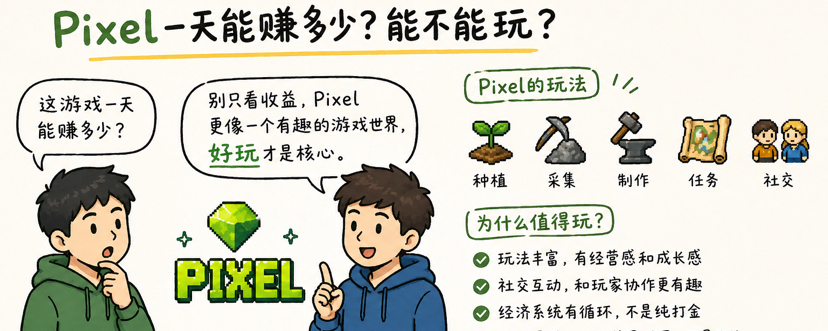
I often have buddies asking me, 'You've been diving into Pixel for a while now, how much can you actually rake in a day? Is it worth my time?' This question feels a lot like how many folks approach blockchain games these days—first they want to know the ROI, then they decide if they want to get in on it.
I didn’t hit him with a number right off the bat; instead, I shared my first impressions of Pixel. Initially, I was all about the GameFi hype, thinking it would be the usual grind: jump in, farm some resources, calculate profits, and wait to break even. But after playing for a bit, I realized it was a different game altogether. It doesn’t shove ‘making money’ in your face right away; instead, it eases you into the game's flow.
Every day I hop on to farm, gather materials, complete quests, and tidy up my plot. Sometimes I trade resources with others or explore the map. What started as a casual experience slowly became a habit. It feels a bit like playing a management game as a kid—not for the output, but to make my little world better.
My friend said, 'It sounds more like a game, not a blockchain game.' I replied, that's probably what makes it special. Many blockchain games have had the issue of being just profit wrappers; discussions revolve around not whether it's fun, but how long until ROI. When profits drop, people scatter. But c-6 makes me feel like it's trying to flip that—first get you to enjoy playing, then talk about ecosystem and value.
My friend asked, 'If profits aren't the focus, why are people still interested?' I said because blockchain gaming has evolved. In the past, GameFi was all about gold farming efficiency; now, discussions are shifting towards content, retention, and community. To put it bluntly, the market is moving from 'who can hand out rewards better' to 'who resembles a real game more.'
Pixel isn't the flashiest, nor the most profitable, but it has this rare chill vibe. It's not in a rush to prove itself as a wealth machine; it's more like building a place you can hang out in for the long haul.
For example, resource management isn't just mechanical repetition; there's a cyclical logic to many things. Social interaction isn't just for show—you'll find player cooperation is quite important; even farm management, which seems simple, has a sense of growth.
These elements might not be dazzling on their own, but together they give people a reason to stick around. My friend later asked an interesting question: 'So are you playing a game, or betting on the future of GameFi?' I thought about it and said, maybe both.
Because if Web3 games are really going to break out in the future, I don't think it'll just be about issuing tokens or creating economic models; it'll more likely be those game ecosystems that get users to want to stick around first. Profits can draw people in, but only content and experience can keep them. This logic holds in traditional games and should apply to blockchain games too.
So if someone asks me if Pixel is worth playing, I won't start with how much you can earn in a day; instead, I'll counter with: are you looking for a gold farming tool, or are you curious to see if blockchain games can evolve into something more game-like?
If it's the former, maybe there are a lot of choices; if it's the latter, I think Pixel is worth experiencing. Later, my friend played for a few days and replied, 'I originally wanted to calculate profits, but ended up researching how to farm more efficiently.' t-37
I smiled because this shows that its appeal might never just be about profits. Sometimes, truly promising projects don't flaunt immediate riches; they slowly make you realize they might represent another direction, and that could be why I'm continuously keeping tabs on m-31.