
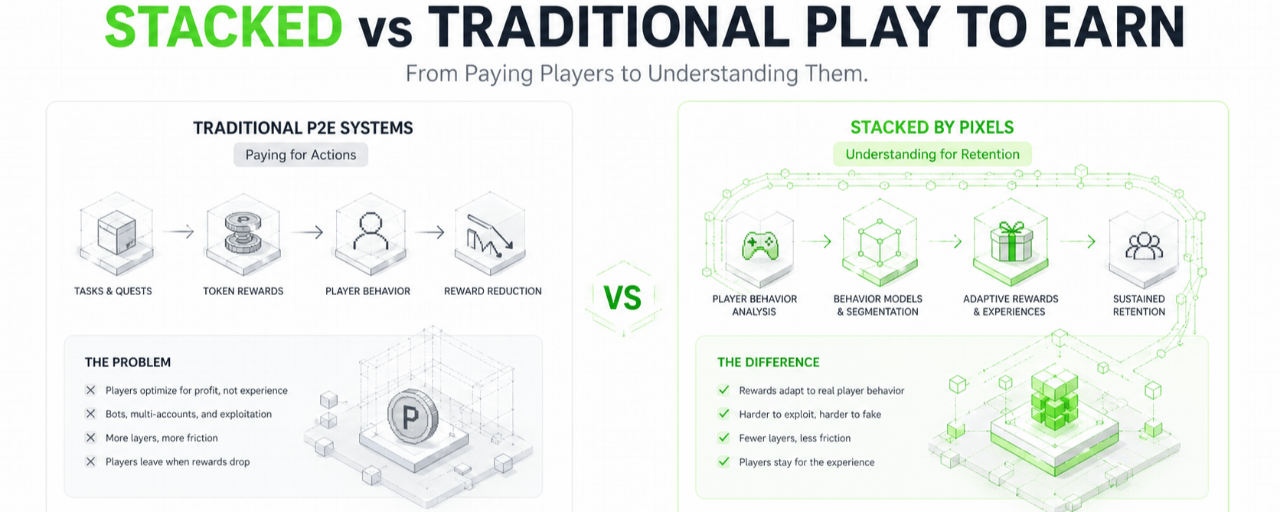
I've seen way too much already, too many times the industry comes up with a new way to 'reward the players.' The names change, the mechanics get more complex, the dashboards look nicer, but the feeling doesn't differ much. Players jump in for the money, stick around out of habit for a while, then bounce when the rewards aren't enticing anymore. That loop just keeps repeating, only now it's designed to be more sophisticated.
The problem doesn't seem to be a lack of incentives. In fact, it might be the opposite—too many tokens, too many quests, too many ways to optimize profits. Players are no longer playing; they're calculating, farming, optimizing their behavior like a worker in a semi-automated system, and then the system responds by tightening rewards, adding sinks, and layering controls. It's an ongoing silent chase.
Traditional Play to Earn systems often start from a pretty straightforward assumption: if you pay enough, players will stick around. Sounds logical, but in reality, it's not sustainable because when the main motivator is money, behavior will revolve around maximizing profit rather than experience, engagement, and any loophole in the system will be exploited. Bots emerge, multi-accounts appear, and real players either turn into farmers or leave.
They try to fix it by adding layers like daily quests, energy systems, cooldowns, NFT requirements, but each layer adds friction. Players no longer feel like they're gaming. They’re ‘operating’ an account that resembles a job more than entertainment.
That's the part I always come back to: the repetitive behavior of players when there's no clear financial incentive. It's not during high rewards but when rewards start to drop that we see if the system can hold up.
At least from my perspective, Stacked by Pixels seems to be trying to go in a different direction. It's not about increasing rewards or adding tokens, but rather reading player behavior more deeply and adjusting the system around that behavior. It's not about paying players to act but observing what they actually do when not pressured.
Sounds unoriginal; the traditional gaming industry has been doing this for a long time. Cohort analysis, retention curve, behavioral segmentation… But in the on-chain context, everything used to be simplified into who can farm the most gets the most, a twisted form of meritocracy.
Stacked seems to be trying to break that. Not everyone gets rewarded equally, not every behavior holds the same value, and it looks like they're trying to distinguish between real players and those just optimizing the system without KYC or technical barriers but through actual behavior.
The difference lies here. It's not X, a linear, predictable reward system that's easy to farm, but rather Y, a behavior-responsive reward system that's harder to predict and optimize.
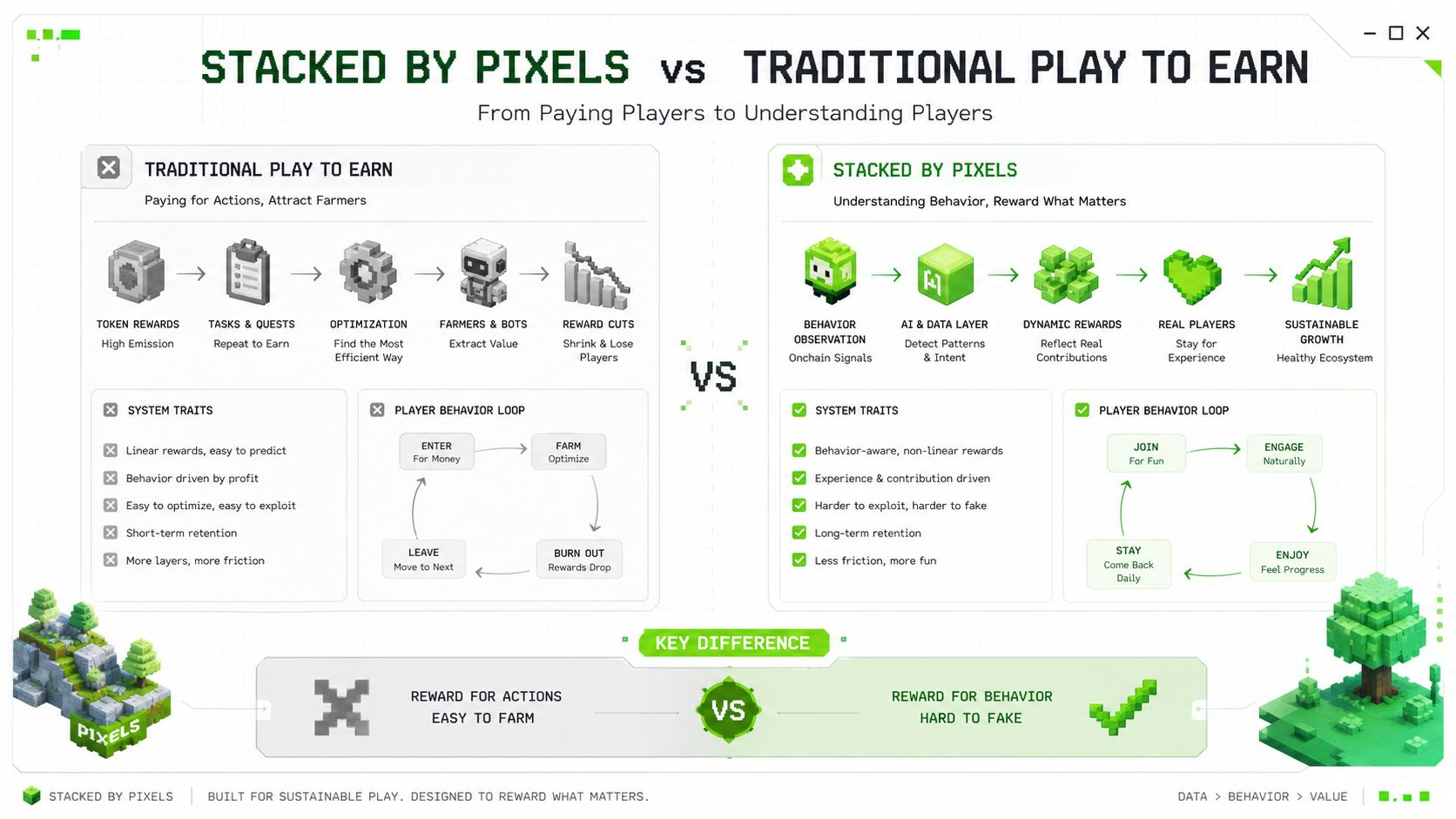
Sounds reasonable, but it's not easy because as the system becomes smarter, players will adapt. Farmers will learn how to simulate 'human-like' behavior, bots will become more sophisticated, and then the old loop might return, just at a more complex level.
Reality check is like that; whitepapers can talk a lot about AI, data, and personalization, but in the end, the question remains: do players stick around when there's no clear incentive? Do they log in daily because they want to, or because they 'should'?
I don’t think Stacked is a complete solution. It seems more like another experiment, but more carefully designed. At least it acknowledges that the issue isn’t solely in tokenomics but in human behavior, which is much harder to predict and control.
I still see a tension here between optimizing the system to retain players and keeping the experience natural enough so players don't feel manipulated. If it leans too far in one direction, the system will again become a sort of behavioral mining machine, which this industry has already tried.
I'm not rushing to conclusions because it seems too early. Stacked is just one layer in a larger system, and player behavior takes time to reveal itself. I'm still monitoring; this part seems to require more time to clarify.