
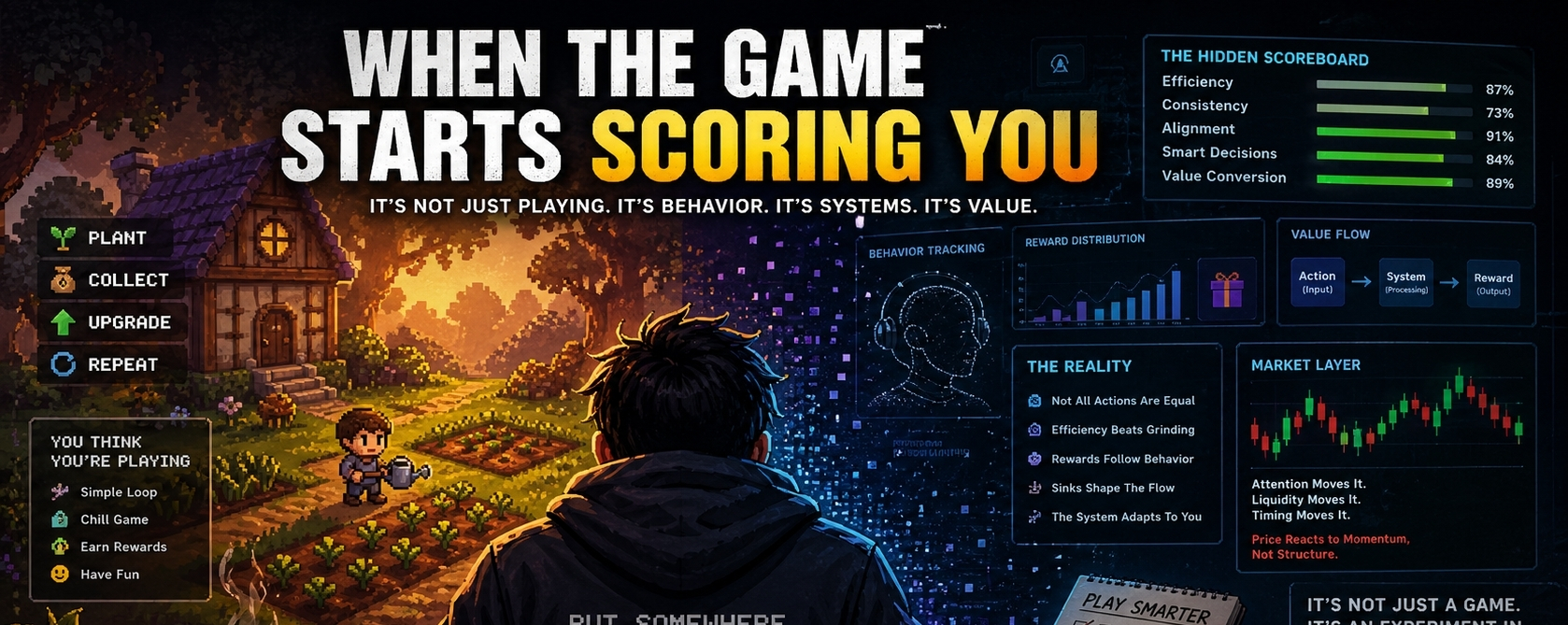
@Pixels At first, nothing about it feels unusual. You open Pixels, move through the same routine you have done many times before, and let muscle memory take over. Plant, collect, upgrade, repeat. It feels simple, familiar, almost relaxing in the way repetitive systems often do. Then one day, without any dramatic moment or visible change, the experience starts to feel different. You still do the same actions, but your mindset has shifted. You begin checking timing more carefully. You delay some moves. You ignore tasks that no longer seem worth the effort. You start making decisions based on what feels efficient rather than what feels fun. That is usually the point where you realize something important has changed. You are not just playing the game anymore. The game is shaping how you play.
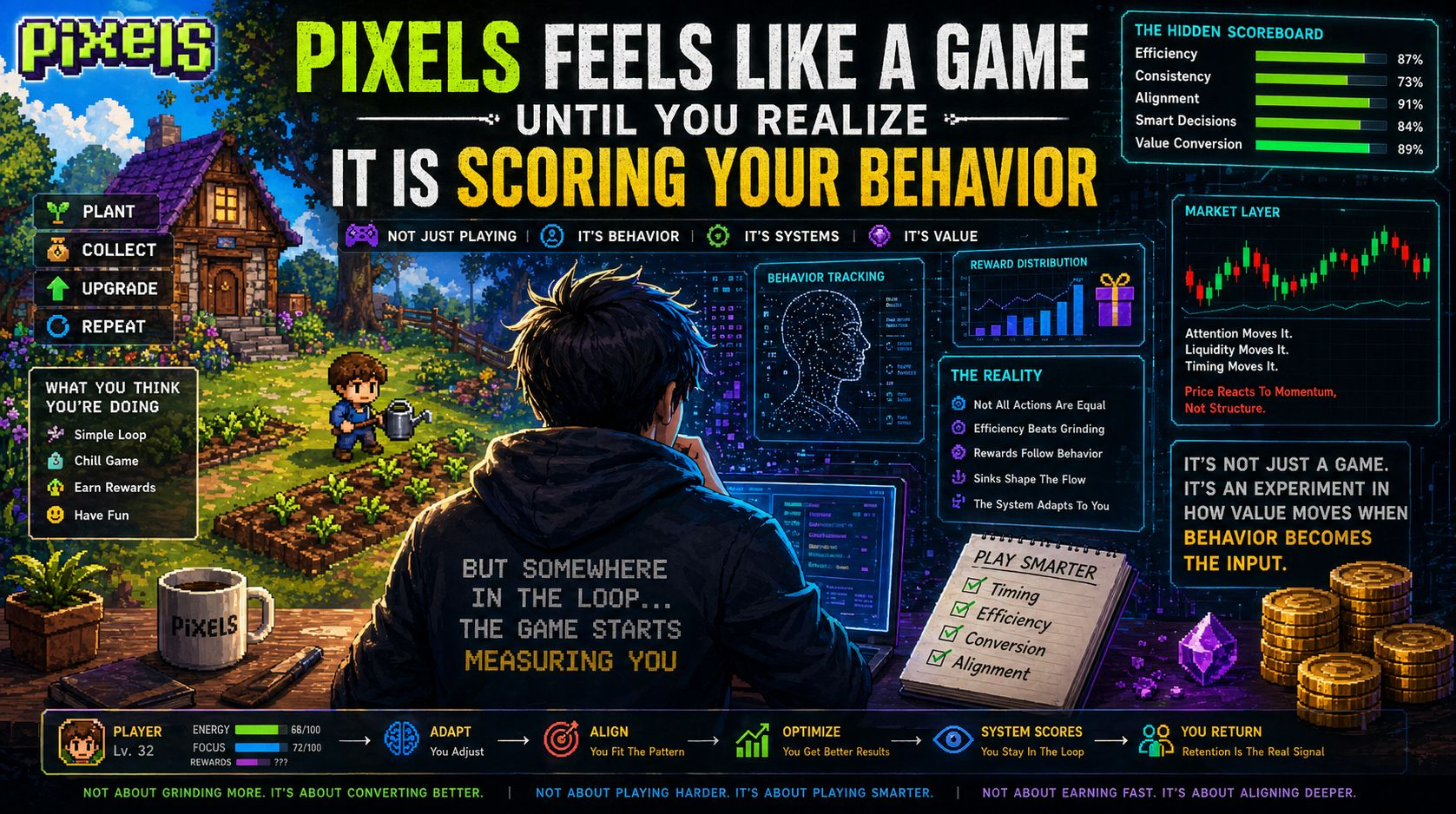
Pixels Feels Like a Game Until You Realize It Is Scoring Your Behavior
I have seen enough Web3 projects to recognize the usual pattern. Most of them begin with excitement, reward activity heavily, and attract people chasing opportunity. Then over time the loop becomes obvious. Players grind harder, rewards lose value, interest fades, and the system slowly empties out. It is a cycle that has repeated often enough to feel predictable. But Pixels has felt different from that standard path. It has not moved in a perfectly smooth line, but it has also not collapsed into the same fast exhaustion many expected. Players leave, but many return. The routine continues. The world keeps breathing. That alone makes it worth looking at more carefully.
The longer I stayed around it, the more I noticed that rewards did not always follow effort in a simple straight line. Two people could spend similar time doing different things and walk away with completely different outcomes. Some paths felt quietly stronger than others. At first, that can look like normal balancing. Every game changes numbers, adjusts progression, and fine-tunes incentives. But after enough time, it begins to feel like more than balancing. It feels like the system is paying attention to behavior itself. Not just how active you are, but how intelligently you move through the environment.
That is where the experience becomes more interesting. Once players sense that certain patterns are stronger, they naturally begin adapting. You stop doing random actions and start making cleaner decisions. You organize time better. You manage resources more carefully. You think in terms of efficiency even when you never planned to. Slowly, the game trains discipline without directly asking for it. You feel like you are making free choices, but many of those choices are being guided by invisible reward pressure.
Even the friction points begin to look different when viewed through that lens. Fees, upgrade requirements, delays, limited resources, progression gates—these things are not only there to slow you down. They help direct movement. They create priorities. They make players choose where energy should go instead of allowing everything to flow endlessly in one direction. That gives Pixels a feeling that goes beyond a normal farming loop. It starts to feel like a live system experimenting with how value should circulate.
At the same time, the token market above it follows completely different logic. Price reacts to attention, volume, sentiment, momentum, and outside narratives. It does not care how carefully designed the in-game economy might be. That creates a visible tension. Inside the world, behavior can be rewarded with precision. Outside the world, price can swing because of emotion in a single day. One layer values structure. The other values movement. Those two layers can support each other at times, but they do not naturally operate the same way.
Maybe that is why Pixels feels so interesting and so uncomfortable at once. The more a system defines what valuable behavior looks like, the more players begin narrowing themselves to fit it. Efficiency rises, but spontaneity can fall. And spontaneity is often what makes games feel alive. The fun moments in games are not always the most optimized ones. They come from wandering, experimenting, failing, and doing unnecessary things simply because they feel enjoyable. If everything becomes too measurable, people stop exploring and start complying without even noticing.
Still, one fact matters more than theory: people keep coming back. Retention says more than any chart or token narrative. If players willingly return day after day, then the system is providing something meaningful, whether that is progress, community, routine, curiosity, or opportunity. That is difficult to fake over time.
So I no longer see Pixels as just a game or just another token project. It feels more like an evolving experiment in how incentives influence human behavior when every action can carry value. It is still imperfect, still changing, still learning. But it does not feel empty. It feels like something trying to understand how digital worlds can hold attention without relying only on hype.
And maybe that is the real question underneath all of it. Not whether the system works, but whether a system that becomes highly efficient can still feel like a game once you are living inside it.