

I’ve been watching AI and crypto smash into each other for years now, and honestly, most of it felt fake.
Not fake in the scam sense necessarily, although yeah, there’s been plenty of that too, but fake in the sense that people kept forcing two industries together without understanding why they should even connect in the first place. Every other project was basically “we added AI to blockchain” or “we put blockchain on AI” and the result was usually some clunky dashboard, a useless token, and a whitepaper full of buzzwords nobody would ever say out loud in a real conversation.
It felt manufactured. Like startup theater. OpenLedger is one of the first times I looked at an AI blockchain project and thought, okay, wait... these people might actually understand where this is all heading.
Because the thing nobody wants to admit right now in January 2026 is that AI is becoming terrifyingly centralized. Like, absurdly centralized. We pretend there’s competition because there are lots of model names floating around online, but if you zoom out for even two seconds, it’s basically the same handful of companies controlling the compute, the distribution, the APIs, the chips, the cloud contracts, the datasets, everything. OpenAI, Google, Anthropic, Meta, Microsoft, Amazon, NVIDIA. That’s the real power structure. Everybody else is renting access from them in some form. Even startups claiming to be “independent” are usually sitting on someone else’s infrastructure stack paying millions to keep inference alive another month.
And that’s the part crypto people noticed early. Data became oil.
Then compute became oil too. Now agents are becoming oil. Weird sentence, but you get what I mean. AI isn’t just software anymore. It’s infrastructure. Economic infrastructure. Whoever owns the pipelines owns the future.
That’s why OpenLedger interests me way more than meme AI tokens or chatbot wrappers pretending to be revolutionary products.
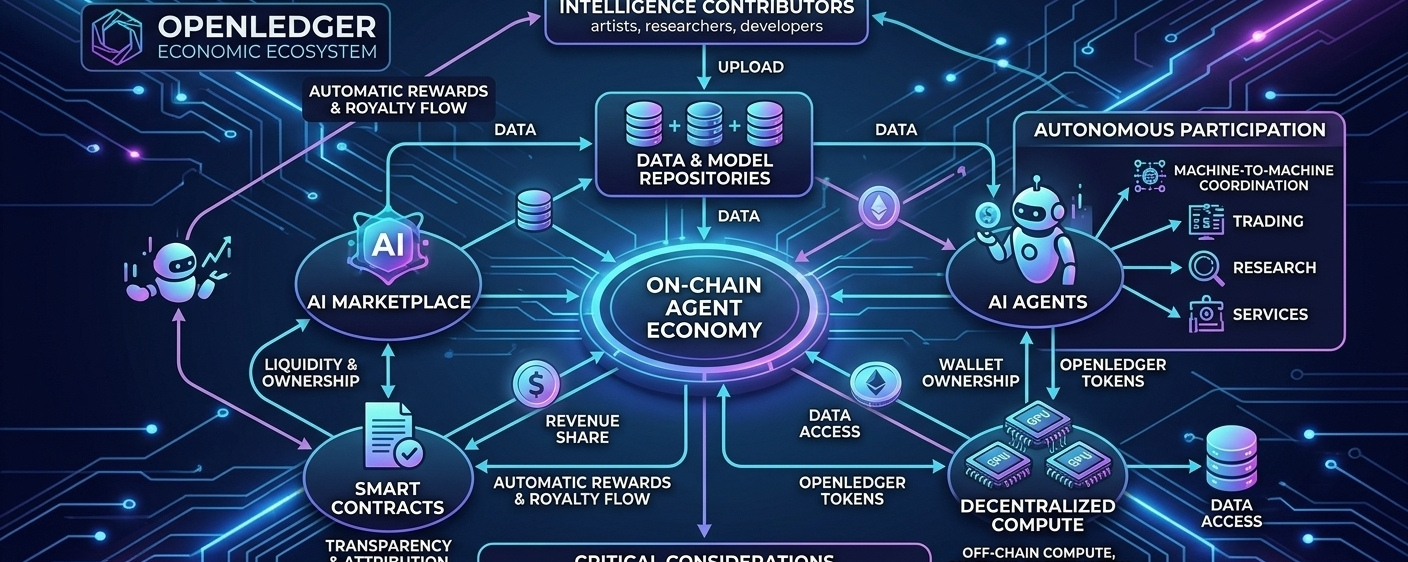
The core idea is actually pretty simple when you strip away the branding. OpenLedger wants AI itself to become an on-chain economy. Not just payments around AI.
Not just tokens attached to AI projects. The actual components of AI. Data. Models. Agents. Liquidity around them.
Ownership around them. Coordination around them. That’s a much bigger idea than people realize.
And honestly, I think most people still don’t fully understand how valuable data has become. They think AI models are the main asset. They’re not. The model is almost secondary now. Data quality is the real moat. Everybody can download open-source models now. Fine-tuning isn’t magic anymore. The real edge comes from exclusive datasets and distribution loops. That’s why every tech company on Earth is desperately trying to trap users inside ecosystems right now. They need behavioral data constantly feeding the machine.
OpenLedger seems to understand that contributors are eventually going to rebel against this setup. Maybe not loudly. Maybe not politically. But economically. People are already getting annoyed seeing billion-dollar AI systems trained on public content while the original creators get nothing except “exposure.” Artists hate it. Writers hate it. Musicians definitely hate it. Developers are getting weird about code scraping too. And let’s be honest here, the current AI economy basically treats humans like unpaid data farms.That’s where OpenLedger gets interesting because they’re trying to turn data contribution into something liquid. Something owned. Something traceable. That changes incentives completely.
Imagine this scenario for a second. A medical research group uploads anonymized cancer imaging datasets into a decentralized AI marketplace. Researchers build diagnostic models on top of it. Hospitals use the models. Revenue flows back automatically to the original contributors through smart contracts. No giant tech monopoly sitting in the middle taking 90%. That’s a radically different economic model than what exists today.
Now, does that magically solve healthcare AI? No. Not even close. Compliance alone is a nightmare. Privacy regulations are brutal. But the structure itself makes sense.
Actually, wait... the really crazy part isn’t even the data layer. It’s the agent layer.
That’s the thing people are sleeping on right now.
Everybody keeps talking about AI assistants as if they’re just chatbots with personalities, but agents in 2026 are becoming something else entirely. Autonomous systems are starting to chain actions together. They browse. They trade. They research. They negotiate APIs. Some of them already manage crypto wallets. Some run customer support businesses almost entirely alone. A few hedge funds are quietly experimenting with semi-autonomous trading agents that humans barely supervise anymore except for kill-switch oversight.
And OpenLedger seems designed for that world.
Not a world where AI just answers questions, but a world where AI participates economically.
That’s a massive difference.
Because once agents can own wallets, execute smart contracts, rent compute, pay for data access, and interact with other agents, you’re basically creating digital economic organisms. Sounds dramatic, but we’re already halfway there. Most people just don’t notice because the interfaces still look primitive.
The current internet wasn’t built for autonomous machine economies. It was built for humans clicking buttons. OpenLedger feels like it’s trying to build rails for machine-to-machine coordination before everybody else realizes that’s where this is going.
And honestly? That might either become gigantic or collapse completely under its own complexity. I genuinely don’t know.
Because here’s the uncomfortable truth nobody in crypto likes discussing. Decentralization is messy as hell. People romanticize it too much. Centralized systems are often faster, cleaner, and easier to scale. That’s just reality. If you want maximum efficiency, centralization usually wins. The reason decentralization matters isn’t efficiency. It’s ownership and control.
That distinction matters so much.
AI companies right now are racing toward vertical monopolies. Own the chips. Own the cloud. Own the models. Own the distribution. Own the app store. Own the users. OpenLedger is basically betting that eventually people will push back against that model hard enough to create demand for decentralized alternatives.
Maybe they’re right.
Because the political temperature around AI shifted massively during 2025. Governments started panicking about sovereign AI dependence. Europe got more aggressive about AI regulation. The US got paranoid about Chinese model acceleration. Open-source communities became way more militant. Even average users started noticing how weird it feels when a handful of corporations mediate access to intelligence itself.
That’s the deeper philosophical layer underneath OpenLedger that I think gets ignored. They aren’t just building infrastructure. They’re making a statement about who should own intelligence systems.
And the timing is weirdly perfect.
AI is simultaneously becoming more powerful and more commoditized. That sounds contradictory but it’s true. Frontier models are absurdly expensive at the top end, yet smaller specialized models are getting cheaper and easier to deploy every month. That means the future probably won’t belong to one giant AGI god-model controlling everything. It’ll probably belong to millions of smaller specialized systems coordinating together.
Which, conveniently, is exactly the kind of environment blockchain systems are good at coordinating.
I almost forgot to mention something important though. OpenLedger’s Ethereum compatibility is probably smarter than people realize. A lot of AI crypto projects try reinventing entire ecosystems from scratch and end up isolated. Nobody wants another ghost chain with no tooling, no wallets, no liquidity, and no developers. Following Ethereum standards means developers can actually plug into existing infrastructure without learning some bizarre custom environment.
That matters. A lot.
Because developer friction kills ecosystems faster than bad technology does sometimes.
Still, there are huge problems ahead.
The compute issue alone is brutal. AI workloads are insanely expensive. Even now in 2026 inference costs are eating startups alive. Training frontier-level systems is basically impossible without massive capital access. Blockchain doesn’t magically eliminate hardware realities. GPUs still cost money. Electricity still costs money. Data centers still matter.
And honestly, this is where a lot of decentralized AI projects quietly fall apart. They underestimate infrastructure economics. Decentralization sounds amazing until somebody has to pay for petabytes of storage and thousands of H100 clusters running nonstop.
OpenLedger seems aware of this at least. They don’t appear to be pretending everything will magically run fully on-chain because that would be insane. Most likely the future is hybrid systems. Off-chain compute. On-chain coordination. That’s the only realistic route right now.
The other problem is quality control.
Decentralized systems attract garbage. Every open network eventually gets flooded with spam, low-quality contributions, manipulative actors, and financial parasites trying to exploit incentives. AI data marketplaces are especially vulnerable because bad data poisons models quietly over time. You can’t just “decentralize everything” and hope quality emerges automatically.
Crypto learned that lesson the hard way already.
And then there’s regulation. Oh man. That’s gonna get ugly.
Autonomous agents executing financial actions across decentralized infrastructure while using AI decision-making systems? Regulators are absolutely going to freak out about that. They already are. The SEC, EU regulators, Asian regulators, everybody’s scrambling to understand how these systems even fit into existing frameworks.
Nobody has answers yet.
But maybe that uncertainty is exactly why projects like OpenLedger matter right now. They’re experimenting early before the rules fully harden.Because once regulations solidify, changing infrastructure becomes much harder.Another thing I keep thinking about is how AI changes the meaning of ownership itself. Sounds abstract, but stay with me here. In the industrial age, ownership meant factories. In the internet age, ownership meant platforms and networks. In the AI age, ownership increasingly means intelligence infrastructure. Whoever controls the models, agents, and datasets controls leverage across almost every industry.
That’s why OpenLedger feels bigger than just another Layer 1 blockchain narrative.
It’s really about whether intelligence becomes publicly participatory infrastructure or privately controlled infrastructure.
And honestly, I think most people are underestimating how economically weird AI agents are about to become. Imagine autonomous systems paying each other for services nonstop. One agent buys compute from another agent. Another rents a model temporarily. Another negotiates data licensing in real time. Tiny microtransactions constantly flowing between machine entities. Humans supervising at the edges instead of micromanaging everything.
That sounds sci-fi until you realize pieces of it already exist right now.
The internet is slowly becoming less human-centric.
Not emotionally. Structurally.
And OpenLedger feels like one of the first projects architected around that assumption instead of pretending the future still revolves around humans manually clicking apps forever.
Maybe it works. Maybe it crashes horribly. Maybe centralized AI giants crush decentralized competitors completely. That’s possible too. People underestimate how powerful incumbents are once network effects lock in.
But I’ll say this. OpenLedger at least feels like it’s aiming at the real problem instead of chasing hype cycles. That alone makes it more interesting than 95% of AI crypto projects I’ve seen lately.
Because the real battle isn’t “AI versus blockchain.”
It’s who owns the intelligence economy once machines become active economic participants themselves.
