
The first generation of AI was built around scale.
Larger datasets.
Larger models.
More computational power.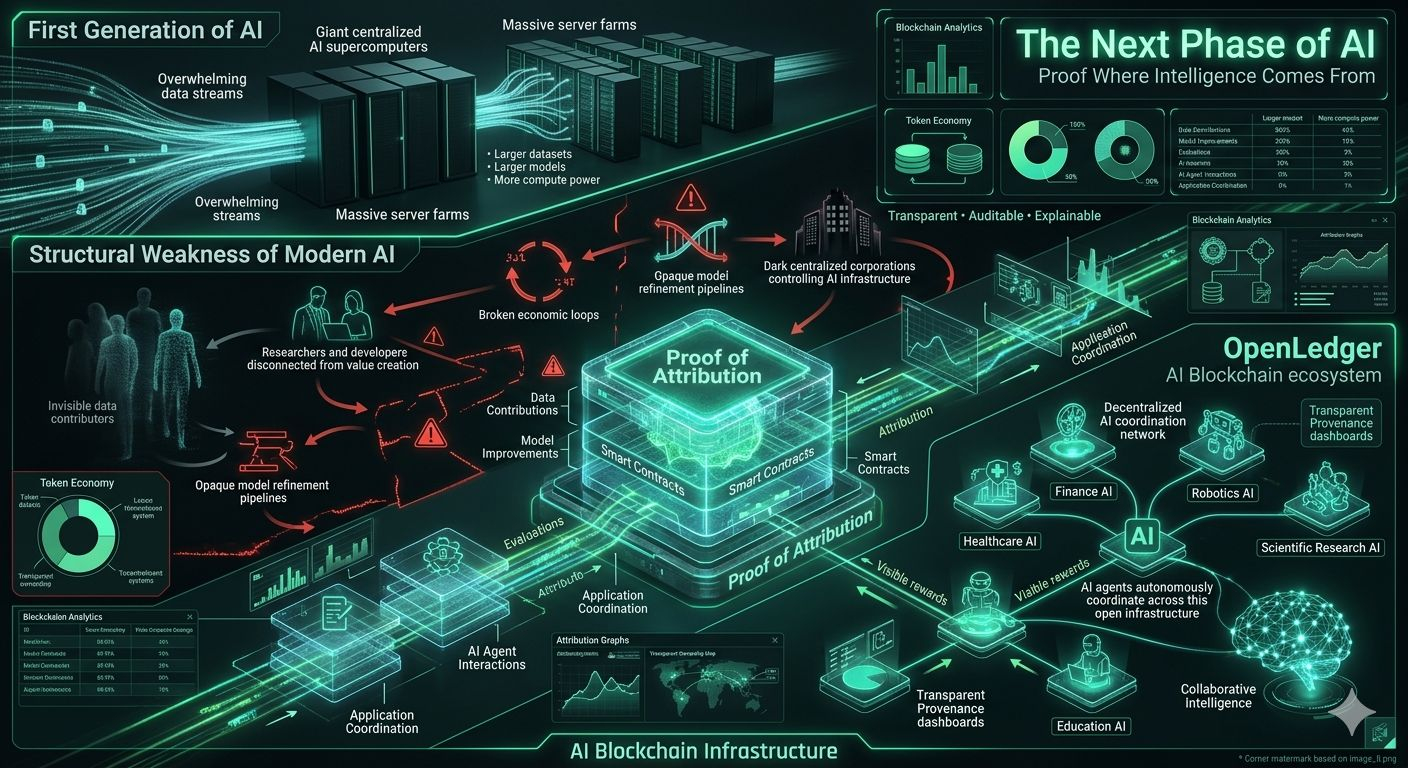
That approach accelerated adoption, but it also exposed a major structural weakness inside modern AI systems: the absence of transparent attribution and economic coordination.
Today, most AI ecosystems operate through centralized infrastructure where contributors remain largely invisible.
Data providers generate value without ownership.
Model refinements happen without transparent provenance.
Researchers and developers improve systems without long-term alignment.
As AI becomes more specialized, these problems become even more important.
Specialized AI requires domain-specific datasets that are curated, refined, and continuously improved. But sustaining high-quality data ecosystems becomes difficult when contributors cannot prove ownership or receive proportional incentives.
OpenLedger is attempting to solve this problem through what it calls the AI Blockchain.
Its architecture introduces Proof of Attribution, a framework designed to record every contribution across the AI lifecycle directly on-chain.
This includes:
• Data contributions
• Model improvements
• Evaluations
• AI agent interactions
• Application-level coordination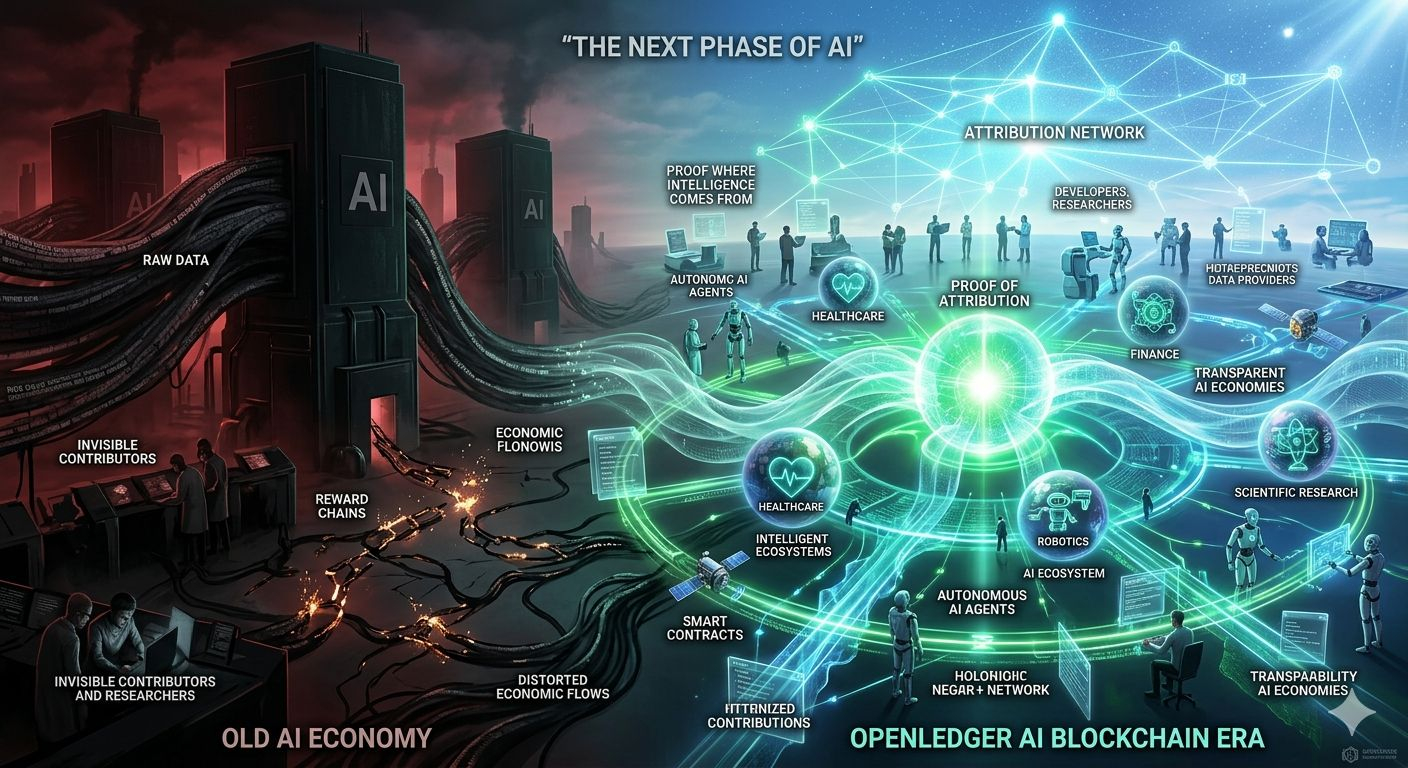
The significance of this model is larger than simple transparency.
OpenLedger is effectively turning attribution into economic infrastructure.
Instead of AI operating as an opaque system controlled by centralized entities, contributors become traceable participants inside an open network where value creation can be measured and rewarded.
This could fundamentally reshape how AI ecosystems function.
If attribution becomes verifiable, entirely new markets may emerge around:
- Specialized datasets
- Decentralized model training
- AI-native applications
- Agent economies
- Collaborative intelligence systems
Another important aspect is explainability.
Most AI systems today still operate as black boxes, making trust and accountability difficult. OpenLedger’s on-chain provenance model introduces traceability across datasets, model refinement, and downstream interactions.
That creates a foundation for more auditable and explainable AI systems.
From a broader market perspective, OpenLedger is positioning itself at the intersection of:
• AI infrastructure
• Blockchain coordination
• Data monetization
• Agentic systems
• Decentralized ownership
If the AI economy evolves toward open participation instead of centralized control, infrastructure focused on attribution and transparency could become essential rather than optional.
The next phase of AI may not simply be about creating more intelligence.
It may be about proving where intelligence comes from.