

OpenLedger is one of the few AI crypto projects I refuse to dismiss too early.
Not because I automatically trust every AI crypto narrative. Honestly, I do not. I have been around long enough to watch entire sectors appear, explode, and disappear while repeating the same promises with slightly different branding. Every cycle has its favorite vocabulary. One year it is interoperability. Another year it is GameFi. Then modularity. Then AI. The words change faster than the actual infrastructure underneath them.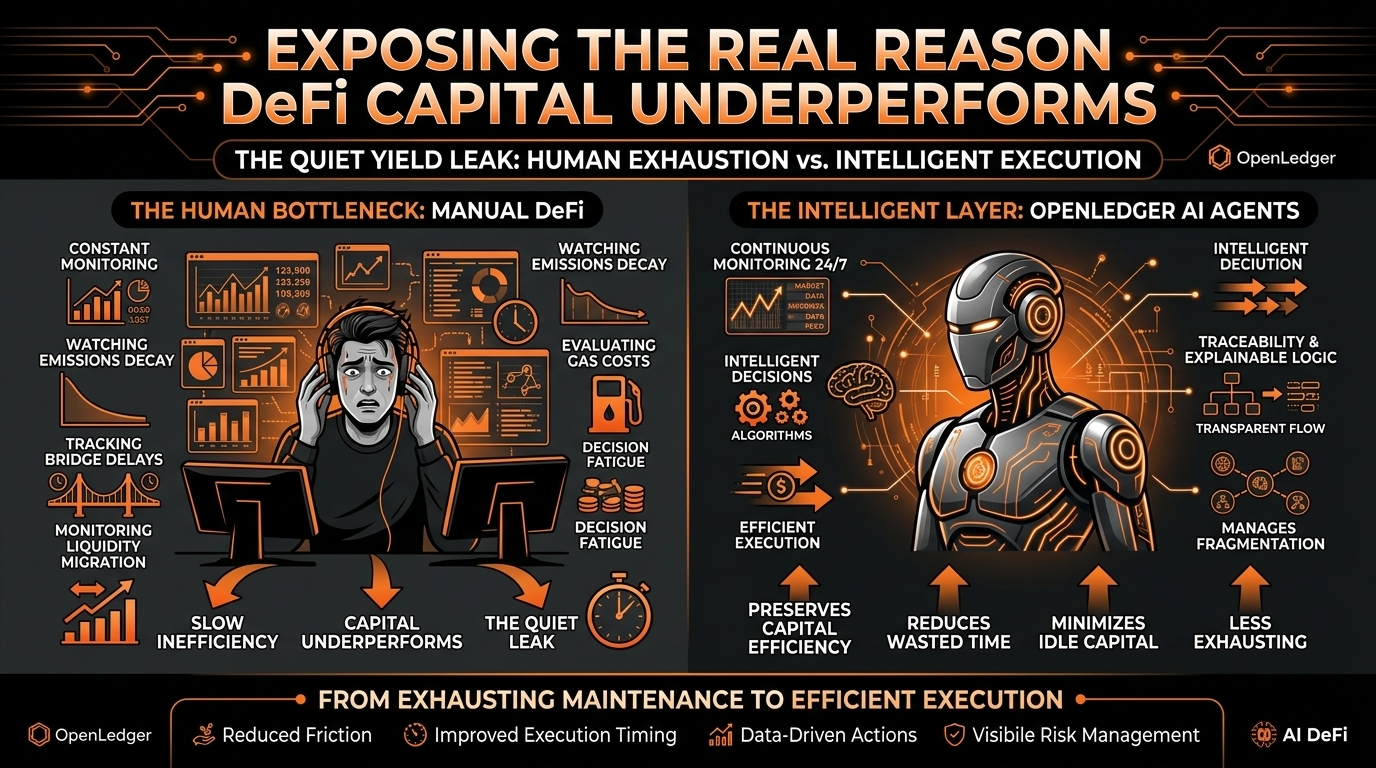
After a while, you develop a habit of filtering noise. Most projects are good at storytelling long before they are good at execution. That is why OpenLedger caught my attention differently. Not because the branding looked clean. Not because the AI narrative is hot again. What interested me was the problem sitting underneath the pitch.
The execution gap inside DeFi.
That gap is real, and most people pretending to talk about DeFi efficiency still avoid discussing it honestly. Because the truth is uncomfortable. DeFi is exhausting.
People outside the space still imagine decentralized finance as this elegant system where users simply deposit assets into a protocol and earn passive yield while the blockchain does all the work. That version sounds smooth in a thread. It sounds attractive in a dashboard screenshot. It sounds simple enough for marketing. It does not feel simple when you actually live inside the system.
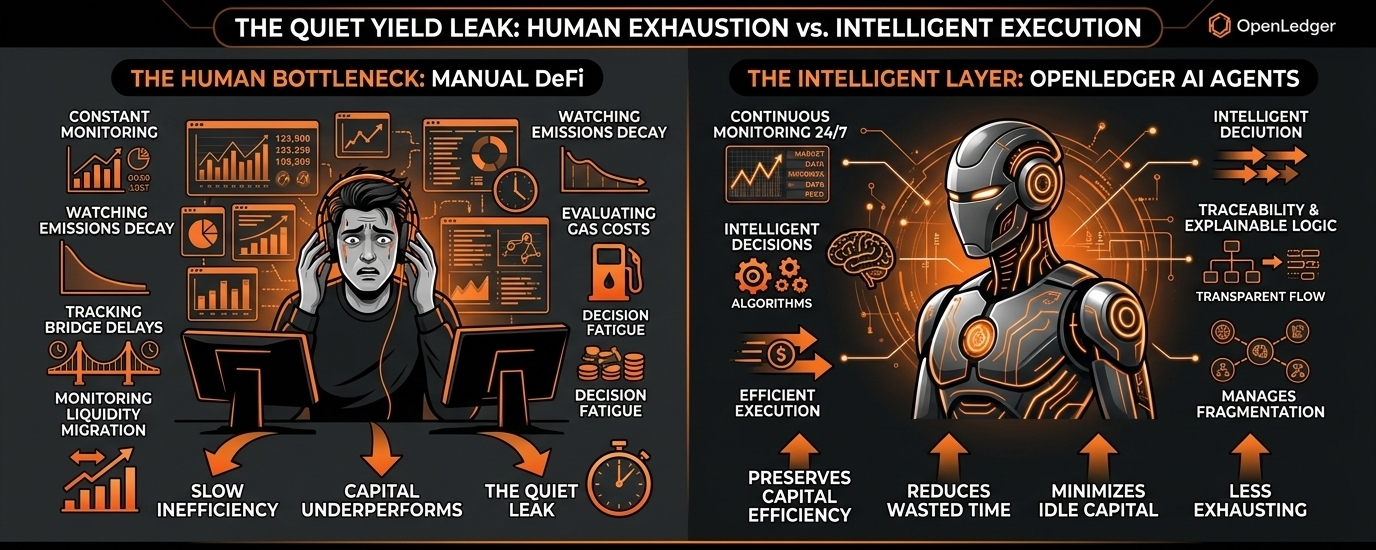
In reality, DeFi feels more like constant maintenance. You are checking APYs. Watching emissions decay. Monitoring stablecoin risk. Tracking bridge delays. Watching liquidity migrate from one chain to another. Trying to figure out whether the extra yield is real or just temporary incentives masking weak demand. Looking at gas costs and asking yourself whether moving funds even makes economic sense anymore.
Sometimes your capital is technically deployed, but it is still underperforming because the market moved faster than you did. That is the quiet leak nobody talks about enough. Not dramatic liquidations. Not catastrophic hacks. Just slow inefficiency. Slow decay. Capital sitting in yesterday’s opportunity while newer flows move elsewhere.
I have experienced this personally more times than I can count. There were periods where I spent more time managing positions than actually researching markets. You open five tabs just to understand whether moving from one vault to another is worth the cost. Then another protocol launches incentives. Another chain suddenly becomes active. Another pool starts attracting liquidity. By the time you finish evaluating one move, three new variables appear.
That is the hidden labor layer inside DeFi. And honestly, I think a lot of users quietly burn out from it. People like to say DeFi is permissionless. That part is true. What they forget to mention is that it also demands constant attention. The market rewards speed, awareness, and adaptability. If you stop paying attention for too long, your capital starts losing efficiency even without losing value outright.
That distinction matters. Because most users do not fail in one giant collapse. They fail slowly. A few missed rotations here. A few inefficient deployments there. Some idle stablecoins. Some outdated strategies. A vault that looked competitive two weeks ago but now barely justifies the exposure.
That is why the “yield leak” framing around OpenLedger actually makes sense to me. It points toward a real operational problem instead of inventing some abstract narrative nobody actually experiences.
The deeper issue is not yield discovery. Finding yield is easy. Twitter can show you yield. Dashboards can show you yield. Anonymous accounts can scream about yield all day long. The hard part is execution. The hard part is knowing when to move, whether the move still makes sense after fees, whether liquidity conditions changed, whether the reward is sustainable, whether the risk profile quietly worsened, and whether the opportunity still exists by the time humans react to it.
That is where things become difficult. And that is where OpenLedger becomes more interesting. Because the project seems less focused on “finding alpha” and more focused on improving how decisions get made and executed inside fragmented markets. That is a very different conversation.
Crypto has abused the words AI, agents, and automation so aggressively that I almost ignore them automatically now. Most projects use those terms like decorative labels. Add “AI” to the homepage. Mention autonomous systems. Show a futuristic diagram. Hope the market fills in the blanks emotionally. I have seen enough of that already.
But execution automation inside DeFi is at least grounded in a real use case. Because humans are becoming the bottleneck. The market moves continuously. Humans do not. That mismatch creates inefficiency.
A normal user sees a vault as a destination. An intelligent execution system sees it as a temporary state. Enter. Monitor. Compare. Exit. Rebalance. Evaluate conditions again. That sounds mechanical, but DeFi is already mechanical underneath the surface. The market does not care whether someone was busy at work, asleep, distracted, or emotionally hesitant. Liquidity shifts anyway. Incentives decay anyway. Opportunities disappear anyway.
The market keeps moving with or without human attention. That is why I think the next major evolution in DeFi may not be better yields themselves, but better execution systems surrounding those yields. And OpenLedger appears to understand that direction. At least conceptually.
The interesting part is not simply that agents could move funds automatically. The interesting part is whether those systems can make decisions intelligently while remaining explainable. That second part matters more than people realize. Because automation without transparency eventually becomes another black box. And crypto already has enough black boxes pretending to be innovation.
I am not interested in systems that simply say, “Trust the AI.” That sentence means nothing to me anymore. I want to know what data shaped the decision, what conditions triggered the move, what assumptions the model used, what risks were weighted, how liquidity depth was evaluated, whether fees were considered properly, and how strategies behave under stress conditions.
That is where most projects break apart. The theory always sounds smooth during favorable conditions. Reality becomes harder when markets get chaotic. What happens when the highest APY sits inside shallow liquidity? What happens when bridging delays destroy timing advantages? What happens when a profitable route on paper becomes inefficient after slippage and execution costs? What happens when incentives disappear faster than the model expected?
These are real problems. And honestly, they are the exact problems that make manual DeFi so frustrating already. That is why OpenLedger’s focus on attribution keeps pulling my attention back. Because attribution introduces accountability.
If agents are going to become part of financial execution, users cannot operate blindly. They need traceability. They need visibility into why something happened instead of just seeing the result afterward. Otherwise the system simply becomes another opaque machine selling convenience while hiding complexity underneath.
I think the strongest version of OpenLedger is actually much more grounded than the hype surrounding AI crypto. The strongest version is not some magical autonomous hedge fund replacing humans overnight. It is simpler than that. It reduces wasted time. It improves capital efficiency. It minimizes idle positioning. It helps users respond faster to changing conditions. It creates systems capable of monitoring fragmented opportunities more effectively than exhausted humans trying to manage twenty dashboards manually.
That alone would already solve a meaningful problem. Because the fragmentation problem inside DeFi is becoming worse, not better. Every cycle introduces more chains, more liquidity venues, more bridges, more vaults, more protocols, more strategies, and more complexity. The opportunity set expands faster than human attention can handle.
And eventually that creates a structural problem. Users are expected to behave like analysts, traders, risk managers, data researchers, bridge operators, macro observers, and security auditors simultaneously. That is not sustainable for normal people. Even experienced users leak efficiency constantly. Even good traders miss rotations. Even sharp participants get overwhelmed by the pace eventually.
I have felt that exhaustion personally. There are moments where DeFi stops feeling like investing and starts feeling like maintenance work. Constant monitoring. Constant comparison. Constant adaptation. You are not relaxing into strategy anymore. You are babysitting capital full-time. That is the part outsiders rarely understand.
And honestly, I think that exhaustion is one reason why many users quietly drift away from active DeFi participation after enough cycles. Not because they hate decentralization. Because the operational burden becomes too heavy.
That is why I think execution-focused infrastructure has a real opening now. Not because AI is fashionable. Because market complexity is becoming unmanageable manually. OpenLedger seems to be betting that the future operating layer of DeFi will involve systems capable of watching markets continuously, evaluating conditions, executing adjustments, coordinating data, and explaining decisions clearly enough for users to trust the process.
That is a meaningful thesis. But it is also a difficult one. Because crypto narratives are easy to launch and extremely difficult to sustain. AI narratives especially. The market has already been flooded with projects using artificial intelligence as decorative branding. At the same time, DeFi yield itself carries heavy skepticism now because users have already survived unsustainable emissions, collapsing farms, fake APYs, mercenary liquidity, broken vault strategies, and protocols that looked stable until they suddenly were not.
So OpenLedger walks into the market carrying two narratives people already distrust: AI and yield. That creates opportunity. But it also creates pressure. Because the project cannot survive on vocabulary alone. Eventually users will ask harder questions. Does execution actually improve? Does the system reduce friction meaningfully? Can it handle real market conditions? Can users verify decision logic? Can risks remain visible instead of hidden behind automation?
Those answers matter more than branding. I do not think OpenLedger needs to “revolutionize finance” to justify its existence. Crypto projects always overpromise because attention rewards grand claims. But honestly, reducing friction alone would already matter.
If the project helps users preserve efficiency, reduce idle capital, improve execution timing, and manage fragmented opportunities more intelligently, that already solves a real operational pain point inside DeFi. And real pain points matter more than narratives eventually.
That is why I keep coming back to the same question. Not whether OpenLedger sounds futuristic. Not whether AI remains trendy. Not whether the token narrative catches momentum. The real question is much simpler.
Can OpenLedger actually make DeFi feel less exhausting?
Because the quiet yield leak draining users every day is not really about APY. It is about attention. Human attention is becoming the weakest layer in decentralized finance. OpenLedger seems to understand that. Now the project has to prove it can build something strong enough to solve it.
@OpenLedger #OpenLedger #openledger $OPEN
