
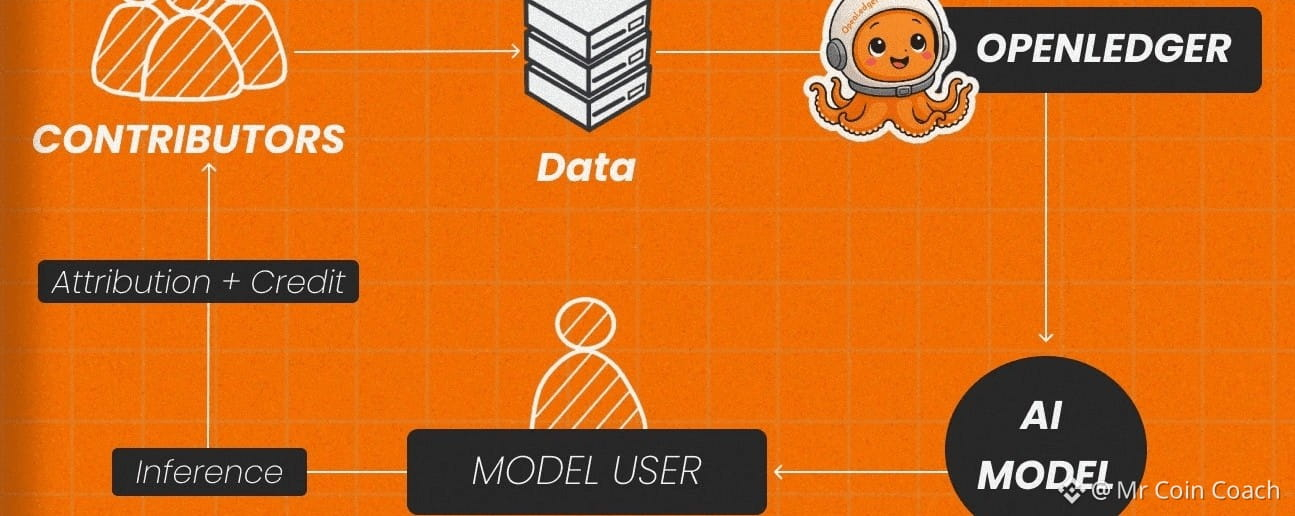
I didn’t come across OpenLedger (OPEN) through some big announcement or hype wave. It showed up in a quieter way, somewhere between curiosity and skepticism, and I remember thinking—this sounds like one of those ideas that either becomes obvious in hindsight or quietly disappears. What caught me wasn’t the “AI blockchain” label. It was the underlying tension it was trying to address. AI keeps producing value, but the people and data behind that value are mostly invisible. That imbalance has been sitting there for a while, and OpenLedger feels like an attempt to pull it into the open.
At its core, OpenLedger (OPEN) is trying to turn data, models, and even AI agents into economic participants. Not just tools that get used, but contributors that can be tracked, measured, and rewarded. That’s a subtle but important shift. Instead of treating data like raw material that disappears into a model, it treats it like something that leaves a footprint—something that can be traced back when value is created.
What makes this idea land, at least for me, is the focus on specialized data rather than chasing scale for the sake of it. There’s a tendency in AI to assume bigger always means better, but that’s not how things play out in real scenarios. The most useful systems are often trained on very specific, well-structured datasets. OpenLedger leans into that reality by building around domain-focused data networks, where contributions are intentional rather than random. It feels closer to how people actually work with AI, not how it’s marketed.
Then there’s the attribution layer, which is really where OpenLedger (OPEN) lives or dies. The promise is that if your data helps shape a model’s output, you should be able to prove it—and get rewarded for it. It sounds fair, almost obvious. But once you think about how AI models are trained, it gets complicated fast. Data isn’t used in isolation. It’s blended, refined, adjusted over time. By the time a model produces something useful, the original inputs are deeply intertwined. Measuring influence in that environment isn’t straightforward, no matter how confident the framework sounds.
And to be fair, OpenLedger doesn’t completely pretend otherwise. The way it approaches attribution—using different methods depending on the model—suggests an awareness that this isn’t a solved problem. It’s still evolving. That honesty, even if it’s subtle, makes the project more interesting than the ones that act like everything is already figured out.
At the same time, there’s a layer of overstatement that’s hard to ignore. Not in a dishonest way, but in that familiar way where a project stretches its potential impact a little too far. Fixing attribution is meaningful, but it doesn’t automatically fix everything around it. It doesn’t guarantee better models, or fair markets, or balanced outcomes. There’s a tendency to connect those dots too quickly, and OpenLedger (OPEN) occasionally drifts into that territory.
What sits in the background, and feels more important than the technical details, is how this kind of system might change behavior. Once data becomes something you can directly monetize, people don’t just share or contribute the same way anymore. Incentives shift. Quality might improve, but it might also become more strategic, more calculated. And if rewards are tied to measurable impact, then the people with access to high-quality datasets are naturally going to have an advantage. That doesn’t break the system, but it does shape who wins inside it.
I keep coming back to the idea that OpenLedger (OPEN) isn’t really about technology as much as it’s about visibility. It’s trying to make the invisible layers of AI visible—who contributed, what mattered, where the value came from. That’s a meaningful direction, even if the execution isn’t perfect yet.
Because right now, AI runs on a kind of quiet imbalance. Value shows up at the top, while contributions stay scattered and unrecognized underneath. OpenLedger doesn’t completely resolve that tension, but it does force it into the conversation in a way that’s harder to ignore. And sometimes that’s where real shifts begin—not with a perfect system, but with a clearer view of what was always there.
