

null
Author: Select-Leading-4542
Compiled by: Deep Tide TechFlow
Recently, the Reddit stock community r/stocks has sparked a heated discussion — as AI infrastructure stocks led by Nvidia (NVDA) have completed their main wave, more and more investors are starting to focus on the application layer companies that are truly turning AI into profit, believing that a new rotation is quietly unfolding.
The targets frequently mentioned in this discussion include:
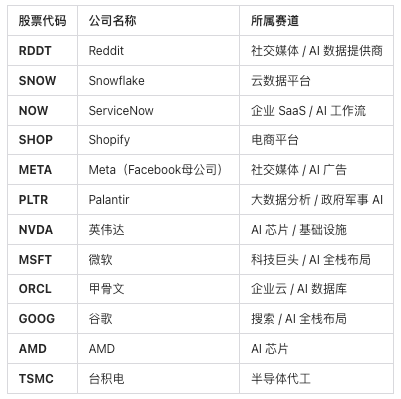
Original post:
NVDA and all AI infrastructure stocks have clearly completed their major pump.
I'm starting to wonder if capital is finally rotating towards those companies that are genuinely leveraging AI to boost their profit margins.
Currently focusing on RDDT, SNOW, NOW, and SHOP.
RDDT is clearly in a core position as a data provider; the fundamentals indeed look strong. SNOW's wild spike post-earnings shows the market is very bullish on its new AI products. NOW and SHOP are both aggressively integrating AI into their platforms—purely from a chart perspective, both look like solid rebound patterns.
What other assets on your watchlist align with this logic? Any worth diving deeper into?
Some representative replies in the comments:
DeathStar_81 (10 hours ago): RDDT is literally breaking out right now. The fundamentals are too strong to hold back. 70% revenue growth, 90% profit margin, PEG ratio below 1.
Ambitious_Traffic530 (11 hours ago): Reddit has jumped a lot these days, is it still worth buying now or waiting for a dip?
tobybells: Reddit has been bouncing within the same range—after dropping from 120-130, it consolidated around 140-150, then surged to 160-170. Buying at any point in this range is viable. I’m holding RDDT long-term, 2000 shares, with a cost basis of 170, so you're getting in cheaper than I did.
ShowerMotor (12 hours ago): Call me conservative, but I still think the second wave is semiconductors, and the third wave will be hyperscale cloud firms and Mag7... boring stuff. I plan to shift most of my positions into Nasdaq 100 next year and hold until who knows when.
AloneStaff5051 (11 hours ago): To add context: all LLM models are trained using Reddit data. Anthropic and Perplexity have not paid, and there’s clearly a lawsuit ongoing against them.
PotatoAjacent104937 (12 hours ago): If you're following this logic, Palantir should be on your list. I hold Palantir, but I feel the adoption of their government contracts is slowing. Last earnings saw government revenue up 84% YoY and commercial revenue up 133% YoY.
Last year it felt like there was a headline about a new Palantir contract every day, but the numbers don't lie!
Zipski577: Defense/AI spending is increasing every year, and Palantir's share is also growing. I used to think the commercial side was the biggest opportunity and was seriously overvalued, but after diving into government contracts and historical data, a target price over $200 looks very realistic.
Hoosier2016: META too. Their AI-assisted ad targeting is already very profitable.
🔴 Bull camp summary: RDDT is the strongest logic this wave.
The discussion on Reddit (RDDT) is the hottest in the community, with bulls focusing on its data moat—all major LLMs have apparently used Reddit data for training, while companies like Anthropic and Perplexity haven’t paid, and related lawsuits are ongoing. Supporters argue that:
70% YoY revenue growth, gross margin reaching 90%, PEG ratio close to or below 1, still severely undervalued.
As LLMs infiltrate the e-commerce scene, Reddit, as the 'trust layer of real human feedback,' will continue to see its data value rise.
The stock price is currently oscillating in the 140-170 range, with technical signals indicating potential upward breakout.
Focus of the divergence: Just how deep is the data moat of Reddit?
Some investors are also taking a reserved stance, believing that more data doesn't equate to higher quality; many new models have pivoted to fine-tuning small language models (SLMs) on existing datasets, and the reliability of Reddit content is questionable, with their bargaining power against big tech overestimated.
For example:
TyrannosPyros (8 hours ago): I’ve completely liquidated my RDDT position because it performed poorly, making it hard for me to funnel more cash into AMD and TSMC. The data moat has been seriously exaggerated. Most new models are just fine-tuning LLMs based on existing datasets. They have decent ad revenue, but I don’t think they have much bargaining power against the big tech players.
Fireballsdude: I really don't get why some folks think that just because LLMs have scraped existing datasets from Reddit, it means fresh data supply isn't important anymore. LLMs aren't just enterprise-focused; they’ll also venture into e-commerce, serving as another monetization avenue for these massive investments.
🟢 Other hot asset perspectives
META: AI-assisted ad targeting has significantly boosted monetization efficiency, with some investors feeling the market has overly punished it due to metaverse failures and high CapEx, presenting undervaluation opportunities.
Palantir (PLTR): The latest earnings report shows government revenue up 84% YoY and commercial revenue up 133% YoY; the numbers are strong, but some investors feel the sentiment doesn’t match the news buzz.
Snowflake (SNOW): Stock skyrocketed over 30% in a single day post-earnings, with AI data products gaining market recognition, but some lament ‘I got in too late.’
Semiconductors and hyperscale cloud players: Some old-school investors think the second wave will still be semiconductors, and the third wave will be for the likes of Google, Apple, etc. (Mag7); they suggest directly buying the Nasdaq 100 for long-term hold.
From a professional perspective, how does the options market view this wave of rotation?
A user in the comments provided a more professional analysis from a volatility surface perspective: Infrastructure stocks (like Nvidia and Dell) experienced volatility compression post-earnings, and the market has reached a consensus on CapEx expansion direction.
The uncertainty of application-layer assets (RDDT, SNOW, SHOP) is two-sided; the implied volatility structure isn’t skewed upwards like infrastructure stocks. So instead of using options for leverage on application layers, it’s cleaner to just buy these stocks directly.
This discussion reflects the core divergence in the current market: the money in AI infrastructure has already been made, so where’s the next ten-bagger?
Most participants lean towards believing the monetization logic of the application layer is gradually becoming clearer, but the catalysts haven't fully materialized yet. RDDT, with its unique data assets, has become the most watched asset, while META and Palantir gain more fundamental support due to their already implemented AI monetization capabilities.