
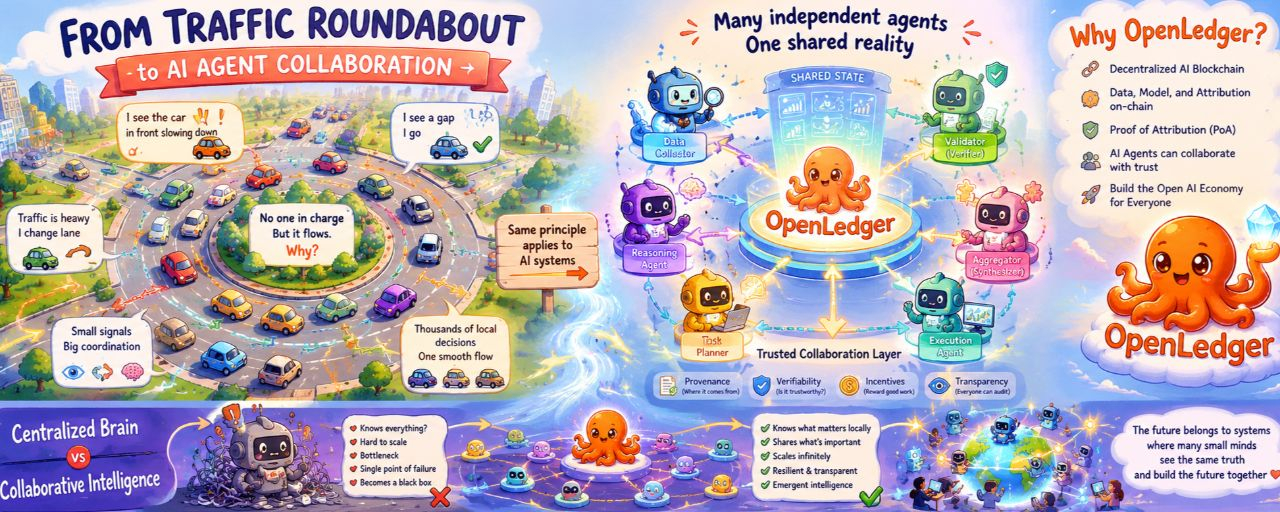
This afternoon I got stuck at a pretty crowded roundabout
Interestingly, there were no traffic police regulating
No one tells each car where to go
Yet the traffic keeps moving continuously
When the car in front brakes, the car behind slows down
When one lane starts to crowd, some cars automatically change direction
Whenever a gap appears somewhere, someone immediately fills it
From above, the whole flow of cars looks like a giant school of fish continuously changing formation
Initially, I thought what made the roundabout work was that everyone followed traffic rules
But then I realized traffic rules are quite similar everywhere
So why are there places where traffic operates smoothly while others experience prolonged congestion, even with the same set of rules?
What’s notable might not be the rules
But it's how drivers continuously see and react to each other
No one needs to know the entire traffic situation of the city
No one needs a display showing the location of all vehicles
Each person only needs to see a few signals right in front of them
The car in front is accelerating or decelerating
The gap next to it is either opening or closing
The traffic in front is either starting to bunch up or spreading out
From those tiny signals, thousands of local decisions are made simultaneously
And somehow, order emerges
This reminds me of how organizations operate
When working alone, we often make decisions quite quickly
But when you combine many people into an organization, the overall speed often decreases significantly
A small task can sometimes take days just for departments to update each other
Initially, I thought the cause was capability
Later on, I thought maybe the issue lies elsewhere
Most of the time is not spent solving the work
But to synchronize the perception of the task
Marketing is seeing a part of the system
The product is seeing another part
The technique sees another part of the puzzle
No one really sees the whole picture
And the more participants there are, the higher the cost to keep everyone looking at a common picture
In a sense, organizations aren't slow because people lack capability
Organizations are slow because the system's state is fragmented
Everyone is making decisions based on slightly different versions of reality
When I read more about multi-agent AI systems, I feel like they are facing the same problem
Most of today's AI race focuses on building larger and larger models
An AI that knows more
Stronger reasoning
Able to handle more tasks
But the more I think about it, the more I feel this might not be the most critical bottleneck
Because in the real world, very few large-scale systems operate with a central brain that knows everything
The internet doesn't work that way
Traffic doesn't operate that way
The financial market doesn’t operate that way either
Most complex systems exist thanks to the coordination among many independent components
Perhaps AI will eventually follow a similar path
That's why I pay attention to the way m-97 thinking and problem-solving approaches
What’s interesting isn’t about creating another stronger AI model
It's all about building the infrastructure so that agents can collaborate reliably
When an agent collects data
Another agent validates
Another agent performs reasoning
Another agent synthesizes results
What matters isn't the capability of each individual agent anymore
But the ability to maintain a common state that everyone can rely on
Without that, a larger network becomes increasingly harder to understand
Decisions will be made continuously, but no one knows where they come from
Data will be transmitted continuously, but no one knows if it's still trustworthy
The speed can increase
But the ability to coordinate diminishes
And that’s when the whole system starts to become a black box
What fascinates me the most is that the traffic roundabout initially seemed unrelated to AI
But in reality, both are addressing the same problem
How can so many independent agents act together without a central controller?
The next advantage of AI might not belong to the system with the biggest brain
That belongs to the system that allows many small brains to see a shared reality 🤙
#openledger $OPEN $XLM $BNB