
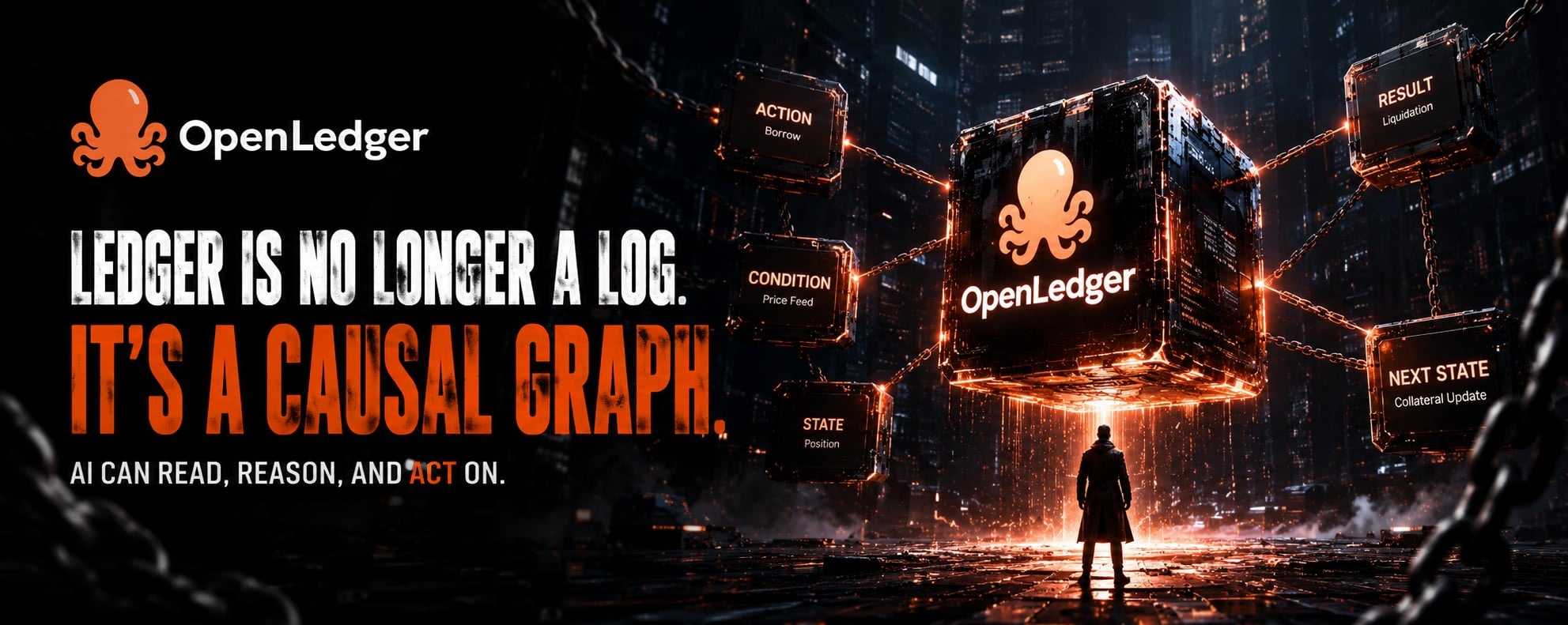
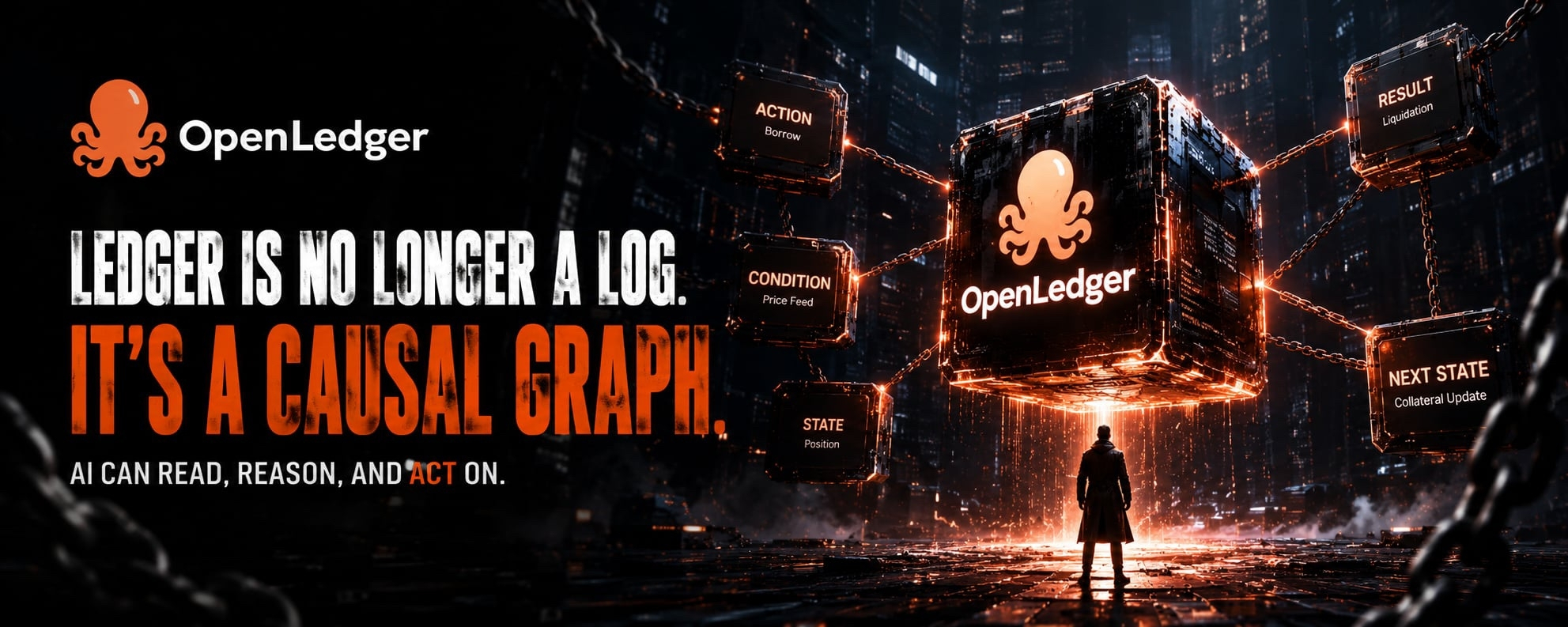
The summer break of 2026 officially begins. Everyone is out having fun, while I reopen a state on OpenLedger to mess around and see something very strange: instead of the familiar transaction lines, the system starts displaying them as a chain of “reasons leading to outcomes.” The same data, but the way it's read is no longer like a ledger. It resembles a story that is explaining itself.
This kept me stuck for quite a while. From what I've learned, in most financial systems, the ledger is just a recording place. A list of transactions organized by time, enough for an audit but not enough to understand. Humans can infer context, but machines cannot. Raw transactions are essentially just discrete points, lacking the structural links between actions and outcomes.
Right now, I'm starting to think about OpenLedger in a different way. Maybe the issue isn't about recording more data but that the current data is too “silent.” It logs what happens, but it doesn't encode why it happens and, more importantly, it doesn't represent how one action leads to another in the financial chain.
In AI-native finance, this becomes a clearer boundary. An agent can read transaction history, but if it doesn't understand the causal relationships between financial actions, it's only seeing the surface of the system. It knows “what happened,” but it doesn't know “what led to that” and “what that will lead to.”
For me, OpenLedger right now is no longer just a ledger system. It's transforming ledger systems into AI-readable financial narratives. Not narratives in the sentimental storytelling sense, but a structure where each financial action is not just a record but an event node with state context, tied to a directed causal graph. In this structure, the relationships between actions are represented as dependencies, rather than just chronological order.
In other words, the ledger is no longer a linear log, but has become a state-transition graph with semantics for machine reasoning in finance. When this structure is applied to each financial action, the meaning of each line of data starts to change completely. A line of liquidity movement is no longer standalone but is understood as the result of many prior conditions, while also being the cause of subsequent states.
The important thing that everyone knows is that AI doesn't just need data. It needs structure to infer actions. That structure can't just be timestamped records. It has to be a financial causal graph, where each node is not just a transaction, but an action with context, premises, and consequences in the same financial reality that agents share.
I think of a pretty clear metaphor: if the traditional ledger is like a disjointed notebook of each moment, OpenLedger is like a network where each trace is not only recorded but also linked together by invisible lines of reasoning.
But more importantly, the difference isn't just in being “connected.” It lies in the fact that every connection must be understood in the same way. If the traditional ledger allows multiple interpretations to coexist, OpenLedger is moving towards a form of alignment of understanding — where data is not only shared, but the interpretation of data is also standardized into a common logic that all agents must traverse.
At that point, the financial reasoning of AI isn't just about reading back transaction history, but about interpreting a system of cause, effect, and constraints that are self-linking into a unified action space.
From my perspective, OpenLedger is no longer just an improvement in financial data storage. It's redefining the essence of the ledger: from passive recording to a narrative structure that AI can directly infer, where financial actions must converge towards a common understanding.