
Not the kind users complain about when a chatbot forgets a detail from three messages ago. This one is bigger. Messier. More expensive.
Every useful AI system is built on somebody’s work. Data scraped from somewhere. Code written by someone. Research papers, forum posts, expert notes, open-source libraries, product manuals, labeled examples, customer support logs, fine-tuning datasets, feedback loops. It all goes into the machine.
Then the machine starts producing value.
And the people behind that value? Usually invisible.
That is the uncomfortable opening OpenLedger is trying to exploit.
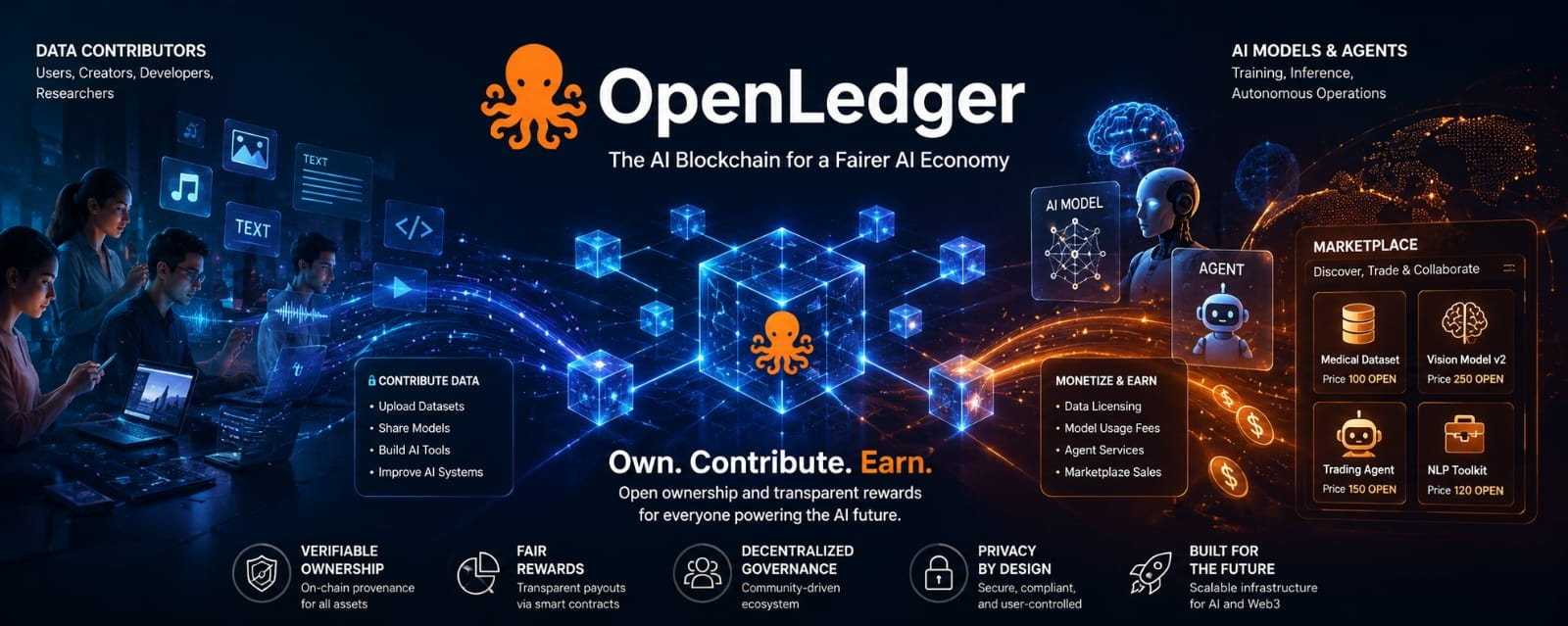
OpenLedger, known by its token ticker OPEN, is pitching itself as an AI blockchain built to unlock liquidity for data, models, and agents. Strip away the usual crypto gloss and the idea is fairly direct: if your data, model, or agent helps an AI system create value, there should be a way to prove it and pay you.
Simple sentence. Brutal problem.
I’ve watched enough tech cycles to know that “AI plus blockchain” usually deserves suspicion before applause. Many projects in this corner of the market are just narrative engineering: take the hottest technology, bolt it to a token, write a manifesto about ownership, and hope the market does the rest.
OpenLedger is at least aiming at a real wound.
The AI economy has an attribution problem. Models are trained on oceans of information, but the value chain behind those outputs is mostly opaque. The platform gets the user. The company gets the subscription revenue. The infrastructure provider gets paid. But the dataset contributor, the domain expert, the model tuner, the creator, the researcher, the small developer — they often vanish into the fog.
OpenLedger wants to make that fog billable.
Its central idea is “payable AI.” That means AI systems should not only generate outputs; they should also preserve a record of the inputs and contributions that helped produce them. If a dataset improves a model, the contributor should have a route to compensation. If a specialized model is used repeatedly, its builder should be able to monetize it. If an AI agent performs useful work using multiple data and model sources, the economic trail should not disappear.
That trail is where Proof of Attribution comes in.
Proof of Attribution is OpenLedger’s attempt to answer a question most AI companies would rather keep fuzzy: whose work shaped this result?
That sounds clean on paper. In practice, it is a knife fight.
AI models do not behave like neat accounting ledgers. You cannot always point to one paragraph, one document, or one dataset and say, “This created that answer.” Models absorb patterns. They generalize. They memorize sometimes. They hallucinate. They compress massive amounts of information into statistical relationships that even their builders can struggle to explain.
So yes, attribution is hard.
Very hard.
But it is also becoming unavoidable.
The next phase of AI will not be built only on giant general-purpose models. Those matter, of course. But the more interesting commercial work is happening in narrower lanes: legal AI, medical education, financial analysis, customer support, enterprise knowledge systems, developer tools, compliance engines, autonomous agents. These systems need specialized data. Clean data. Licensed data. Data with provenance.
That last word matters.
Provenance is the difference between “the model said so” and “we can show where the knowledge came from.” In casual consumer AI, people may tolerate fuzzy sourcing. In hospitals, courts, banks, and regulated industries, fuzzy sourcing becomes a liability.
Here’s the catch.
Most companies do not want to open their data pipelines. They like control. They like owning the user relationship. They like keeping contributors far away from revenue. Corporate ego is not a bug in this system; it is part of the operating model.
OpenLedger is pushing against that.
The project’s Datanets are meant to function as structured networks for useful data. Think of them as specialized data pools built around a domain or purpose. Healthcare data. Legal data. Education material. Financial research. Technical documentation. Instead of dumping everything into one giant model and hoping for the best, OpenLedger’s approach tries to organize data into traceable, usable networks.
That is the good version.
The ugly version is obvious too. Open contribution systems attract junk. Duplicated files. Stolen material. Low-quality spam. Questionable licensing. Private information someone had no right to upload. Anyone who has spent time around open platforms knows the pattern. Incentives bring builders. They also bring parasites.
If rewards exist, people will game them.
That is not cynicism. That is Tuesday.
So OpenLedger’s challenge is not just building a blockchain. The real challenge is building a system that can separate valuable contribution from noise. It needs filtering, validation, reputation, dispute handling, and probably a lot of boring governance work that never looks exciting in a pitch deck.
Then there are models.
OpenLedger is not only focused on raw data. It also wants models to become monetizable assets. A specialized model trained on high-quality legal data, for example, could be valuable to law firms, compliance teams, or contract platforms. A medical education model could serve students or institutions. A support model trained on product documentation could help companies reduce ticket volume.
That makes sense.
But model marketplaces are messy. Developers have different standards. Evaluation is inconsistent. Benchmarks can be gamed. One model works beautifully in a demo and collapses the moment real users start asking weird questions. Bugs appear. Latency spikes. Costs creep up. Documentation goes stale. Someone updates a dependency and breaks the pipeline.
This is the part most marketing pages skip.
OpenLedger talks about tools such as Model Factory and OpenLoRA to make model creation and deployment easier. That could matter because the people with the best domain knowledge are often not machine-learning engineers. A teacher may have excellent educational content. A doctor may understand a rare clinical niche. A lawyer may have carefully annotated contract examples. A manufacturer may have years of troubleshooting records.
Those people should not need to become GPU infrastructure experts just to participate in AI.
But “easy model-building” is a dangerous promise. No-code tools can lower the barrier, but they cannot remove the need for judgment. Bad data still produces bad models. Poor evaluation still creates false confidence. A slick interface does not fix weak methodology.
The real kicker is agents.
AI agents are where OpenLedger’s idea becomes more interesting — and more chaotic.
A chatbot answers. An agent acts.
An agent can search, compare, summarize, call APIs, trigger workflows, monitor information, prepare documents, and coordinate tasks across systems. Once agents become common, they will constantly consume data and model services behind the scenes. One agent might use a finance dataset, call a risk model, summarize filings, and generate a recommendation. Another might use legal data, review a contract, and produce suggested edits. A third might use technical manuals to troubleshoot a machine.
Who gets paid in that chain?
That question is going to matter.
If agents become economic actors, the infrastructure around them needs memory. Not emotional memory. Transactional memory. A record of which data was used, which model was called, which contributor added value, and where payment should flow.
OpenLedger wants to be that record layer.
Not the brain. The ledger.
That distinction matters because some people misunderstand blockchain’s role in AI. The chain does not make the model smarter. It does not magically improve the data. It does not solve hallucinations by existing. What it can do, if designed well, is provide a shared settlement and provenance layer for AI activity.
That is useful. Potentially.
But only if people actually use it.
This is where many protocols die. Not because the idea is stupid, but because the ecosystem never arrives. Developers are busy. Enterprises are slow. Users do not care about architecture unless it solves pain. Founders underestimate integration headaches. Investors push for token momentum before product maturity. Communities get impatient. Governance becomes theater.
I’ve seen this pattern before.
A protocol can have the right thesis and still lose to friction.
OpenLedger has to prove several things at once. It has to prove that attribution can work well enough to be trusted. It has to prove that high-quality data contributors will show up. It has to prove that model builders can create useful products on top of the system. It has to prove that agents need this kind of payment and provenance layer. And it has to do all of that while navigating token volatility, regulatory pressure, and the usual developer chaos.
No small lift.
The regulatory side could get especially nasty. Data monetization is not a playground. If someone contributes copyrighted content, private medical information, leaked business records, or personal user data, who is responsible? The uploader? The protocol? The application using the data? The model builder? The end user?
Lawyers will have fun with that.
Builders will not.
This is why serious AI-data infrastructure needs more than ideology. It needs permissions, licenses, audit trails, removal mechanisms, compliance design, and a mature approach to privacy. “Decentralized” does not mean “immune from consequences.”
Still, OpenLedger’s timing is sharp.
AI companies are facing increasing pressure over training data. Creators want compensation. Enterprises want explainability. Regulators want accountability. Developers want alternatives to closed platforms. Users are beginning to question black-box outputs. The old model — scrape everything, train privately, monetize aggressively, explain later — is getting harder to defend.
OpenLedger is trying to offer a different bargain.
Contribute value, keep attribution.
Build models, monetize them.
Deploy agents, track their economic activity.
Use blockchain not as decoration, but as the accounting layer for AI work.
That is the pitch.
Whether it becomes real depends on execution.
The OPEN token sits inside that system as the economic unit for gas, incentives, governance, and contributor rewards. That gives it a functional role, but it also introduces the usual crypto distortion field. Token markets are noisy. Prices move on hype, listings, liquidity, unlocks, macro sentiment, and whatever influencers decide to shout about that week.
A rising token does not prove product-market fit.
A falling token does not automatically kill the technology.
You have to separate the casino from the construction site.
The construction site is what matters here. Are real Datanets forming? Are they useful? Are models being trained from them? Are people using those models? Are rewards being distributed in a way contributors find credible? Are developers building because OpenLedger solves a real problem, or because there is a token campaign running?
Those are the questions worth asking.
The best version of OpenLedger is not a vague “AI ownership” slogan. It is a working market for traceable AI inputs and outputs. A place where specialized data has value, models can be monetized, agents can transact, and contributors are not erased from the final product.
The worst version is also easy to imagine. A noisy token ecosystem filled with low-quality data, thin models, inflated claims, governance drama, and very little real usage.
Both futures are possible.
That uncertainty is what makes it interesting.
OpenLedger is not trying to solve a fake problem. The AI economy really does need better attribution. It really does need better ways to compensate contributors. It really does need provenance if AI is going to move deeper into serious industries. And it really does need infrastructure for a future where agents interact with data, models, and payment systems without humans manually tracking every step.
But ambition is cheap.
Execution is where the bodies are buried.
OpenLedger will have to survive bugs, spam, scaling problems, regulatory headaches, corporate resistance, funding pressure, and the brutal indifference of developers who only care whether the thing works. The project has a compelling thesis, but compelling theses do not ship reliable infrastructure by themselves.
The bottom line?
OpenLedger is worth watching because it asks one of the most uncomfortable questions in AI: when intelligence is built from everyone’s work, who gets paid?
That question is not going away.
