
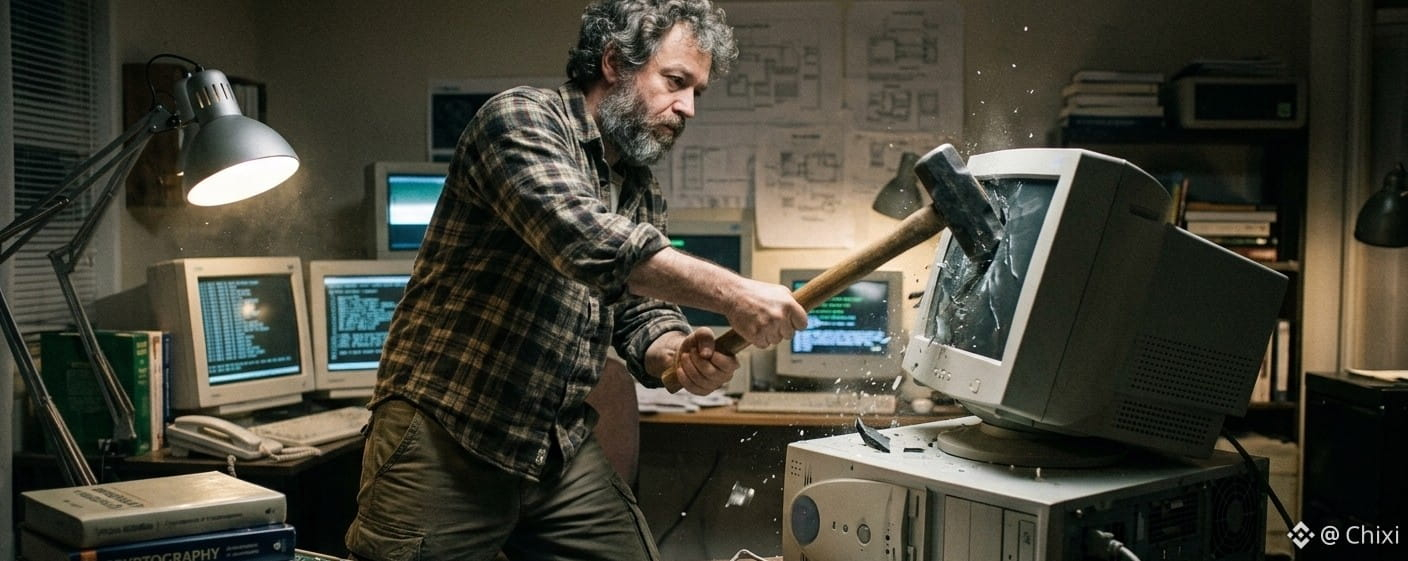
How Julian Assange's decision almost wrecked a world-changing project, and why Satoshi chose to vanish for good.
Nobody believed in Bitcoin back then.
2008. The world was on fire due to the global financial crisis.
Amidst the wreckage, someone (or a group of people) using the alias Satoshi Nakamoto published a white paper: "Bitcoin: A Peer-to-Peer Electronic Cash System."
The crypto community is feeling super bearish.
Not without reason. Before Bitcoin, dozens of digital currency projects tried and failed (DigiCash, b-money, Bit Gold). Crypto experts were already fed up with big claims that ended in disaster.
But this time, something was different.
Nick Szabo, architect of the Bit Gold concept. Hal Finney, veteran cryptography developer who received the first Bitcoin transaction in history. Adam Back, creator of Hashcash, which became the foundation of Bitcoin's proof-of-work algorithm. They saw something that others missed.
Satoshi didn't just write code. He built a community.
The Bitcointalk forum became the headquarters. Satoshi was actively present discussing, explaining, answering complex technical questions with extraordinary patience. Bugs were reported. Bugs were fixed. Trust was built one commit at a time.
This project is growing organically. Slowly. Cautiously.
Too cautious, it turns out, to face what was soon to come.
WikiLeaks and the Bomb that Exploded
April 5, 2010
WikiLeaks released a video titled "Collateral Murder."
Footage from a US military helicopter in Baghdad, 2007. It is clear: US forces shoot at civilians, including two Reuters journalists, while laughing at the fallen victims.
The world is shaken.
Julian Assange (founder of WikiLeaks) suddenly became public enemy number one for the US government. Not just because of that video. WikiLeaks then leaked hundreds of thousands of secret US diplomatic documents known as Cablegate, resulting from cooperation with Chelsea Manning, a US military intelligence analyst.
Washington's reaction: brutal and systematic.
All of WikiLeaks' bank accounts were blocked. Visa, Mastercard, PayPal, all stopped services to WikiLeaks under pressure that was never officially acknowledged. Donations from all over the world could not come in.
WikiLeaks needs a solution. They found Bitcoin.
For the first time in history, Bitcoin has a real and very public use case: breaking the financial blockade of a superpower.
Satoshi Read Everything
On Bitcointalk, the community was excited.
This is a validation moment. Proof that Bitcoin is not just an academic experiment. One user even explicitly proposed that WikiLeaks actively use Bitcoin. Another user excitedly said: "bring it on!"
Satoshi read everything.
His response did not contain euphoria. Right on December 5, 2010, he wrote on Bitcointalk:
"No, don't 'bring me in.' The project needs to develop gradually so that the software can be strengthened over time. I make this plea to WikiLeaks not to try to use Bitcoin. Bitcoin is a small beta community still in its early stages. You will get no more than pocket change, and the pressure you cause may destroy us at this stage."
~ Satoshi Nakamoto, Bitcointalk, 5
Clear. Firm. Fearful.
Not because Satoshi lacks sympathy for WikiLeaks' struggle. Rather, because he understood something that the community didn't grasp: Bitcoin in 2010 was an incredibly fragile project. Its network was small. Its code had not been tested in a real-world large scale. A coordinated attack from the US government could end it all overnight.
Yet WikiLeaks continued to receive Bitcoin donations.
And the media started to cover it.
The Hornet's Nest Stirred
A few days later, an article was published in PC World titled: "Could the WikiLeaks Scandal Lead to New Virtual Currency?"
Bitcoin is now on the mainstream media's radar. For the first time.
And Satoshi wrote his follow-up comment about WikiLeaks on Bitcointalk:
"It would be nice to get this attention in another context. WikiLeaks has stirred the hornet's nest, and the swarm is heading our way."
~ Satoshi Nakamoto, Bitcointalk, December 11, 2010
Those thirteen words, "The swarm is heading our way," contain everything that needs to be known about what Satoshi felt at that moment.
Not pride. Not euphoria. A very real fear.
The Gavin Andresen factor
Just when external pressure was mounting, news came from within the community itself.
Gavin Andresen, one of Bitcoin's trusted contributors, a developer who even created a Bitcoin Faucet and filled it with 10,000 BTC from his own pocket to introduce Bitcoin to the public for free, publicly announced on Bitcointalk that he would meet with the CIA to present Bitcoin technology.
For Satoshi, this is a critical point.
Gavin is not a bad guy. He is a dedicated developer. However, that CIA announcement put Satoshi in a position he couldn't tolerate.
Imagine Satoshi's position at that time:
His identity is anonymous, kept under tight wraps.
He created a tool that is now used by organizations being hunted by the FBI and CIA.
And now, his community peers will meet directly with US intelligence agencies to "explain" how the technology works.
In the cypherpunk tradition, this is not just discomfort. This is an existential threat.
Last Post on Bitcointalk
December 12, 2010.
Satoshi wrote his last post on Bitcointalk. Not about WikiLeaks. Not about the CIA. Not about his fears.
About unfinished technical work:
"There's still work to do on DoS, but I'm making an early version of what I've created so far, just in case it's needed, before trying more complex ideas. The version I've made is 0.3.19."
~ Satoshi Nakamoto, Bitcointalk, December 12, 2010
Professional until the last word.
He did not say goodbye. Did not give a speech. Did not write a dramatic farewell manifesto. Just a technical note about denial-of-service protection, and then, total silence from any public forum.
The Last Message Ever
Months passed. Satoshi still occasionally communicated privately with a few core developers.
Until April 23, 2011.
Mike Hearn, the developer who built BitcoinJ, the implementation of Bitcoin in Java, emailed Satoshi asking if he planned to return to the community. Satoshi replied:
"I've moved on to other things. Now everything is in the right hands with Gavin and everyone else."
~ Satoshi Nakamoto, email to Mike Hearn, April 23, 2011
A few days later, Satoshi sent a separate email to Gavin Andresen, handing over the Bitcoin network's alert key: the cryptographic key that allows anyone who holds it to broadcast emergency alerts to the entire network.
This is not just a handover of the project. This is a systematic self-erasure.
Gavin now holds the keys. Satoshi no longer has anything tying him to Bitcoin.
And then there's a detail that feels too big to be a coincidence: on April 27, 2011, one day after Satoshi handed over the alert key, Gavin announced he would speak at CIA headquarters in June.
Satoshi disappeared just before that announcement.
The Unrecoverable Wallet
This is the part that is rarely discussed seriously.
In 2009–2010, Bitcoin Core did not recognize the concept of a seed phrase. There were no 12 words to be written down. No BIP-39. No mnemonic phrases that could be laminated and stored in a safe.
All that existed was one file: wallet.dat, an encrypted database containing the private keys. Nothing more, nothing less.
Electrum only introduced the concept of a seed in 2011, with their proprietary format (1,626 words, not a universal standard). BIP-39, the seed phrase standard now used by almost all wallets, was only published in 2013. To this day, Bitcoin Core does not use BIP-39.
Meaning: at the time Satoshi disappeared, the only way to secure Bitcoin was to physically store the wallet.dat file.
Now imagine replaying the scenario honestly:
You are the person who created the tool now used by the FBI and CIA's primary targets. Your identity is anonymous, but digital forensic investigations are becoming more sophisticated every day. Your trusted associate is meeting with the CIA next month. You hold about one million Bitcoins, worth ±$230,000 at that time, stored in a digital file on your computer.
What do you do?
For a cypherpunk who understands how digital forensics work better than anyone else, the answer is not "hide." Not "encrypt stronger." Not "copy to a flash drive."
The answer is: destroy everything.
Because in 2010, $230,000 meant nothing compared to freedom. And Satoshi knew very well that storing wallet.dat in any form, anywhere, was a risk not worth taking for his life.
Why Those Coins Will Never Move
If one day Satoshi's wallet moves, there are only two possibilities that are worth considering seriously:
First: Satoshi is still alive, still holding the original wallet.dat, and decides to reemerge after more than 15 years, a scenario that becomes increasingly absurd each year.
Second: Someone successfully ran Shor's algorithm on a quantum computer with enough capacity to break the elliptic curve secp256k1 (ECDSA-256), specifically on early P2PK addresses, where the public key was directly exposed on the blockchain without a hash protection layer.
For the second scenario: the best quantum computer currently available, IBM Flamingo with around 4,158 physical qubits in a multi-chip configuration, only has about 0.032% of the physical capacity needed (estimated ±13 million physical qubits for a 1-hour attack, based on Webber et al., 2022).
NIST estimates that quantum computers capable of threatening ECDSA-256 won't exist until 2030–2040. That is, if technological development goes according to the roadmap. The barriers are not just the number of qubits, but three technical layers that must be solved simultaneously: the number of physical qubits, fidelity per qubit, and coherence time.
Those coins are silent. It's been over 16 years. And most likely, they will remain silent forever, not because they are guarded, but because the keys may no longer exist.
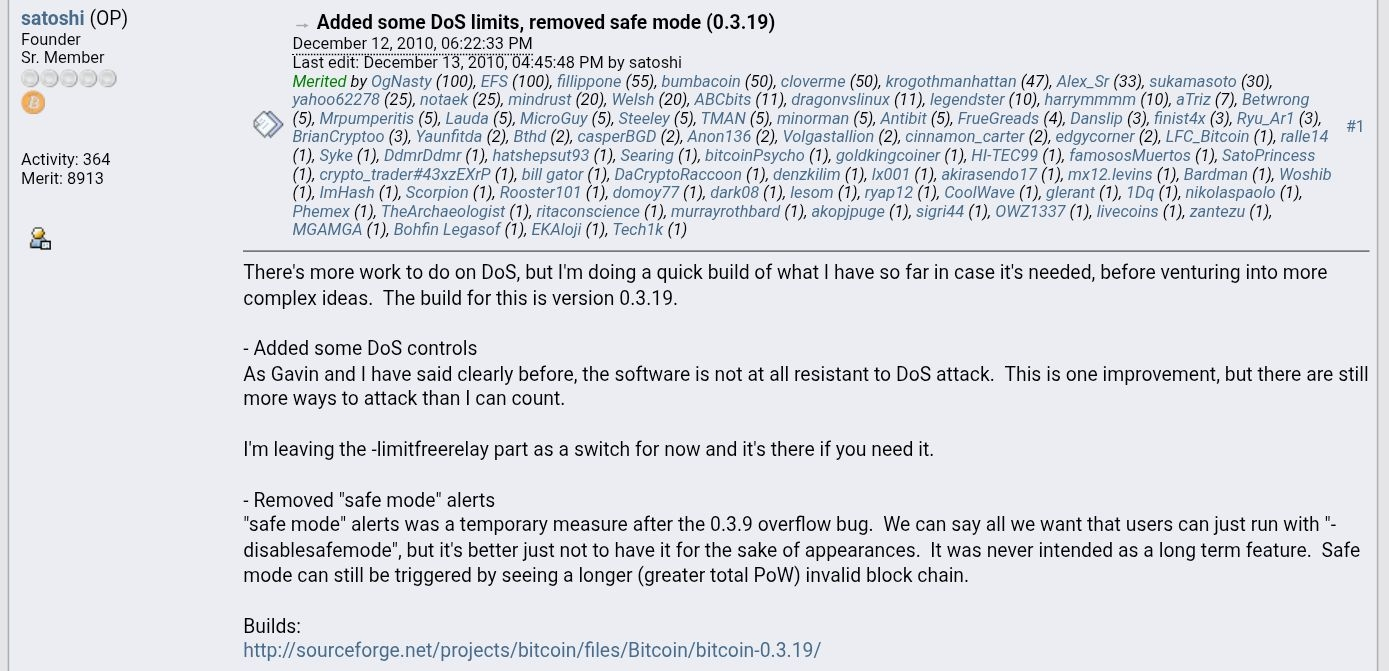
Satoshi Nakamoto's last post on Bitcointalk.
At the time this article was written,
Julian Assange was finally freed in June 2024, after 12 years of asylum in the Ecuadorian Embassy in London and 5 years in Belmarsh prison, UK. Through a plea deal with the US Department of Justice. He returned to Australia as a free man.
Chelsea Manning was released early in 2017, after President Obama commuted her sentence.
Bitcoin, which in December 2010 traded at $0.23 per coin, is now an asset with a trillion-dollar market cap.
Dan Satoshi Nakamoto? Nobody knows.
Perhaps he is watching all of this from somewhere, without a single Bitcoin that he ever mined. Or maybe there's nothing left to watch, as his hard drive has long turned to dust.
Clearly: those coins are silent.
And that silence, in its own way, is the most honest answer of all that Satoshi ever gave.
..................
References:
https://satoshi.nakamotoinstitute.org/posts/bitcointalk/523/
https://satoshi.nakamotoinstitute.org/posts/bitcointalk/threads/241/
https://satoshi.nakamotoinstitute.org/quotes/general/
https://blockchain.oodles.io/blog/satoshi-nakamoto-last-email/
https://vancelian.com/en/news/the-elusive-satoshi-nakamoto-last-emails-reveal-bitcoin-creators-thoughts-before-disappearing-over-a-decade-ago
https://thedefiant.io/news/people/bitcoin-creator-satoshi-nakamoto-sent-final-email-to-mike-hearn-on-april-23-2011-6735013c
https://en.wikipedia.org/wiki/WikiLeaks
https://en.wikipedia.org/wiki/Satoshi_Nakamoto
https://avs.scitation.org/doi/10.1116/5.0073075