
I have been trading cryptocurrencies for more than 10 years. I suffered huge losses in the first three years and was in debt of 2 million. After self-adjustment, I have achieved financial freedom in the last 6 years, with stable compound interest, a monthly income of 7 figures, and an annual income of 8 figures!
In this era of serious internal competition, all walks of life are difficult, with constant price wars. For ordinary people, the cryptocurrency world is now the easiest blue ocean to make money, with small investments and big returns, and all you need is a certain level of technology!!!
If you are currently losing money on cryptocurrency trading, take a few minutes to read this article and you will find the answer!
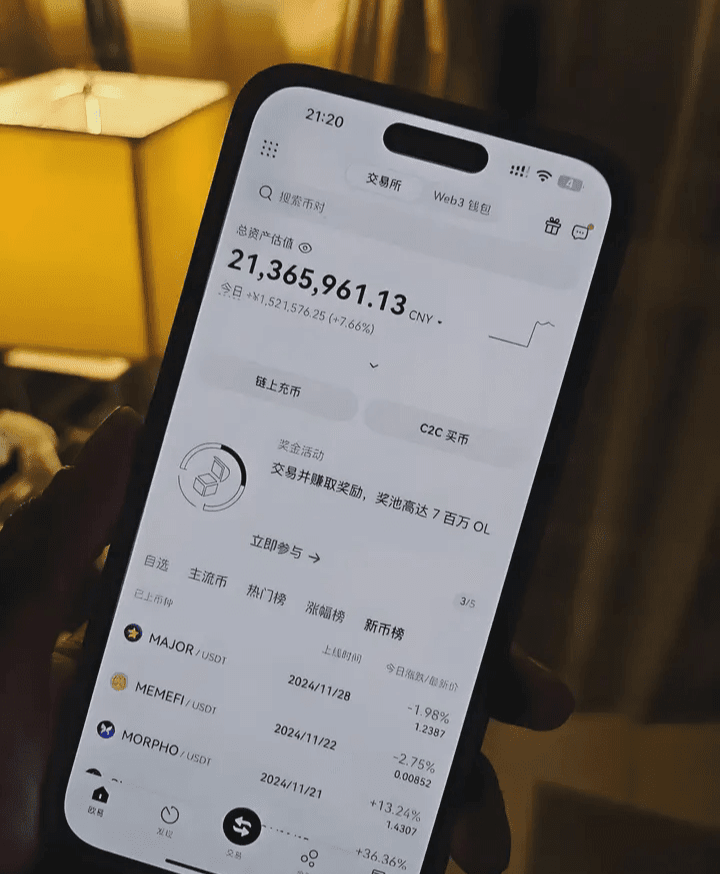
There is a very stupid method of cryptocurrency trading that can help you achieve small goals quickly!
A monthly salary of 3,000 yuan, an annual income of 36,000 yuan, and a total lifetime income of 1.44 million yuan is expected;
With a monthly salary of 4,000 yuan and an annual income of 48,000 yuan, the accumulated wealth in one's lifetime is expected to reach 1.92 million yuan;
With a monthly salary of 5,000 yuan and an annual income of 60,000 yuan, the total income expected in a lifetime is 2.4 million yuan;
With a monthly salary of 6,000 yuan and an annual income of 72,000 yuan, the accumulated wealth in one's lifetime may reach 2.88 million yuan;
With a monthly salary of 7,000 yuan and an annual income of 84,000 yuan, the estimated lifetime income is 3.36 million yuan;
With a monthly salary of 8,000 yuan and an annual income of 96,000 yuan, the total income in a lifetime is estimated to be 3.84 million yuan;
With a monthly salary of 9,000 yuan and an annual income of 108,000 yuan, the accumulated wealth in one's lifetime is expected to exceed 4.32 million yuan;
A monthly salary of 10,000 yuan, an annual income of 120,000 yuan, and a total lifetime income of 4.8 million yuan is expected;
With a monthly salary of 20,000 yuan and an annual income of 240,000 yuan, the accumulated wealth in one's lifetime may be as high as 9.6 million yuan;
A monthly salary of 30,000 yuan, an annual income of 360,000 yuan, and an estimated total lifetime income of 14.4 million yuan;
With a monthly salary of 40,000 yuan and an annual income of 480,000 yuan, the accumulated wealth in one's lifetime is expected to reach 19.2 million yuan;
With a monthly salary of 50,000 yuan and an annual income of 600,000 yuan, the total income expected for a lifetime may reach 24 million yuan.
However, there are very few people who earn over 10,000 yuan a month, and even fewer who earn over 20,000 yuan a month. Most people's monthly salary still hovers below 10,000 yuan. It seems that the average person's lifetime income is barely enough to buy a house.
So, if you are in the cryptocurrency circle, how much do you want to earn before you stop?
If you are over 50 years old, then my suggestion is that holding 10 bitcoins is enough. After all, the value of Bitcoin is likely to soar to millions in the future. Conservative estimates show that one bitcoin is worth a million, and 10 are worth tens of millions. Holding 10 bitcoins is equivalent to having the lifetime income of an ordinary working elite!
If you are in your forties, 5 bitcoins are enough;
If you are in your thirties, 2 Bitcoins are enough;
If you are young, 0.5 bitcoins is enough;
If you were a kid, 0.36 bitcoins would be enough.
If you are in your 30s or 40s and hold 20 bitcoins, you have the key to a free life; if you hold 100 bitcoins, the world is yours to explore. Come on, my friends in the cryptocurrency world!
Although there are many ways to make money, the lessons learned are often similar.
Do you think those stories of six times the profit in one month are all scams? I witnessed a madman using this method to turn 500,000 yuan into 3 million yuan! This is not metaphysics, but the most brutal "floating profit rolling technique".
The Devil's Three Laws: 5% trial and error, 300% harvest - Use mini positions to explore the way, and then increase the position when the big market comes
Principal safety cushion - withdraw the principal immediately when the floating profit reaches 50%, and continue to play with the profit
The three fatal opportunities: the moment of sideways breakthrough, the sharp drop in the bull market, and the false breakthrough of the weekly line
Institutional-level Tips for Adding Positions
Pyramiding: Every time a key position is broken, the amount of positions added decreases by 50%.
Moving average blood sucking: When EMA21 falls back to EMA144, place a breakthrough order with floating profit
Stop loss hunting: ambush reverse orders in the dense stop loss area
Death red line: Never add positions when liquidity is exhausted, always keep 20% cash to prevent being stuck, and strictly control leverage within 3 times
Ultimate Tips: Real rolling masters all use the "position thermometer": for every 20% increase in the account, the position is reduced by 10%, and if there are three consecutive losses, stop immediately.
The maximum daily retracement is controlled within 5%. Those who are still studying K-line will never understand:
The most profitable thing in this market is not technology, but the art of fund management
While you are hesitating, the first batch of people who have learned it have already made millions with 50,000...
Remember: playing the market with floating profits is like fighting a war with enemy bullets - if you lose, it won't hurt, but if you win, you'll make a fortune!
Three iron rules for currency selection:
The weekly line must climb upwards - don't go against the trend
The transaction volume must be large enough - don't play it like a single-player game
Stay away from Dogecoin - you don’t want to be the last one to take over, right?
Five steps to kill the rolling warehouse:
First warehouse 500U (10% of the principal) to test the water
Earn 750U and add 500U immediately
If the loss exceeds 50U, close the position immediately
Don’t exceed 20% of your total position - leave yourself a way out
Repeat the above steps 5 times - 32 times the profit
The violent rolling technique of turning 1000U into 30,000U: I used this formula to help my friend turn the tables
Last year, I helped my friends to verify the strategy in practice. Today, I have condensed the essence into 5 steps. 99% of people will fall into the trap of the last step - after reading this, you will be able to avoid all detours.
1. The core of rolling position: let profits multiply on their own
1000U is divided into 10 parts, and only 100U is played each time (no big loss)
After making a profit, the principal and interest will be divided into 10 parts and continue to roll (for example, if you make 120U from 100U, you can use 12U to open a new position next time)
Core formula: 1000U × (1+20%)^20 ≈ 380,000U (30 times in half a year is more realistic)
2. Coin selection: only play with two coins
60% of the positions are for mainstream coins (BTC/ETH/BNB) - anti-fall, as ballast
40% of the positions are for potential coins (top 50+ three elements in market capitalization):
✓ 24-hour trading volume > 50 million U (guaranteed to be able to run away)
✓ There will be hard-core positive news within 30 days (for example, SOL surged 40% last year due to Binance’s leverage + technological breakthrough)
3. Timing of action: Only when the three signals resonate can the action be taken
Technical oversold (RSI<30 + MACD golden cross)
Funds enter the market (contract open interest reaches a 30-day high)
Tips: When all three signals are present, invest 10% of your position directly
4. Position management: 3-2-1 pyramid rule
First warehouse: 10% (100U test)
Adding positions: For every 10% increase, add 50% of the current position (100U→110U, add another 50U)
Stop loss: 30% if the loss is 5%, and sell all if the loss is below 10% (total loss in a single day shall not exceed 5%)
Stop profit: take half of the 20% profit, and set the remaining half to "highest price retracement 8%" to automatically stop profit
5. Breaking point: 99% of people die here
When it reaches 10,000 U, you will encounter a bottleneck in compound interest - this is when you need a capital fission switch (stay tuned for more on how to play this later).
Rolling is not gambling, it is a math game. According to this method, turning 1000U into 30,000U is just the beginning.
Every pullback in the bull market is God sending red envelopes
Those who have their accounts blown up do not lose to the market, but to their own impatience.
The real risk control is to calculate "this position is something that even the dealer is reluctant to break through"
Now look at your positions and ask: Is this order going to take 200 points and run, or take the 2000-point swing? The answer determines whether you sleep on the rooftop or in the club tonight.
People who have succeeded in cryptocurrency trading: The pursuit of perfection is a manifestation of "greed". It is recommended to collect and read carefully!
One, heavy positions will lead to death; two, no stop loss will lead to death; three, greed will lead to death; four, blind entry will lead to death; five, frequent operations will lead to death; six, left-side operations will lead to death.
These experiences can only be understood after experiencing many painful lessons.
Unfortunately, retail investors do not learn their lessons and always suffer huge losses because of these things. Are you paying for the same mistakes? Every loss is a profound lesson, but why is it still difficult for most traders to avoid repeating the same mistakes?
First, heavy positions lead to death, the price of greed. Heavy position trading + is one of the easiest mistakes for traders to make. When you invest a large amount of money in a trade, you are actually replacing rational decision-making with a gambler's mentality. Any trade determined by the volatility of the market is risky, and heavy positions will only magnify this risk, causing you to be unable to bear the potential losses. Heavy position trading often leads to a break in the capital chain, or even a complete exit. The unpredictability of the market means that you can never guarantee that every heavy position will be profitable. It is recommended to diversify investments and strictly control the risk exposure of each trade, and control the risk of each trade between 1% and 2%, to ensure that even if a loss occurs, it will not cause a devastating blow to the overall funds.
Second, no stop loss means death, the grave of luck. No stop loss trading + is the second biggest fatal flaw of traders. No stop loss plan means that you cannot effectively control the risk, and ultimately you can only passively take a beating in market fluctuations. No stop loss trading will make it impossible for you to exit in time when you lose money, resulting in a continuous increase in the amount of losses, or even a total loss. It is recommended to clearly set a stop loss point before each transaction and strictly implement it. Stop loss is not a confession of defeat, but a basic respect for market risks.
Third, greed leads to death, the trap of desire. Greed is one of the weaknesses of human nature. Traders often try to make unrealistic profits, but ignore the potential risks of the market. Excessive pursuit of profits will make you hesitant when making profits, and eventually miss the best time to leave the market, or even lead to profit taking. It is recommended to set a reasonable profit target and leave the market in time when the target is reached. Remember, trading is not charity, your goal is to make steady profits, not to get rich overnight.
Fourth, blind entry is a sure death, and it is a risk for the ignorant. Blind entry is a manifestation of lack of trading plan. Without a clear entry logic, it is just gambling instead of trading. Blind entry will make you lose your way in the market and eventually fall into the abyss of loss. It is recommended to make a detailed trading plan before entering the market, including entry point, stop loss point, take profit point and risk-return ratio. Only when the plan is clear can you enter the market with confidence.
Fifth, frequent operations will lead to failure and lack of patience. Frequent operations are a sign of traders' impatience for success. Excessive trading not only increases trading losses, but also increases the probability of making mistakes. Frequent operations will make you run around in the market and eventually make costly mistakes due to fatigue and emotional fluctuations.
Sixth, left-side operation is doomed to fail, timing error. Left-side operation means forcibly entering the market when the market trend is unclear, which often leads you into a quagmire of losses. Left-side operation will make you bear huge risks in market fluctuations, and eventually lose money due to misjudgment. It is recommended to wait until the market trend is clear before entering the market. Although right-side operation may miss some profits, it can effectively reduce risks.
In the trading market, many people are superstitious about "frequent trading" and "daily compound interest", thinking that this is a shortcut to quickly grow a small amount of capital. However, the truth is: frequent trading will not make you rich, but will make you fall into the abyss. Today, we will uncover the fatal trap of frequent trading from multiple angles such as mathematical probability, cognitive dimension, market structure, etc., and tell you the real core of growing a small amount of capital - pattern and cognition.
Want to make money? First, understand how to play in the cryptocurrency circle! There are many types of cryptocurrencies, such as spot, contract, and spot. The most important thing is to find the one that suits you. Blindly following the trend will only make you cannon fodder in the end!
I have been in the cryptocurrency market for more than 10 years. I think I have outperformed 90% of the contract traders in the market. I have experienced Ponzi schemes, contracts, and arbitrage. I have also been ruthlessly harvested by the banker. I have experienced all the pitfalls that the market should experience. How can retail investors take advantage of the "free ride"? Revealing the secrets of the main force hidden in the K-line
Why are some people able to make money from their investments, while I always get stuck? I have also had family members and friends who listened to some gossip or unconfirmed rumors and traded stocks, and ended up losing a lot of money.
If you want to seize opportunities in the investment market, it is crucial to know when to enter and exit. This is why it is so important to be familiar with the candlestick chart pattern! By understanding the changes in the candlestick chart, you can begin to understand the flow of funds and analyze the secrets hidden by the main force.
The candlestick chart consists of the opening price, the highest price, the lowest price and the closing price of each day (or week or month). However, to be successful in investing, we need to understand that the most important one is the "closing price", and the following will explain why.

◒ “Closing price” is the price commonly recognized by market participants
The closing price plays a vital role in the candlestick chart because it reflects the final result of the entire trading cycle. At the end of the day (or week, month), the closing price is the price that market participants are willing to pay at the last moment. This price represents the market's overall assessment and sentiment of the asset during that trading cycle. Therefore, the level of the closing price is crucial to determining the trend and direction of the market.
After the market opens, prices often fluctuate due to various news, rumors or information. However, as the market approaches closing time, market participants gradually understand the reasons for price fluctuations. Therefore, savvy investors will think deeply about whether the coins they hold are undervalued or overvalued based on the current market conditions and evaluate whether the price can be sustained. Based on their judgment, they may adjust their positions.
Gonzalo Canete, ATFX's global chief market strategist, said that such transactions usually go against the current market trend, so the market trend often changes near the close. Such changes may surprise some investors, causing them to rush to sell to secure profits or make minimal stops. However, for those investors who are confident in their market views, they will only make necessary position adjustments.
Eventually, the market closes, and the result of the above actions is called the "closing price". This price can be regarded as a reasonable price determined by most market participants after considering the current market environment. In this situation, the desire for profit in the market will inevitably determine a value, namely the "closing price".
Generally speaking, if the closing price is higher than the opening price, it means that the market is in an upward trend during the period; on the contrary, if the closing price is lower than the opening price, it means that the market is in a downward trend. In addition, the closing price can also serve as an important reference point for determining support and resistance levels, which is crucial for formulating trading strategies and developing risk management plans. Therefore, the formation logic of the closing price is a comprehensive reflection of market sentiment and asset price trends, providing investors with an important basis for decision-making.
◒ The length of the shadow line can show the buying and selling pressure during the trading session
The upper and lower shadows of a candlestick are the lines extending above and below the body of the candlestick, and they provide important information about the range of price fluctuations.
Upper shadow: The upper shadow extends from the top of the candlestick body, indicating the highest point the price has reached during this period. The long upper shadow suggests that there has been a lot of selling pressure in the market during this period. Although the price rose, it was eventually suppressed by the selling.
Lower shadow: The lower shadow extends from the bottom of the candle body, indicating the lowest point the price has fallen to during this period. The long lower shadow suggests that there has been a large buying support in the market during this period. Although the price fell, it was eventually pushed up by buying.
The presence of upper and lower shadows can provide clues about market strength and trends. For example, even if a trading day almost forms a "bare-legged bullish candle", the strength of the selling pressure above will determine the length of the upper shadow after the close. The longer the shadow, the greater the selling pressure.

Price changes in the last stage of a trading day often reflect the mentality of investors. After the market forms the highest or lowest price, until the closing, the price fluctuates greatly, which reflects the fluctuations in investor sentiment and changes in market supply and demand. Therefore, by analyzing the price changes at this stage, we can infer the potential supply and demand situation in the market.
In 24-hour trading markets such as foreign exchange, in order to allow the candlestick chart pattern to be more fully displayed on the chart, the opening and closing times are usually set from 8 am to 6 pm. This setting allows investors to observe the trend and pattern of price changes more clearly.
◒ Investment transactions should also be “abiding by haste and impatience”
In the trading market, the key for buyers and sellers to reach a deal is that they reach a consensus on the price at a certain point in time. However, this does not mean that both parties can trade at their most ideal price.
It often happens that investors who believe that the market will continue to rise may have intended to buy at a price 10% lower than the current price, but for fear of missing out, they choose to buy at the market price. On the other hand, investors who are worried about the market falling further may be eager to sell their holdings and choose to sell at the market price.
Market participants must be flexible in responding to market changes. However, this impatience often weakens another necessary condition - calmness. The result is often the dilemma of "selling at the bottom and buying at the top". The candlestick chart is regarded as one of the best tools for objectively analyzing the market.
◒ When you see the “end line”, it’s best to lock in your profits
In an upward trend, a large positive line appeared, and then a positive line was closed the next week, but it failed to create a new high price. The K-line combination pattern in this case is called the "end line".
The appearance of the big positive line deepened investors' confidence in the continued rise of the market, so investors who decided to wait and see also began to enter the market and place orders. Whether they are investors who already hold positions or new investors, they will pay close attention to whether the recent price has set a new high and whether it can continue to rise after setting a new high.

However, even if the price closes with a positive line, if no one follows up and buys higher near the close, disappointment will spread quickly.
This feeling of disappointment will prompt investors with two choices: "stop loss or continue to wait." However, if investors understand the concept of the "end line", their response may be significantly different from those who do not understand it.
Gonzalo Canete, ATFX's global chief market strategist, explained that in trading, the closing price is considered a crucial indicator. Investors pay close attention to market movements at the closing, especially when the chance of setting a new high gradually approaches zero. Investors who understand the "end line" can predict the emergence of this candlestick pattern in advance, so they often consider selling part of their positions before waiting for next week to ensure profits. On the contrary, for investors who do not understand the "end line" or its pattern, they may be hesitant between the expectation of rising and the disappointment. It is not until the selling pressure becomes heavier that they are forced to decide to sell their positions.
This shows that the characteristics of various K-line or K-line combination patterns have a significant impact on trading decisions.
◒ The appearance of a "big positive line" is not necessarily a buy signal
When analyzing candlestick patterns, it is crucial to consider the location where the pattern occurs, as the same candlestick pattern can have very different meanings in different market environments.
For example, a "big white candlestick" is usually seen as a very strong bullish signal, but if it appears at the end of an uptrend and forms a "Last engulfing top" pattern, the situation is completely different. Although the pattern is still a big white candlestick, its result may deviate from investors' expectations and may indicate that the market is about to turn. Therefore, for investors, understanding the location of the candlestick pattern is crucial to correctly interpreting market trends.

In a rising market, ordinary investors tend to expect the market to continue to rise, so they will continue to raise their profit targets and postpone the opportunity to take profits.
On the other hand, speculators holding large short positions may face unbearable losses when the market continues to rise, forcing them to cover their positions. This stop-loss covering behavior may temporarily disrupt the balance of supply and demand in the market, and sometimes even cause the market to rise sharply.
Therefore, when a long white candlestick appears in the high area of a rising market, it does not necessarily mean the entry of new funds or increase in positions, but may be because investors begin to sell, or because speculators are eager to cover their positions, causing prices to rise sharply, eventually forming a long white candlestick.
◒ Different positions have different meanings
When a long white candle appears in the market, investors may mistakenly believe that the rally will continue and be confident if they lack understanding of the "Last Engulfing Top". However, we must realize that in the early stages of a rally, a long white candle may have a real basis for the rally, but after the rally has lasted for a period of time, a long white candle that appears in a high area and lacks a basis for continued rally has different meanings and risks.
We must jump out of the simple logical thinking of "a big positive line appears → it will continue to rise → so buy", and instead need to analyze the market more deeply. Therefore, we need to pay close attention to the location of the K-line pattern and the market environment behind it.
Although a single K-line pattern has important reference significance, a combination of multiple K-lines can more accurately convey investors' psychological changes and the true appearance of the market. Therefore, when analyzing K-line patterns, we should focus on the more accurate information conveyed by the composite K-line combination.

From 8,000 to 10 million, the winning rate is as high as 95%. The practical strategy and risk management will systematize the following thinking, and the following practical framework can be constructed:
Position management strategy: adopt the "base position + mobile position" mode, the base position does not exceed 50%, and the mobile position is used for swing trading. In Bitcoin investment, it is recommended to control the total position within 20% of personal liquid assets.
Entry and exit standards: adopt a fixed investment strategy in the accumulation phase, and buy a fixed amount every week or month; hold the bottom position unchanged in the lifting phase, and use the mobile position to trade in waves; in the delivery phase, reduce positions by 50% if the price falls below the 30-day moving average, and clear positions if the price falls below the 60-day moving average.
Risk control mechanism: The loss of a single transaction shall not exceed 2% of the principal, and the total account drawdown shall be forced to reduce the position if it exceeds 15%. Bitcoin contract traders should avoid using leverage exceeding 3 times to prevent violent market manipulation by the market maker from causing liquidation.
Psychological discipline is the key to success in following the market maker: do not predict the top and bottom, just follow the traces left by the market maker; do not pursue selling at the highest point, just make sure to get the fish body; do not be disturbed by short-term fluctuations, and strictly implement the trading plan.
Remember, the banker's advantage lies in capital and information, while the retail investor's advantage lies in flexibility and patience.
Conclusion: Wisdom for Surviving in a Zero-Sum Game The financial market is essentially a place for wealth redistribution, and following the market leader mentality provides the wisdom for surviving in this zero-sum game.
Investors need to understand that no strategy can win all the time. The key to successfully following the market leader lies in probabilistic thinking - accumulating statistical advantages through multiple transactions, rather than pursuing a single perfect operation.
With stricter supervision and improved market efficiency, the traditional market manipulation model is changing, but the essence of market manipulation will not disappear, it will only appear in new forms.
In emerging asset classes such as Bitcoin, due to regulatory gaps and liquidity stratification, market makers will continue to exist for a long time. Only by continuously learning the market language, honing technical analysis capabilities, and cultivating reverse thinking habits can investors remain invincible in the dance with the market makers.
Remember the old adage of Wall Street: "Markets change, but human nature does not." The essence of following the market maker's thinking is not to defeat the market maker, but to understand the behavioral patterns of market participants and find your own living space from them.
In this battlefield without gunpowder smoke, knowledge is the shield, discipline is the weapon, and patience is the secret to the ultimate victory.
Cryptocurrency trading is connected to life. When you understand life, you will also understand the cryptocurrency world. The truth is simple. Only when you integrate knowledge and action can you be at ease and invincible!
Keep reading me, I believe you will avoid many detours! I only share the most practical emoji tips
Strong recovery, assets doubled! Follow the nostalgia, plan ahead, and easily gain big profits
Continue to follow: ALT ZKJ BID