
There are times when I don’t need to look at the market for too long to know something's off.
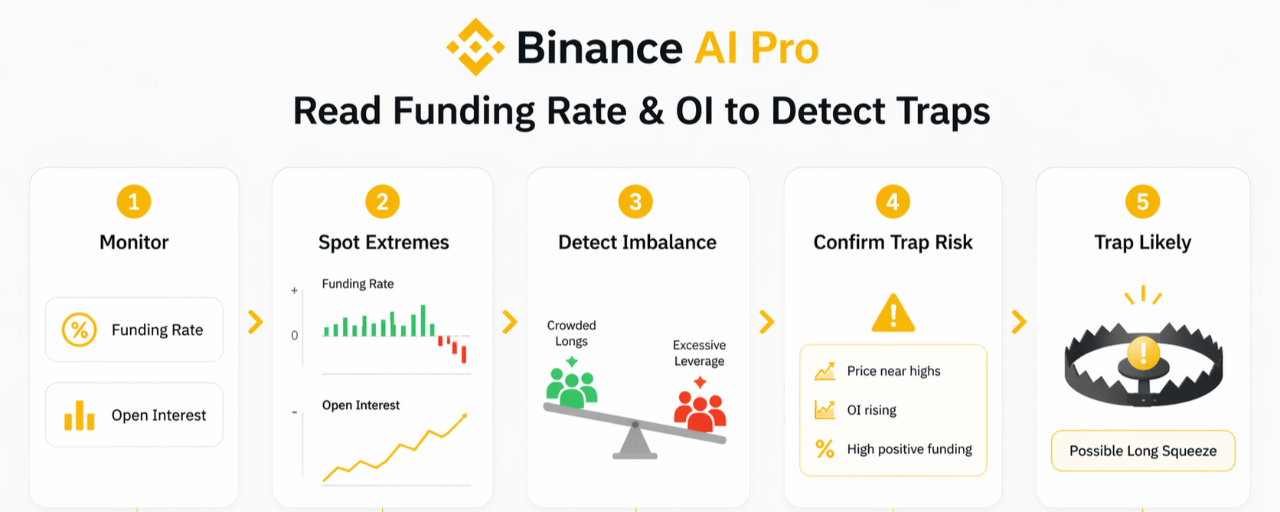
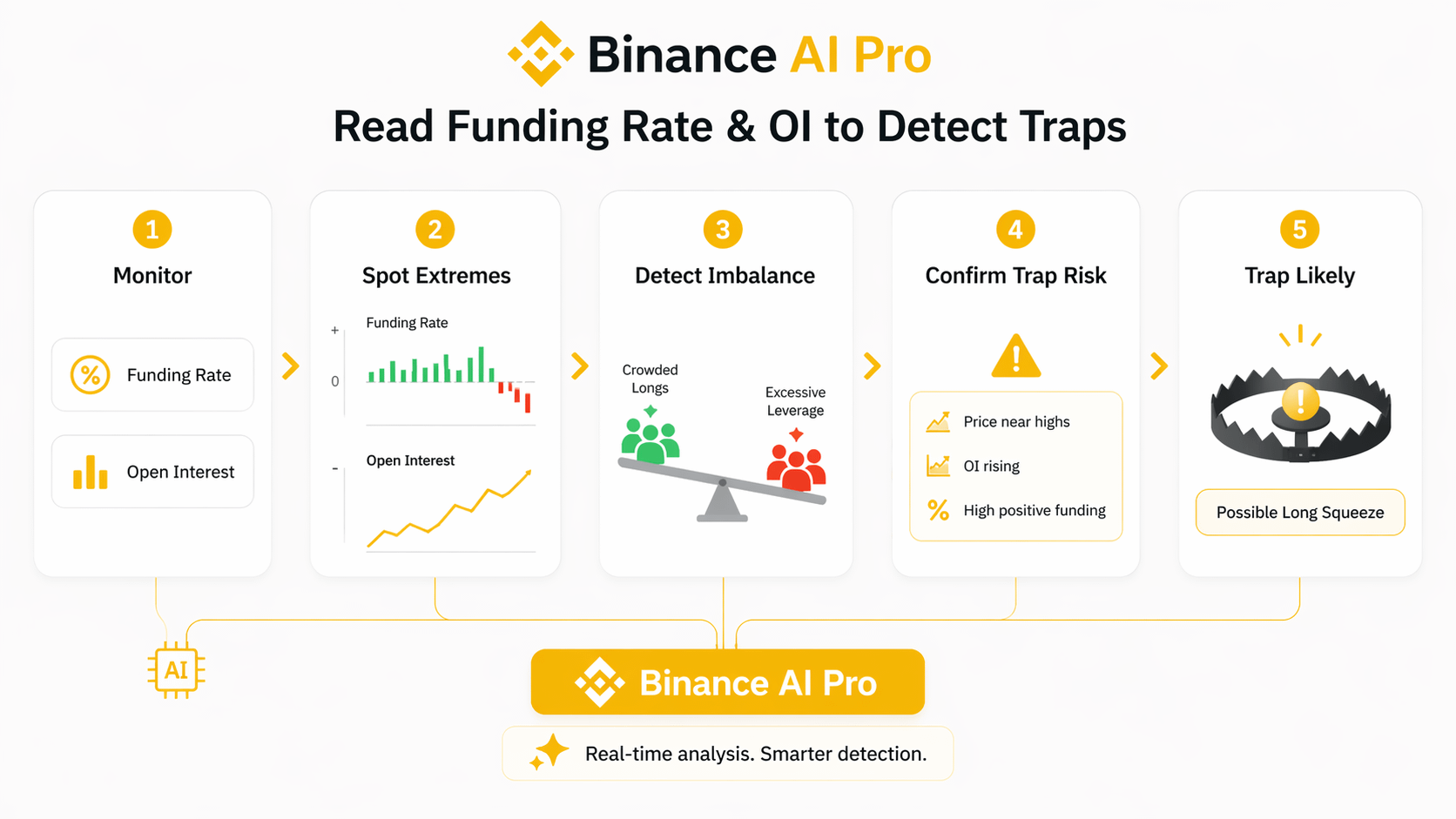
The price is still holding up pretty well on the surface, but the funding is starting to skew, and the OI is ballooning quickly, which makes me think more about a trap than a genuinely strong trend.
In situations like that, I don’t ask whether I should long or short; I usually see it as a psychological test of the market.
The thing I check the most is: whether this is real money flowing in or just the crowd adding positions to get trapped later.
From my perspective, funding rate and OI are two very useful data points for reading traps, but only when placed side by side, not looked at separately.
Funding tells me which side is paying fees to maintain their position.
OI tells me how many positions are open and whether participation is increasing or decreasing.
If I just look at high funding, I can't conclude that the market is about to trap long.
If I only look at rising OI, I still don’t know if it’s building a strong position or just the crowd FOMOing.
What’s noteworthy is how these two things move alongside the price.
I often use Binance AI Pro in a very pragmatic way.
I'm not asking it to read data mechanically, but in context.
For example: if funding is strongly positive while OI is still rising, but the price isn’t following through, how should that be interpreted?
What I like is that AI Pro quickly helps me connect three layers: which side is leaning, whether leverage is being pushed up, and whether the price reaction confirms the crowd’s belief.
A classic long trap setup is when funding spikes quickly, OI rises sharply, but the price fails to break through resistance or can't hold after a breakout.
From my perspective, at that moment the market shows too many people believing in one direction, but the real buying power isn't enough to push the price far.
When I use AI Pro to analyze segments like that, what I'm concerned about isn't the funding rate percentage, but the story behind it: the crowd is paying fees to maintain their bullish belief, but the price isn’t rewarding that faith.
That’s when the trap starts to smell.
Conversely, a short trap reads similarly in logic.
Deep negative funding, rising OI, a very bearish sentiment, but the price can’t drop significantly or only breaks support momentarily before bouncing back strongly.
I've noticed in those segments that AI Pro is helpful in distinguishing between a real breakdown and a liquidity sweep.
If the short is really strong, the price usually has to move relatively clearly after OI expands.
But if OI is rising while the downside follow-through is weak, that often tells me there are too many people betting on one side and the market is starting to have reasons to do the opposite.
What I find noteworthy is that Binance AI Pro doesn't just read funding and OI as two static numbers.
It's more useful in placing them within the flow of the market.
There are times when rising OI is a good sign because the price is moving alongside, volume is solid, and the market structure is opening up.
However, there are times when rising OI is just the market piling on leverage for an already crowded belief.
If I don't factor funding in, I can easily get it wrong.
If I don't place a price on it, I can easily get it wrong.
For me, the trap isn’t in single data points.
The trap lies in the contradiction between positional belief and the actual price reaction.
Another detail I often look at is whether OI can hold after a strong run.
This is where AI Pro is quite handy because it spares me from having to flip through many sources myself.
If the price just shot up but OI fell quickly, I often understand that a short squeeze has already happened, not necessarily that a strong new trend is being built.
Similarly, if the price just crashed down and OI contracts sharply, many times that's just a long squeeze relieving leverage.
The real traps usually happen right before a squeeze, when OI is swelling but the price isn't moving as the crowd expects.
I've also noticed that a high funding rate isn't always a reversal signal.
This is a spot where many people can easily get trapped.
High positive funding can last quite a while in a strong trend.
Deep negative funding can also persist if the market is truly weak.
From my perspective, AI Pro is useful not because it gives me a rigid formula, but because it helps me see when funding is becoming a burden for the dominant side.
A strong trend often still absorbs skewed funding.
A weak trend will quickly start to reveal exhaustion when both funding and OI go too far.
For me, the clearest trap signal is always where the market is crowded with people looking in one direction, OI is rising to confirm that belief, funding is skewed heavily to show leverage is piling on, but the price is no longer obedient.
It doesn't continue, or it struggles to continue, or it just broke out and then reversed.
That’s when I find AI Pro most valuable: not because it predicts every trap correctly, but because it helps me slow down just when the crowd is speeding up.
After some time using the Beta version at $9.99/month, I clearly see that Binance AI Pro is not a tool for generating entry signals.
It fits better as a layer of context checking.
Funding and OI themselves don’t lie, but they can easily be misread if looked at individually.
AI Pro helps me see them as part of a larger structure: which side is too crowded, which side is paying to maintain their belief, and most importantly, whether the price is confirming that belief.
If I had to sum it up in one sentence, I would say Binance AI Pro reads funding rate and OI to detect traps not by finding a magical number threshold, but by identifying where the crowd is too confident but the price is no longer cooperating.
For me, that's where the trap starts to reveal itself the most.
@Binance Vietnam $XAU #BinanceAIPro
Trading always carries risks. AI-generated suggestions are not financial advice. Past performance does not reflect future results. Please check the availability of products in your area.