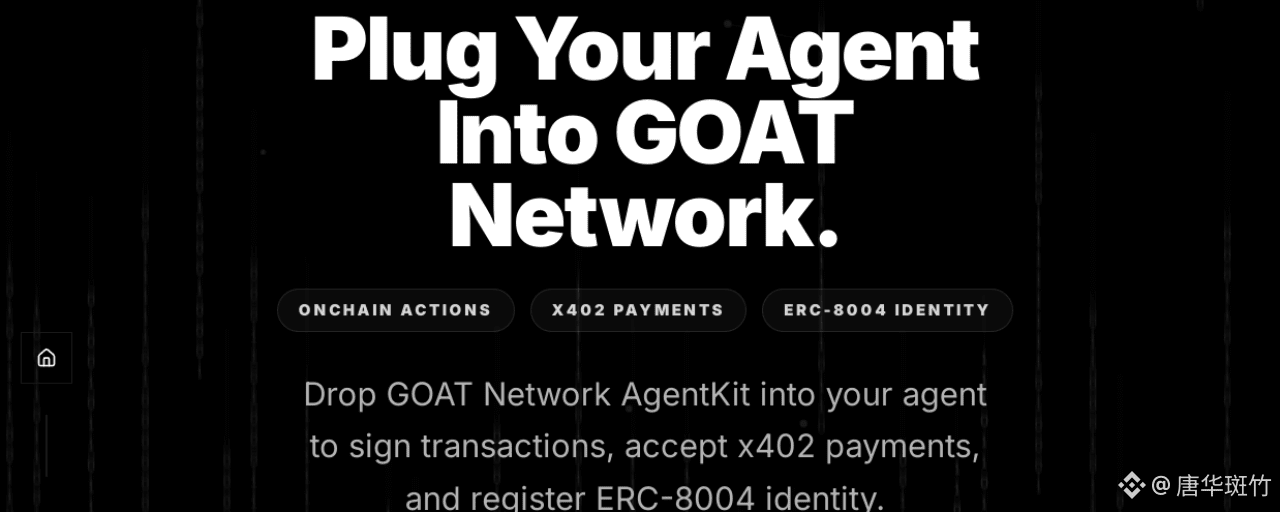


In the lane where AI Agents and blockchain are deeply integrated, the speed of iteration for infrastructure layer tools directly impacts the entire ecosystem's deployment efficiency and commercial ceiling. The AgentKit toolkit launched by GOAT Network, with its differentiated product positioning, robust tech architecture, and extensive ecosystem adaptability, has emerged as a core asset with significant growth potential in this sector, making its long-term investment value and upside potential well worth watching.
Unlike most similar products on the market, GOAT Network's AgentKit has a core positioning that offers distinct advantages. It's not a creation tool for building brand new AI Agents from scratch; instead, it focuses on empowering existing users' AI Agents and various applications by providing foundational tools for on-chain capability expansion. This product logic completely sidesteps the pain points of industry homogenization, allowing for rapid on-chain functionality upgrades without the need to rebuild existing project architectures, significantly lowering integration and trial-and-error costs for developers, while maximizing adaptability and practical deployment.
From the perspective of technical configuration and functional reserves, this toolkit's hard power is quite remarkable, featuring a wealth of deployable functional modules, including 95 core operations, 13 exclusive plugins, 5 major framework adapters, and 30 merchant operational capabilities. It also natively supports the ERC-8004 protocol standard, comprehensively covering various integration needs of developers. In terms of underlying ecosystem interactions, the product deeply integrates the GOAT NETWORK, BTC, and LAYERZERO ecosystems, with significant advantages in cross-scenario and cross-chain coordination, laying a solid foundation for future ecosystem expansion.
The entire product has built a three-layer closed-loop core capability system, which is also the source of its core competitiveness, consisting of on-chain execution capabilities, X402 payment capabilities, and ERC-8004 on-chain identity capabilities. These three capabilities work in synergy to construct a complete commercial operation system for AI Agents on-chain.
In terms of on-chain action execution, it can achieve a complete on-chain asset operation process. For example, the procedure for swapping 0.03 ETH for USDC can be completed through a standardized process involving intent, dex.quote, and dex.swap, allowing for wallet authorization, contract calls, DEX swaps, cross-chain bridging, transaction signing, and asset transfers—all part of the full chain operations. This perfectly suits various high-frequency scenarios like on-chain trading, asset exchanges, and cross-chain asset flows, serving as the core support for AI Agents to perform autonomous on-chain operations.
The X402 payment and merchant layer completes the commercialization loop of AI Agents, supporting custom payment access fees like 5 USDC. Utilizing standardized processes like intent, payment.create, and submitSignature, it can handle payment intent recognition, transaction signing, order generation, balance calculations, and merchant callbacks in one go. This mature commercial system perfectly fits scenarios like paid content access, X402 compliant charging, and regular merchant operations, endowing AI Agents with the ability to generate revenue autonomously.
The ERC-8004 identity and trust layer addresses the challenges of identity verification and trust endorsement for on-chain AI Agents. Developers can register AI Agent identities and publish metadata using tools, relying on core operations like register_agent and set_metadata to record trustworthy behavior data and trust signals in the 8004 registry. This achieves on-chain identity disclosure and trust signal accumulation, precisely covering core scenarios like on-chain identity verification, ecosystem retrieval, and trust system establishment, thus enhancing the entire ecosystem's credit foundation.
In product architecture design, the GOAT Network AgentKit adopts a unified access layer model with clear architectural logic and strong scalability. The product can seamlessly connect with various mainstream AI development ecosystems, fully compatible with four major AI frameworks and runtimes: OpenAI, LangChain, MCP, and Vercel AI. Developers only need to configure once to synchronize the entire on-chain capabilities across multiple platforms, adapting to mainstream industry development scenarios. Additionally, the architecture includes strategy hooks, observability monitoring, security protection, and a multidimensional evaluation system, covering the entire project lifecycle from construction to deployment and operation, ensuring stable and efficient operation of the ecosystem.
From an integration standpoint, the project offers lightweight and diversified access solutions, greatly reducing the entry barriers for ecosystems. For developers with established AI Agents and applications, they can quickly install via the command npm install @goatnetwork/agentkit for lightweight integration; for developers needing to rapidly deploy projects, they can use the official CLI scaffold, executing the full command set npm create goat-agent, cd my-agent, pnpm start to quickly build a runnable starter project. These two access methods cater to different development needs, further accelerating the product's ecological deployment speed.
Overall, the core advantages of the GOAT Network AgentKit are crystal clear: first, the product logic based on existing resources eliminates the need to rebuild the original AI Agent, significantly lowering development costs; second, it integrates three core capabilities—on-chain execution, X402 commercial processes, and the ERC-8004 identity system—into a unified tool layer, providing comprehensive and closed-loop functionalities; third, it offers compatibility with all mainstream AI frameworks and multi-ecosystem interactions, leading the industry in adaptability and scalability.
From a long-term investment perspective, the on-chain and commercialization of AI Agents is a highly certain trend in the industry. The GOAT Network AgentKit positions itself perfectly within the core sector, continuously attracting developers with its comprehensive technical system, mature commercial deployment scenarios, and extremely low integration barriers. As the ecosystem expands, merchant systems improve, and the on-chain trust system proliferates, the project's commercial value and ecosystem scale will continue to rise, possessing strong long-term growth potential and valuation upside. It's a quality asset with core configuration value in the AI + blockchain integration sector.