

If we compare the AI supply chain to building a skyscraper, then GPUs are just the crown on the roof, but what really determines whether the building can be erected is the foundation, steel bars, cement, and circuitry; these seemingly unremarkable elements are often the most profitable.
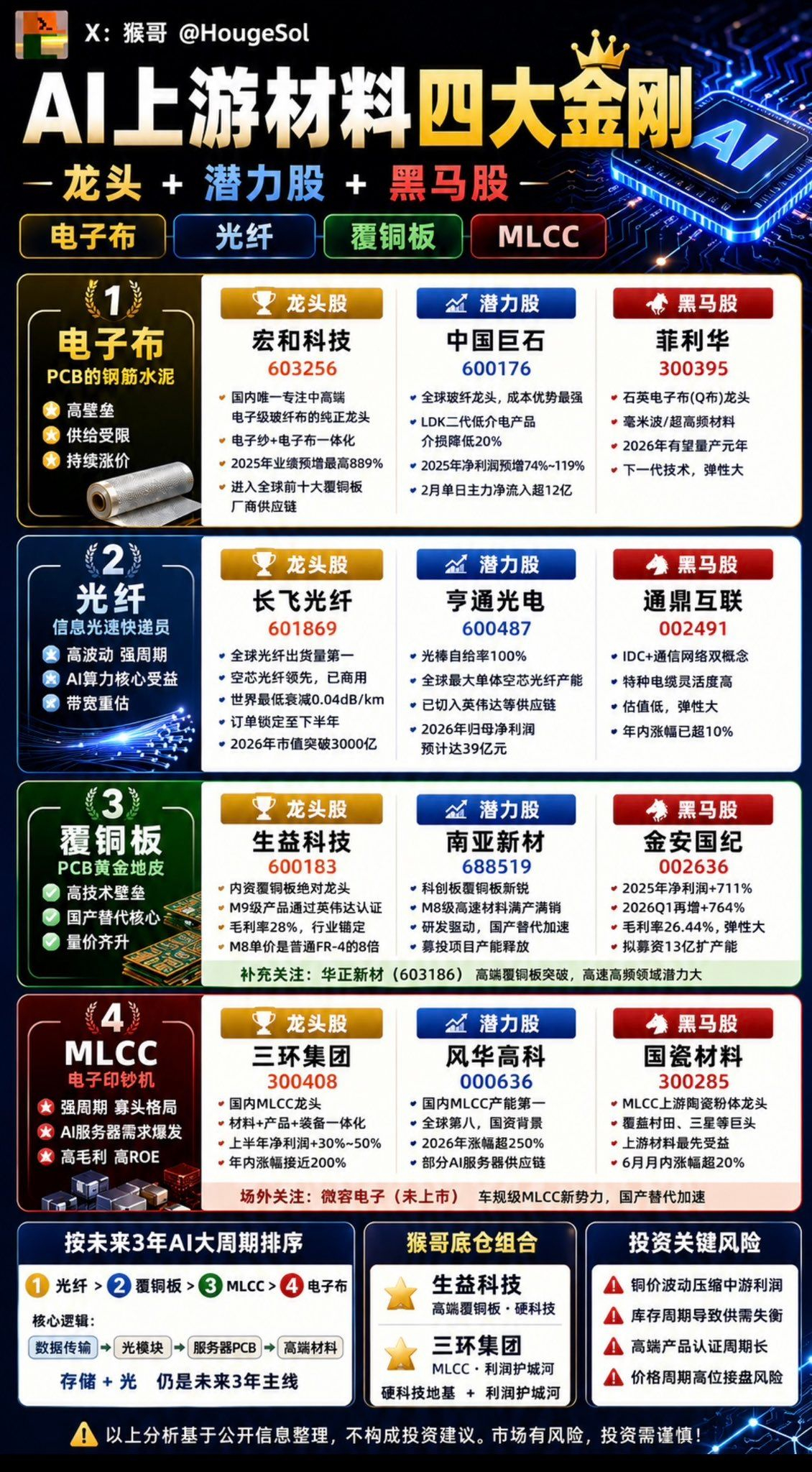
Electronic cloth, fiber optics, copper-clad laminates, and MLCCs; I call them the 'Four Heavyweights' of upstream materials in AI.
Because these four links run through all AI hardware devices, from servers to switches, from robotics to autonomous driving, from data centers to edge computing, you can skip certain generations of GPUs, but it's hard to bypass these four foundational links.
Electronic cloth is the concrete and steel of PCBs, fiber optics are the data highways, copper-clad laminates are the golden land, and MLCCs are the capillaries; they may not seem sexy, but without any one of them, the whole system can't function.
The first heavyweight, electronic cloth.
A lot of folks think electronic cloth is just ordinary fiberglass.
In fact, the low-dielectric electronic cloth used in AI servers is far more technically challenging than ordinary products, and core equipment is heavily reliant on imports from Japan; wanting to expand production isn’t just about throwing money at it, which is why electronic cloth prices have been rising continuously in recent years.
In this track.
Honghe Technology (603256.SH) is the purest leader in the electronic cloth space in my eyes; it’s like the top student in the industry, putting all its energy into electronic cloth, and when AI demand explodes, the elasticity is often the greatest.
China Jushi (600176.SH) is like the national team in the industry, globally leading in scale with clear cost advantages.
Feilihua (300395.SZ) is more like a growth stock betting on the next-gen technology route, banking on the large-scale application of quartz electronic cloth in the future.
The second heavyweight, fiber optics.
If we compare GPUs to Ferraris.
Then fiber optics are the highways.
No matter how fast a Ferrari is, if you take it on a rural dirt road, it won't run; therefore, the true beneficiaries of the AI era are not just GPUs, but also the fiber optics supply chain responsible for data transmission.
Changfei Fiber (601869.SH) is the global leader in fiber optics and one of the most advanced companies in domestic hollow fiber technology.
Hengtong Optic-Electric (600487.SH) is a player that can attack and defend; it benefits from the fiber optic boom while also having submarine cable business providing stable cash flow.
Tongding Interconnection (002491.SZ) is a typical small-cap stock with elasticity, more suitable for playing the industry rotation.
The third heavyweight, copper-clad laminates.
If you ask me to choose one direction among four tracks that I’m most optimistic about in the next five years.
I would likely cast my vote for copper-clad laminates, as they are currently one of the most undervalued links in the AI server supply chain.
Many people know PCBs.
But many don’t know about copper-clad laminates.
Actually, copper-clad laminates occupy the core material value in PCBs, and high-end copper-clad laminates are key materials that are indispensable during the upgrade of AI servers.
If we draw an analogy with real estate.
PCBs are like houses.
Copper-clad laminates are land.
No matter how beautiful the house is, it won’t sell for a good price without a prime location, and the explosive demand for high-speed, high-frequency materials in AI servers essentially makes prime locations increasingly valuable.
Shengyi Technology (600183.SH) is the undisputed leader in this track.
Many institutions consider it the Kweichow Moutai (600519.SH) of the copper-clad laminate industry because in terms of technology, scale, and client certification, it sets the industry benchmark.
Nan Ya New Materials (688519.SH) is more like a growth player.
Jin'an Guoji (002636.SZ) is a typical cyclical elastic stock, often performing exceptionally well when the price increase cycle arrives.
So if you ask me where to park my capital for peace of mind.
I would not hesitate to choose Shengyi Technology.
Because many times, making money relies not on explosive growth but on surviving long enough.
The fourth heavyweight, MLCC.
If GPUs are the brain of AI.
Then MLCCs are the nervous system.
An AI server may need to use thousands, even tens of thousands, of MLCCs; without them, even the strongest chip cannot function properly.
The biggest characteristic of the MLCC industry is oligopoly.
#Murata #SamsungElectronics #Taiyo Yuden have long controlled the high-end market, and since the certification cycle is particularly long, every time there’s a supply-demand imbalance, the price increase happens faster than many people can imagine.
In the A-share market.
Sanhuan Group (300408.SZ) is one of my favorite picks because it not only makes products but also materials and equipment, integrating almost the entire supply chain, giving it a long-term profit margin advantage over its peers.
Fenghua Gaoke (000636.SZ) has one of the largest MLCC capacities in the country.
Guoci Materials (300285.SZ) is a typical shovel seller company, not directly competing at the terminal level but able to share in the whole industry’s growth dividends.
If you ask me to do a simple ranking.
Sanhuan Group makes money from profits.
Fenghua Gaoke makes money from scale.
Guoci Materials makes money from industry upgrades.
If we break down the entire AI supply chain.
GPUs are responsible for computing, HBM for storage, optical modules for connectivity, while electronic cloth, fiber optics, copper-clad laminates, and MLCCs are responsible for making it all happen; they may seem unremarkable, but they determine whether the entire supply chain can run smoothly.
If I had to choose a base position from four tracks right now.
I lean more towards Shengyi Technology (600183.SH) and Sanhuan Group (300408.SZ).
One locks down the materials for AI servers, while the other takes care of electronic components, just like one sells foundations while the other sells steel bars; no matter how AI develops in the future, they both have the opportunity to continuously benefit, and this is precisely the most important logic for long-term investment.