
In the previous post, I talked about $CRDO; in this one, let’s discuss $ALAB (Astera Labs), since these are stocks that my buddy picked up when he started buying US stocks this year, so they go hand in hand.
If the two kings of optical chips are $LITE and $COHR, then $CRDO and $ALAB are the two little kings of optical interconnects.
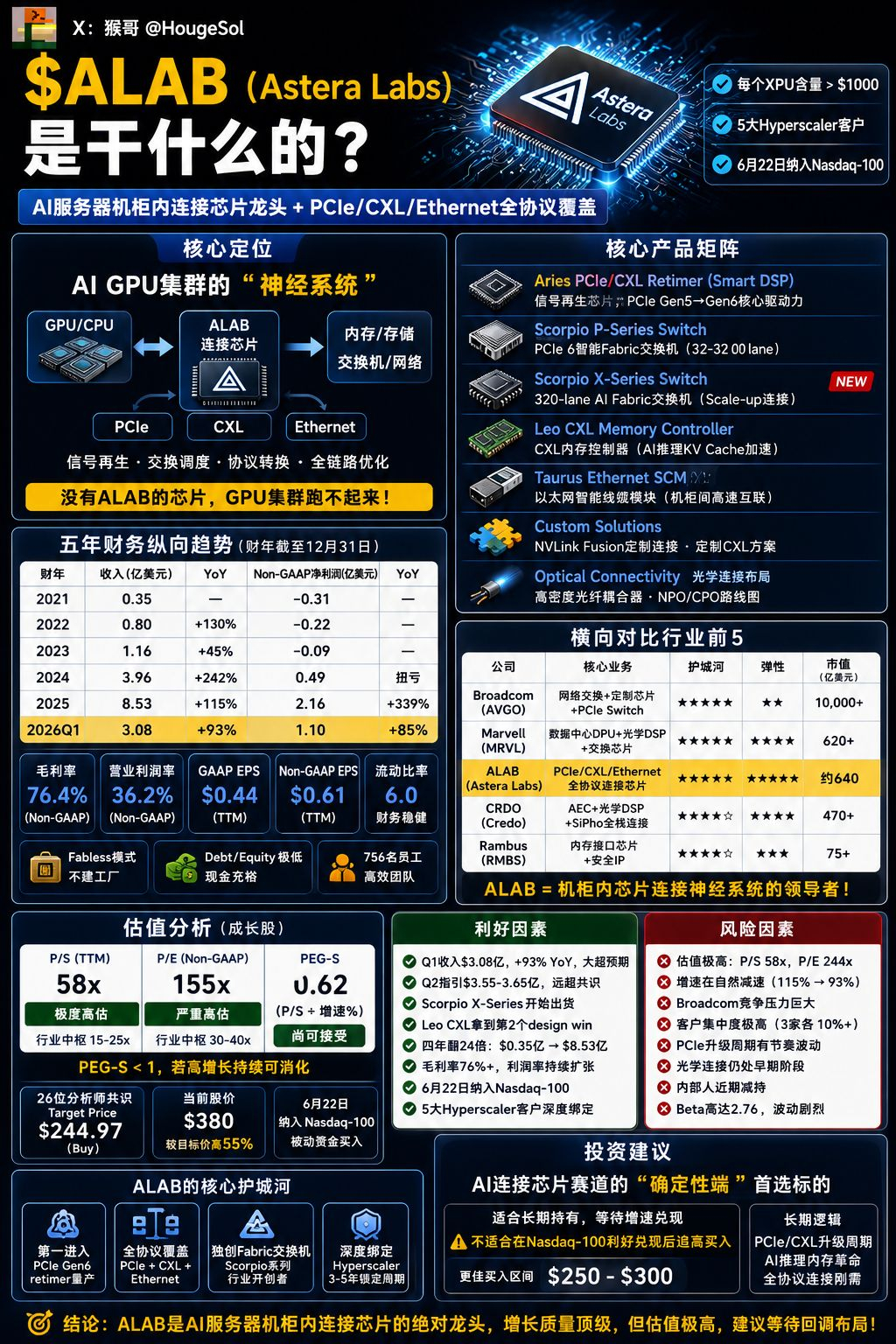
When many first see ALAB, they might think it's similar to CRDO (Credo Technology) since both are into connectivity. However, while both companies operate in the AI interconnect space, their functions are completely different.
If CRDO is like building highways, then ALAB is more like the traffic lights, navigation systems, and traffic control centers on those highways.
CRDO (Credo Technology) deals with how data gets transmitted, while ALAB (Astera Labs) ensures that once data is transmitted, it reaches its destination accurately.
One focuses on the roads, the other on traffic order.
What’s the most important thing in an AI data center?
Many think it’s all about the GPUs, but when thousands of GPUs are working simultaneously, the biggest challenge isn’t computing power—it's communication.
GPUs need to communicate with GPUs, GPUs need to talk to CPUs, and CPUs need to talk to memory. If there's a communication issue, no matter how expensive the GPU, it’s just useless metal.
Let me give you a simple example.
Imagine you have ten thousand employees in a meeting, all talking at once. Without traffic rules, a moderator, or a signal amplifier, it would turn into chaos. ALAB’s role is to ensure that data flows in an orderly manner.
Currently, there are three main communication protocols for AI servers.
PCIe is used between CPUs and GPUs.
CXL is used between CPUs and memory.
Ethernet is used between servers.
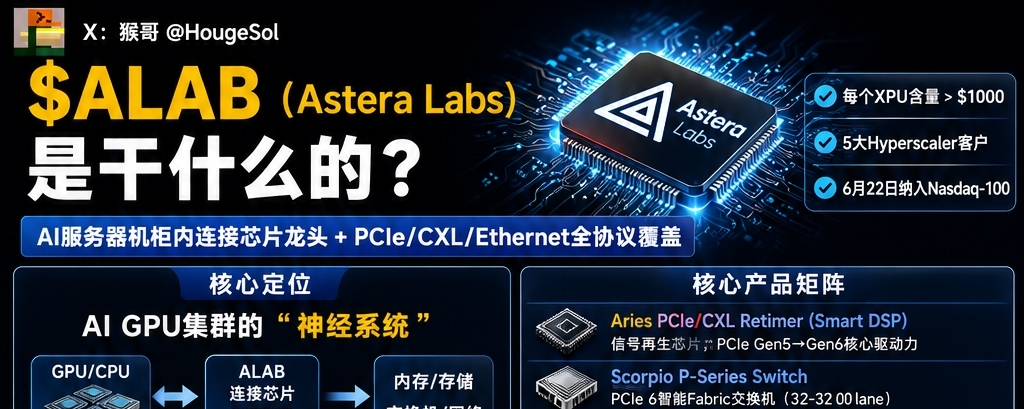
ALAB is one of the few companies that covers all three major protocols. Its core product is called Retimer, which you can think of as a signal amplifier in the data world.
As PCIe Gen5 upgrades to PCIe Gen6, the transmission speed doubles, but signal attenuation also becomes a bigger issue. That's when the Retimer goes from optional to essential.
Besides Retimer, ALAB offers switches, CXL controllers, smart cable modules, etc. All these products essentially help AI servers tackle one problem: how to efficiently coordinate an increasing number of GPUs, CPUs, and memory.
Why is the market so bullish on ALAB?
As AI develops, the number of GPUs increases; the more GPUs there are, the more complex the connections become. With more complex connections, the demand for ALAB's products grows. Essentially, they're selling a 'traffic management system' for AI clusters.
Currently, deploying a high-end AI chip already adds more than $1000 in value for ALAB, and with the arrival of PCIe Gen6, CXL memory expansion, and the AI inference era, this number continues to grow. That's the core reason for its explosive growth over the past few years.
Simply put: look for ALAB within the racks, and for CRDO between the racks; the two complement each other more than they compete.