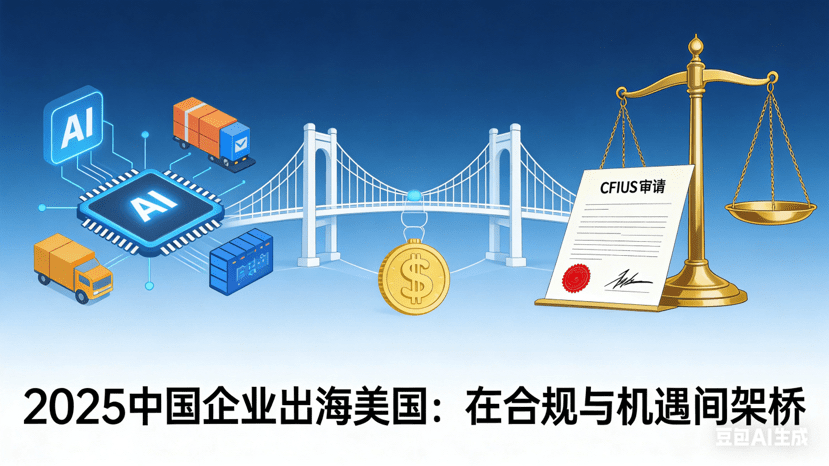
In 2025, Chinese companies face both opportunities and challenges in going to the United States. On one hand, investment in the AI sector in the U.S. is booming, with high participation from the Chinese community; on the other hand, policies such as investment reviews and technology controls are becoming increasingly stringent. Huang Mindao, the founder of Qinglv Law Firm in New York, leverages his background in Chinese and American law to provide legal services for over a hundred outbound companies, with clients gradually shifting from early cross-border e-commerce to the AI sector.
He pointed out that U.S. market regulation relies on prevailing practices rather than solely on explicit rules, and Chinese companies are prone to disputes due to neglecting hidden costs (such as compliance hiring, clauses for passing on lawyer fees, and commercial insurance arrangements); although there are few public cases of CFIUS and reverse CFIUS reviews, their deterrent effect is strong, and reverse CFIUS has significantly expanded the scope of 'regulated Chinese companies'.
Huang Mindan suggests that Chinese companies going to the United States in 2026 should pay attention to communication with the local society and shape a trustworthy corporate image, rather than just focusing on products and scale.#美联储降息 #加密市场反弹 #Web3 #科普知识 #美国