At my peak, I owned four-digit amounts of Bitcoin! If I had held onto it until now, it would probably be worth a ten-digit sum in RMB.
But most of them were sold after making dozens of times profit, but there is still a small portion left unsold. The reason for not selling is simple: the remainder is too small to care about, so it has been left on the exchange without attention.
But even if it's a small portion, it's still a three-digit amount of Bitcoin. To put it bluntly, this Bitcoin remainder that I initially looked down upon is now approaching a nine-digit sum in RMB.
In the last bull market, I made 10w and turned it into an eight-figure sum. I've been trading cryptocurrencies for ten years and now trade full-time. I've learned this, my most basic trading method, and since then, it's been like a cheat code in the crypto world, with a green light all the way.
If you want to treat cryptocurrency trading as a secondary source of income, want to share a piece of the pie in the crypto world, and are willing to spend time growing and learning, then this article is not to be missed. Read it carefully; every point is the essence of the crypto world.
From 5000U to 200,000U: Three iron rules of rolling positions for a comeback after liquidation (bloody experience).
Those who tremble at liquidation records understand that 5000U is the last opportunity.
I've seen too many people use 'all-in contracts' to roll 500U into 500,000U, but more people fall before dawn. The following position management strategy is the survival rule that a private equity team gained after 300 liquidations.
1. The initial position must be controlled within 2% of the devil's arithmetic.
Taking 5000U as an example, the initial position should never exceed 100U. When you go long as BTC breaks through its previous high, the stop loss must be set 3% below the previous low point.
This isn't being timid; it's giving the market 'false breakouts' some room for error—last year before the ETH Cancun upgrade, over 60% of false breakouts wiped out retail traders with over 5% losses.
2. The forbidden zone of accelerated rolling positions.
Strictly prohibit increasing positions before the first profit reaches 300%. When your 100U turns into 300U, the next maximum position can only be increased to 5% of the total capital (at this point total capital is 5300U × 5% = 265U).
This step-by-step rolling model allowed an anonymous trader to accurately escape before the 2021 LUNA crash, turning a 2000U capital into 170,000U.
3. The forced take-profit 'guillotine' mechanism.
Any single floating profit exceeding 50% of the principal must lock in profits. When your 5000U turns into 7500U, immediately close 50% of the position and continue to play with the profits. Last year, a trader preserved 23000U of real profit using this strategy when PEPE surged 200 times.
But the real killer move lies in step four—when total capital exceeds 20,000U, the 'death spiral hedge' must be activated. This trick allowed a Wall Street-returned trader to earn a 400% return during the 312 crash. As for the specific parameter settings...
Remember: all turnaround myths begin with preserving capital. What you are fighting against now is not the market, but that part of yourself that always wants to 'win back everything in one go.'
Stage two: When you have 100,000, you have achieved 1,000,000!
I use this method in a very simple way, just four steps: selecting the coin, buying, position management, and selling. I will explain every detail clearly!
In the first step, open the daily chart and only look at the daily level.
For MACD + Jin You's cryptocurrencies, it is best to choose a golden cross above the O-axis +; this effect is the best!
In the second step, switch to the daily chart, where you only need to look at a moving average called the daily moving average +, buy above the line and sell below.
After buying in step three, if the price breaks through the daily moving average and the volume is also above the daily moving average, then buy with the full position.
Then for the fourth sell, it is divided into three details. The first is when the wave height exceeds 40%, sell 1/3 of the overall position. The second is when the overall wave height exceeds 80%, sell 1/3. If it breaks below the daily moving average, liquidate the entire position.
The fourth step is also the most important one, since we are using the daily moving average as our buying basis. If some unexpected situation occurs the next day and it directly breaks down, then we must sell everything and not harbor any delusions! Although we use this method to select coins!
The probability of it breaking down is very low!
But we still need to be aware of risks!
After selling, wait until it rises above the daily moving average again, and then you can buy back!
Without further ado!
Share my trading strategies and insights with friends. There's a saying: standing on the shoulders of giants saves you ten years of struggle. Friends who happen to see this and want to improve their cryptocurrency trading skills should definitely read carefully and consider saving it!
When prices fluctuate in the market, it is usually because they are riding the wave of higher trading volume. Sometimes, these waves are part of a surge pushing prices into a trend; other times, whirlpools appearing in the 'ocean' of trading volume can cause prices to exhibit a degree of chaotic fluctuation. Alternatively, the market may be calm, with low trading volume, thus forming a narrow range of fluctuations.
Regardless of the state of the market's surface, prices ultimately always 'float' above trading volume.
Many technical analysts focus only on price action itself, ignoring trading volume—at least I often see this situation when browsing various trading forums or social groups, and I admit I have made the same mistake. However, observing price action along with trading volume can reveal a new layer of actionable information.
Let's look at the role of trading volume in technical analysis and how to apply this knowledge in actual trading.
What is 'trading volume' in the forex market?
Volume bars typically represent the total units bought and sold within the same time frame set by the chart. For example, in a daily chart, each volume bar represents the total trading volume for that day; in an hourly chart, each volume bar represents the trading volume for that hour.
However, in forex varieties, the calculation of trading volume may vary slightly, depending on the broker.
How is trading volume calculated?
The forex market is an over-the-counter (OTC) market, meaning there is no centralized exchange. Forex brokers only display their own trading volume information on their charts, not the total trading volume of the entire industry—which means that trading volume data may vary between different brokers. This is true for all over-the-counter markets (such as Contracts for Difference, CFDs).
In contrast, markets with centralized exchanges (such as stocks and futures traded through the NYSE or CME, or major domestic securities and futures exchanges) should report the actual trading volume of the exchanges, and this data should be consistent across all brokers providing access to that exchange.
Most online brokers use 'tick volume.' Tick volume measures the number of trades rather than the actual total monetary amount of the trades; that is, it is not trading volume in the true sense, but rather a measure of market activity. However, traders generally believe that tick volume is highly correlated with actual trading volume, so it can be utilized in trading decisions.
What does trading volume mean for brokers?
It is well-known that for online brokers, trading volume is a key indicator for measuring and determining the size, operational stability, and liquidity depth of a broker.
Some large retail brokers (including listed brokers) monthly/quarterly disclose their trading volume data on their official websites or to the media. This trading volume data includes two key indicators: monthly average and daily average.
However, to obtain relatively accurate trading volume data, the best way is to calculate the average trading volume of a broker over a longer period (a quarter/half year), so the daily and quarterly trading volume fluctuations are smaller. At least, the daily average trading volume of a broker should be calculated over the past three months or more. A broker's daily average trading volume should be at least over $3 billion to be considered relatively large.
Recently, the global fintech leader #ATFX announced impressive results. According to the latest data from Finance Magnates, #ATFX ranked seventh globally in the first quarter of 2025 with a trading volume of $776.5 billion on the MT4/MT5 platform, achieving growth for the 19th consecutive quarter. Against the backdrop of increasing macroeconomic volatility, ATFX once again demonstrated its strong market competitiveness through continuous expansion in all categories of business, technology-driven strategic layout, and deepened localized services.

Paresh Patel, the Global Trading and Risk Management Director of online broker ATFX, which is regulated by multiple strict authorities like the UK's FCA and Australia's ASIC, stated, 'In the first quarter of this year, driven by Trump's tariffs and the continued depreciation of the dollar, the financial markets exhibited record volatility and high uncertainty. Thanks to this market environment, ATFX achieved strong growth for the 19th consecutive quarter. The significant increase in trading volume mainly stemmed from the continuous fermentation of tariff policy uncertainties and the clear divergence between the policies of major central banks globally, especially between the Federal Reserve and the Bank of Japan, which brought many trading opportunities for major currency pairs like USD/JPY.'
In the first quarter of 2025, the global economy was affected by geopolitical tensions and policy adjustments, leading to increased volatility in financial markets. In the face of a complex and changing market environment, ATFX accurately grasped trends and achieved collaborative growth across multiple business lines. Among them, trading volume in precious metals increased by 34.86% year-on-year, trading volume in currency pairs increased by 20.43% quarter-on-quarter, index trading volume surged by 106.43% year-on-year, while stock products saw a year-on-year increase of 645.6% and a quarter-on-quarter increase of 97.59%, becoming the key engine of performance growth.
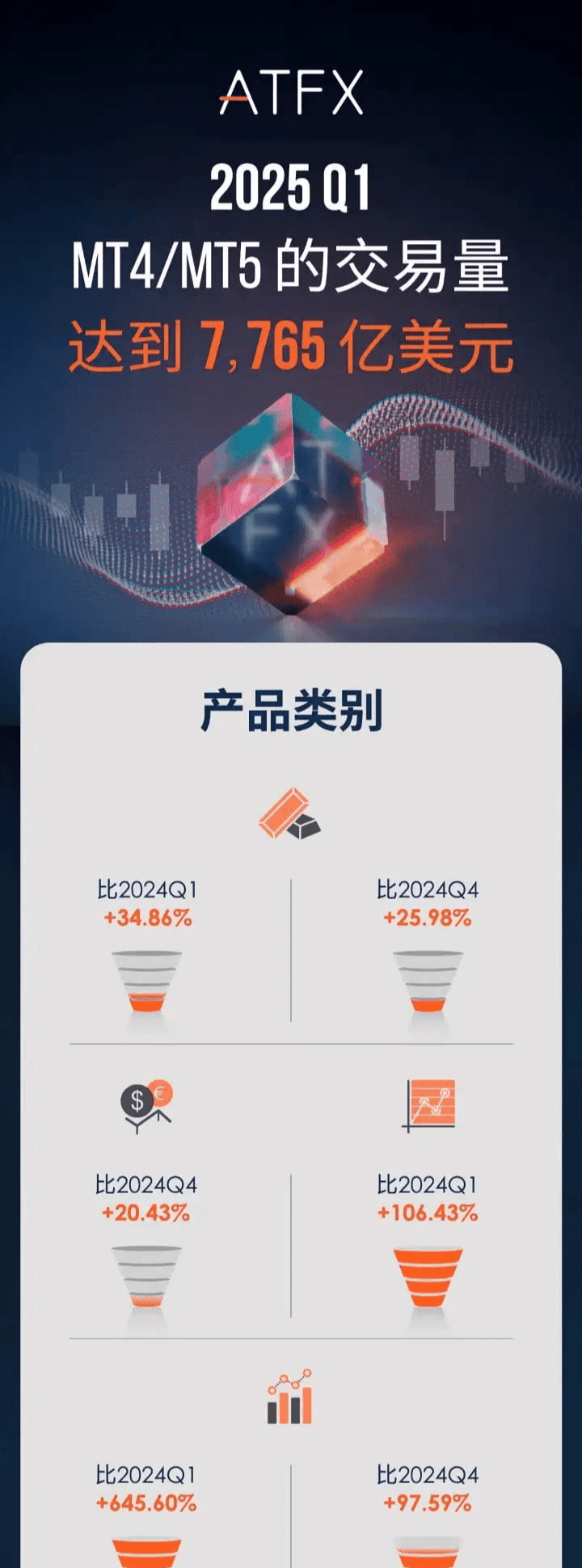
The rise in risk aversion has become an important factor driving trading activity. Global economic uncertainty has prompted investors to increase their allocation to precious metals like gold, significantly boosting trading demand. At the same time, the explosive growth of stock products also validates ATFX's strategic foresight and execution in the CFD sector.
To adapt to the rapid changes in the market, ATFX continuously optimizes its trading system, enhances execution efficiency, and expands liquidity solutions to strengthen market coverage. These measures not only help ATFX effectively capture trading opportunities but also further meet investors' needs for diversified asset allocation, driving overall performance to achieve triple-digit growth.
ATFX's trading volume has steadily increased, thanks to its dual-driven strategy of 'technological innovation + localized services.' In terms of technology, ATFX continues to increase R&D investment, launching several innovative tools including AI smart trading platforms, facial recognition account opening systems, and social trading features, significantly optimizing the user trading experience and enhancing platform intelligence and convenience.

In terms of service, ATFX relies on 23 offices around the world to provide localized services in over 20 languages, closely aligning with regional market needs. In 2025, the company held more than 2,000 investor education activities throughout the year, continuously strengthening user interaction and professional empowerment, further enhancing customer stickiness and brand influence.
At the same time, ATFX places great importance on compliance management, holding global regulatory licenses from eight major authorities including the UK's FCA, Hong Kong's SFC, and Australia's ASIC, establishing a robust global regulatory system to effectively safeguard investors' asset security. This series of measures not only allows ATFX to stand out in fierce market competition but also helps it achieve double-digit growth for 19 consecutive quarters. Looking ahead, ATFX will continue to rely on technological innovation and a global perspective to lead the upgrade of industry services and move towards a higher stage of development.
Cross-check broker trading volume against other data sources.
Since forex or CFD trading volume depends on specific broker data, it is beneficial to occasionally compare the trading volume bars of a particular broker with those from other brokers' simulation platforms or web-based chart platforms. For example, when I see a significant increase or decrease in trading volume, does it also appear in the data from other brokers? Some web-based chart tools (like TradingView) aggregate trading volume from multiple data sources to average out certain discrepancies, providing more reliable reference data.
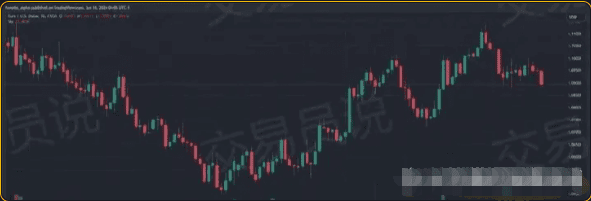
Note that some volume bars are green, while others are red. This corresponds to the color of the candlestick chart—green volume bars appear on 'up days,' while red volume bars appear on 'down days' (notably, this is the opposite in domestic financial markets).
Factors to consider when trading volume in forex.
1. Does strong trading volume support the market direction?
If I am trading in a trend following an upward trend, I want to see significant volume on the green volume bars; when the market experiences a correction, the volume on the red bars should be smaller. This indicates that market demand for that asset supports the current upward trend.
On the other hand, if I am trading in a downtrend, I want to see significant volume on the red bars, while the volume on the green bars should be smaller when the market rebounds.
Later in this article, we will further illustrate through an example where a new trend is confirmed by high trading volume following a price breakout.
2. Does the candlestick pattern come with high trading volume, thereby enhancing its effectiveness?
Let's take the pin bar (an important candlestick pattern in price action) as an example. A pin bar refers to a candlestick with a small body and a long shadow. Ideally, the shadow should account for more than two-thirds of the total length of the candlestick, meaning the body of the candlestick should be in the top or bottom third. Whether the pin bar is green or red is not important; the key is the direction of the shadow.
If I see a pin bar accompanied by high trading volume, I will pay special attention to it. I won't blindly trade it—I will also consider the market context to judge, for example: did this pin bar appear at previous support or resistance levels? Below is an example of a high volume pin bar appearing on the EUR/USD daily chart.
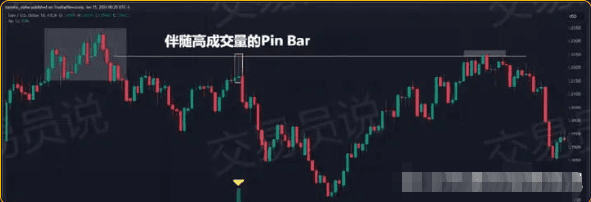
Let's analyze:
The volume bar corresponding to this pin bar is significantly enlarged.
The shadow of the pin bar pierced into a resistance area, which is a position that previously saw a market reversal.
These two factors made this pin bar a strong bearish signal. Subsequent price action confirmed this, with the market declining after this pin bar and again touching this strong resistance area.
Let's look at another example.
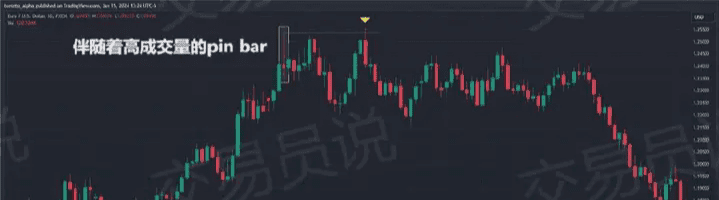
In this example, there is also a bearish pin bar, accompanied by high trading volume. However, this time, there was no obvious resistance level near the pin bar (in fact, the price had not reached that level in nearly three years). But after the pin bar appeared, the price immediately stopped rising, entered a consolidation range, and then started to fall. Note that the pin bar served as resistance during the consolidation.
3. Use trading volume to confirm breakout trends.
When the market is in a consolidation phase, trading volume usually decreases. This is not surprising, as low trading volume helps reduce volatility, which is a typical characteristic of market consolidation. If trading volume starts to increase during a breakout from the consolidation range, it can help confirm the validity of the breakout direction and indicate that the price momentum is sustainable. Let's continue with the EUR/USD example to see the price action after the pin bar.
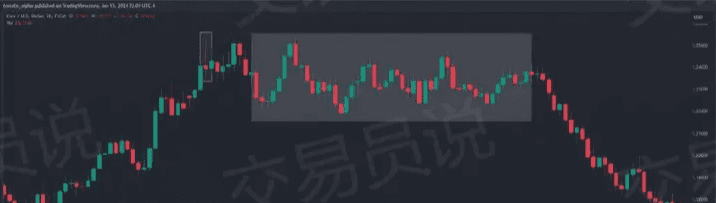
Let's analyze:
During market consolidation, trading volume gradually decreases.
As the market begins to decline, the trading volume gradually increases, with the red volume bars rising, indicating that trading volume on down days is increasing. This helps confirm that the breakout direction is valid.
Top forex volume trading strategies
My favorite volume trading strategy is Volume Spread Analysis (VSA). This is a complete trading method: it is not a mechanical strategy, and it takes time and practice to learn and apply it to real trading opportunities. I have seen many traders successfully use this method, and this concept has stood the test of time.
Volume Spread Analysis.
Volume Spread Analysis (VSA) is a trading philosophy system proposed by Tom Williams, based on the 'Wyckoff Method' developed by Richard Wyckoff. The VSA method contains many concepts, primarily sourced from Tom Williams's works (Master The Markets). Here, I will briefly introduce a widely circulated VSA concept to help you feel its core idea.
No Demand Up Bars: This bar closes higher than it opens, and the volume is lower than the past two days, which is seen as a bearish signal.
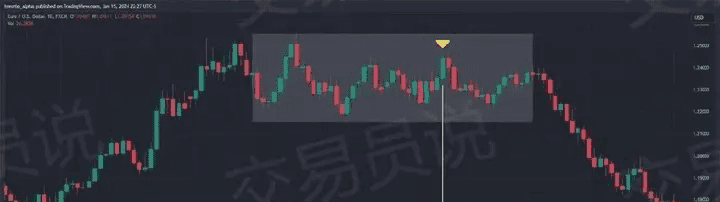
Let's break down this setup:
A bullish bar appeared with trading volume lower than the previous two candlesticks.
This case is typical because the fluctuation range (from high to low) of this bullish bar is greater than that of the previous two candlesticks. This indicates larger price fluctuations, but lower trading volume, suggesting that this rise is weaker, hence a bearish signal.
The highest price of this candlestick coincides with the resistance area on the left.
This 'No Demand Up Bar' suggests that the consolidation range may soon end and prices will fall. This pattern also helps identify the top of the consolidation range, providing a good early bearish signal.
No Supply Down Bars: This candlestick closes lower than it opens, and the average volume is lower than the trading volume of the past two days, which is interpreted as a bullish signal.
How and when to use volume trading strategies.
1. Always pay attention to market context.
Trading volume is used to confirm price action, not the other way around. In all examples, I identify bullish or bearish patterns through price action, then use trading volume as an auxiliary confirmation factor.
2. Ensure that signals are clear and distinct.
Volume analysis may be one of the most subjective areas of technical analysis—there are very few mechanical rules. Ensure that the pattern setups are clear and distinguishable—my common method is to write the trading setups into a trading log to ensure I can clearly explain my intentions and that the logic is consistent on paper.
3. Higher time frames are more valuable for reference.
My favorite volume analysis time frame is the daily chart. Then I combine it with pure price action from lower time frames to find the most ideal entry points, usually based on expected support and resistance levels.
Advantages and disadvantages of volume trading strategies
Advantages:
1. Additional information source: Trading volume provides important clues beyond price action.
2. Early reversal signals: Initial signs of market reversals are often reflected first through changes in trading volume, providing early entry opportunities for new trends.
3. Time-tested: The concepts behind volume trading have been validated for decades and remain effective.
Disadvantages:
1. High subjectivity: Very few traders adopt completely mechanical volume rules.
2. The learning curve is long: successfully integrating volume into trading requires a long time of learning and practice.
3. Trading volume is a confirming factor: traders should understand the overall context of the market, for example, whether the market is in a trend, consolidation, or approaching key support/resistance levels, and then use trading volume in conjunction with that.
Summary
The driving force of all markets comes from trading volume. Learning to interpret trading volume adds an important layer of information and context to market analysis and predicting future trends. Although learning how to use volume as an analytical tool takes some time, the rewards are worth it.
Volume analysis often reveals that prices are about to reverse or enter a new trend before other signals appear. In addition, trading volume can also help confirm the importance of certain candlestick patterns (like pin bars) and price breakout directions. Most importantly, traders should always combine trading volume with price action.
Wen Jing focuses on Ethereum contract spot ambush, and the team still has positions to quickly jump in #美联储FOMC会议 $ETH