
This morning, Ethereum skyrocketed from a low of $3022 to $3150, and the market is in a frenzy. However, a Bitcoin whale address that has been silent for 8 years is quietly absorbing a loss of $22 million amid the celebration.
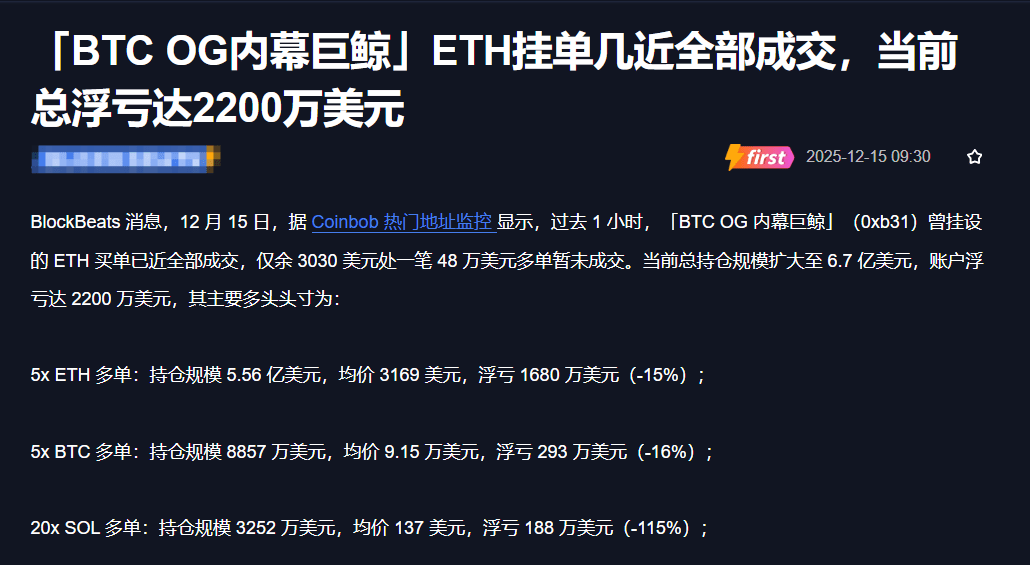
The ETH buy orders set by the BTC OG insider whale have nearly all been filled, with only one pending large order of $480,000 at $3030. This whale, with a total position size of $670 million, has current unrealized losses reaching an astonishing $22 million, of which the ETH long positions with 5x leverage have unrealized losses of $16.8 million.
Emotional Trap
The market is boiling today. A hundred-point bullish candlestick seems to have made everyone forget last week's crash, and voices proclaiming the return of the bull market and the start of a reversal are incessant on social media.
This scene is so familiar. Every rebound in a downtrend ignites hope in retail investors, but Lao Luo wants to ask: do you really believe the market will be so merciful as to give everyone a chance to break even immediately after a crash?
The essence of the market is cruel. The morning's rise, accompanied by the heated emotions across the network, is precisely the most efficient 'bull trap.' When most people begin to believe in a reversal, it often signals that the rebound is about to end.
Historical data has proven multiple times that when bearish comments about Ethereum on social media actually outweigh bullish comments, large buyers are often quietly accumulating chips. And today, the situation may be just the opposite.
Warning from the whales
The real signal lies in the blood and tears of the whales. That legendary address, which once held over 50,000 BTC and was silent for 8 years - 'BTC OG insider whale' - shows everything about its current situation.
The whale transferred a total of about $230 million to the trading platform between December 7 and December 12, and placed buy orders of about $92.7 million in the range of $3030 to $3150. These orders were almost all executed in today's morning rebound.
So what? This operation has repeatedly synchronized with Trump's statements and US policy trends. It once precisely laid out a $500 million short position before the sharp drop on October 11 and made nearly $100 million in profit. The insider whale is currently bearing a floating loss of $16.8 million on its 5x leveraged ETH long position.
If even such an insider player is stuck at this position and suffering a large floating loss, why should ordinary investors believe this is the beginning of a reversal?
Core logic: why the rebound is a trap.
My bearish logic is completely consistent with the basic laws of capital flow and price behavior.
First, this is a typical technical rebound after killing leverage. The market, after quickly dropping and cleaning out highly leveraged longs, will inevitably show a reverse pull to attract new longs, accumulating energy for the next drop.
Second, the funding situation does not support sustained rises. Historically, when Ethereum's price significantly retraces, it is often accompanied by a record outflow of ETF funds. Although there is currently no real-time ETF data, in the context of a market that has just experienced a crash, institutional funds are likely still flowing out rather than in.
Third, the key psychological level has not yet been recovered. A true trend reversal requires a strong price breakout and stabilization above key resistance levels. Currently, the pressure at $3280 is heavy; a hundred-point rebound is far from enough to turn the tide.
Short-term trading strategy
Based on the above analysis, my judgment on today's and short-term trends is as follows:
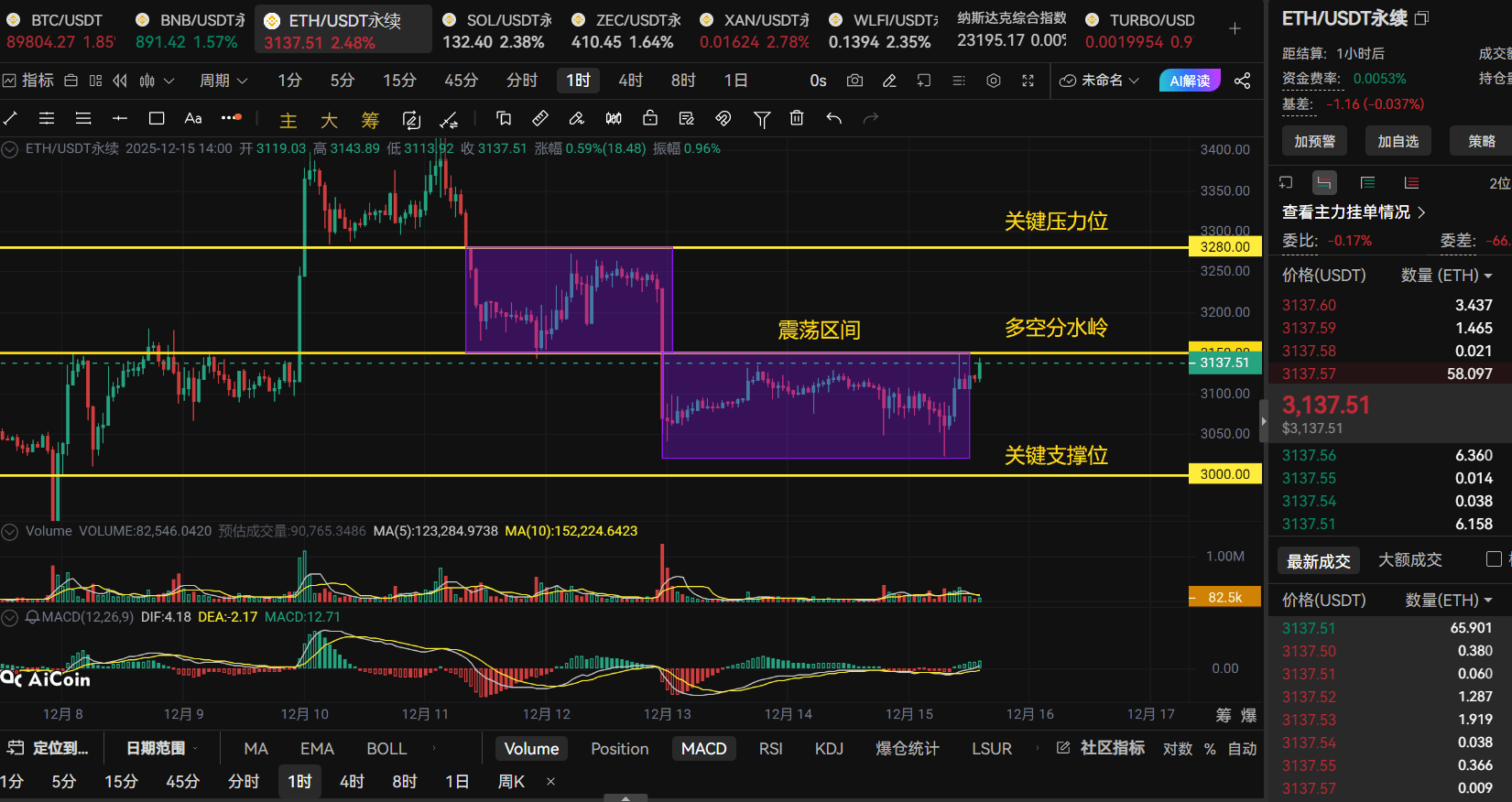
Key position determination:
Bull-bear dividing line: $3150. This is the morning rebound high point and also the area of dense whale orders. If it stabilizes here, there may be a test of higher pressure in the short term; conversely, it confirms the end of the rebound.
Lower support: $3000. This is the morning's 'spike' low point and also a psychological integer level. Once broken, the downside space will be opened.
Upper pressure: $3280. This is the lower edge of the previous dense transaction area, and a large selling pressure is expected.
Main strategy: short on rallies.
Ideal entry area: $3150-$3200 range.
Core logic: price rebounds to the dense area of whale orders and near the morning high, momentum tends to exhaust; this is the best short position risk-reward ratio.
Key position: strictly set stop loss above $3280, with the first target looking towards the psychological level of $3000; if broken, can look below $2900.
Alternative strategy: chasing shorts after a breakdown.
Trigger condition: the price effectively breaks below the $3000 integer level.
Operation key points: can follow in lightly near $2990-$3000, with a stop loss set above $3050.
Expected space: after breaking this position, there is no substantial support below, and it is expected to quickly test below $2900.
Extreme situation response: chase long after a breakout.
Low probability contingency plan: if the price strongly breaks through $3280 and stabilizes.
Cautious participation: can lightly try long in the $3280-$3300 range, with a stop loss set below $3150.
Key requirement: must be accompanied by significant volume; otherwise, it is considered a false breakout and not advisable to participate.
The calm before the storm
The market always operates in cycles: despair at the bottom, hesitation on the rise, madness at the top, and decline in hope. Today's market is currently in the stage of decline in hope.
The morning's hundred-point rise is merely the last decent exit opportunity for those who have not yet left the market, and it is also accumulating new short momentum for the next drop.
That whale with a floating loss of $22 million may be waiting for an opportunity to close their position, and their exit could very well become the last straw that breaks the market.
Remember Lao Luo's words: in a downtrend, all rebounds are for better declines. A bigger storm is brewing, and all you need to do is protect your principal and wait for the market to give the clearest signal.
When most people are immersed in the joy of a rebound, maintaining calmness, or even indifference, is the way to survive. A bull market does not start in a day, but a bear market can return instantly after a rebound.

