
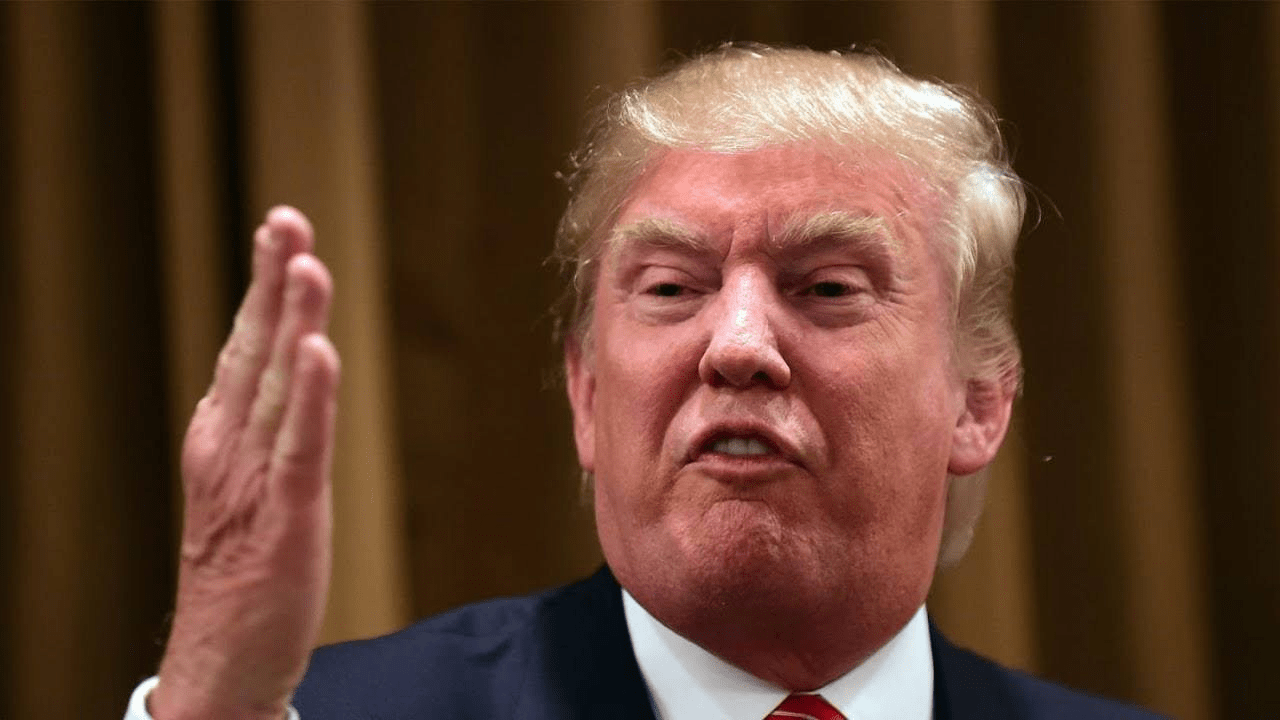
A desk where a White House executive order was signed, with Bitcoin price charts fluctuating violently in the background, ultimately settling around $92,000, while those analyses predicting $200,000 were left scattered aside.
01 End of Rumors: Trump's Real Crypto Policy
If you recently heard that Trump was going to sign an executive order banning coins sold on exchanges, I must tell you - that news is ridiculously wrong.
On the contrary, the Trump administration took an unprecedented supportive stance on cryptocurrency in 2025.
On January 23 of this year, Trump signed an executive order titled 'Strengthening America's Leadership in Digital Finance.' This document not only did not restrict cryptocurrency trading but explicitly stated the intention to 'support the responsible growth and use of digital assets.'
In fact, the core content of this executive order is to establish a presidential working group on digital asset markets led by the White House's 'Special Advisor on Artificial Intelligence and Cryptocurrency Affairs.'
This working group brings together more than a dozen federal agencies, including the Treasury Department and the Securities and Exchange Commission, with tasks including creating a federal regulatory framework covering stablecoins and other digital assets, and even studying the feasibility of establishing a national digital asset strategic reserve.
02 Policy Trends: From De-Banking to Stablecoin Legislation
The Trump administration's cryptocurrency-friendly policies go beyond this. In August of this year, Trump signed another executive order that formally prohibits federal agencies and banking regulators from denying legal cryptocurrency companies access to financial services.
This measure directly addresses what is referred to in the industry as 'Chokehold Action 2.0'—that quiet yet ongoing practice of preventing cryptocurrency companies from obtaining financial resources.
At the legislative level, Trump signed the (Guidance and Establishment of the U.S. Stablecoin National Innovation Act) (referred to as the (Genius Act)) in July, marking the first formal establishment of a regulatory framework for digital stablecoins in the U.S.
The act requires stablecoins to be backed by liquid assets such as U.S. dollars or U.S. short-term Treasury bills and mandates that issuers disclose reserve details monthly.#BinanceABCs
03 Market Reality: Why the $200,000 Forecast Failed
Now let's talk about the more eye-catching part—can Bitcoin soar to $200,000?
Unfortunately, reality dealt a heavy blow to this forecast.
At the beginning of 2025, the market was filled with enthusiastic optimism for Bitcoin, with almost all mainstream institutions setting target prices above $150,000 by the end of the year, and some aggressive forecasts even pointing to $200,000-$250,000.
Standard Chartered once predicted that Bitcoin could surge to $135,000 in the third quarter of 2025, with hopes of reaching $200,000 by the end of the year. However, the reality is that Bitcoin peaked at about $126,000 in early October and then plummeted over 33%, currently stabilizing in the $92,000 range.
Why did these forecasts collectively fail? There are four reasons:
First, the positive news has been fully anticipated by the market. 'Positive news' like ETF fund inflows had already been fully reflected in prices at the beginning of the year, losing its marginal driving force.#巨鲸动向
Second, historical cycle models have failed. Many institutions relied on the historical pattern of 'peak prices 12-18 months after halving,' but the macro environment faced in 2025 is fundamentally different from historical cycles.
Third, institutions have conflicts of interest. Many of the most aggressive forecasters are themselves stakeholders in the cryptocurrency market, such as issuing Bitcoin ETF products or providing custody services for crypto assets.
Fourth, misjudgment of the liquidity environment. Almost all institutions presupposed that 'the Fed's interest rate cut cycle is about to begin,' but the risk of inflation rebounding reignited, completely collapsing the expectations for rate cuts.
04 Forecast Revision: From Euphoria to Calm
Facing reality, institutions have had to adjust their forecasts. The most representative is Standard Chartered, which has significantly lowered its target price for Bitcoin in 2025 from $200,000 to $100,000.
The bank's analysts clearly pointed out that the main reasons for the downgrade are the weakening of two key demand drivers: the corporate treasury hoarding of Bitcoin has basically ended, and the influx of funds into Bitcoin spot ETFs is far below expectations.
Standard Chartered also clearly stated that the traditional 'halving cycle' model is no longer applicable to the current market. As ETFs become the main purchasing force, the historical pattern of dramatic ups and downs may fail.
05 Future Outlook: The Crypto Market in the New Normal
So, what can we learn from this forecast failure?
Investment experts point out that annual price targets are basically just for entertainment. They help reveal some informed participants' assumptions about supply, adoption, and macro conditions, but should not be the basis for portfolio decisions.
An important lesson is: market consensus can easily become a trap. When 90% of analysts are telling the same story, the story has lost its value for excess returns.#美联储降息
For long-term investors, the best strategy may be to continuously accumulate Bitcoin through dollar-cost averaging. By making regular, fixed-amount purchases and having sufficient patience, the probability of price increases in the long run remains high, regardless of how prices fluctuate next year.
The Bitcoin price curve is set to end in 2025 at $92,000, far below the optimistic expectations of the market at the beginning of the year. In the West Wing of the White House, that executive order supporting the development of digital assets lies quietly on the desk.
The crypto world is always searching for a balance between reality and expectations. When mainstream voices are all singing the same song, the faint voices of contrarian thinking are often the most worth listening to.
The market is always changing; the only constant is that independent thinking is more important than following authority, and risk management is more critical than precise predictions.
