
On December 16, 2025, TSLA slightly rose by 0.01% in pre-market.
A seemingly insignificant jump, yet it played out a completely different fate on Arbitrum:
An arbitrage bot running on a competing oracle suffered a daily loss of $45,000 because the price feed only had 8 decimal places, being 'squeezed' by the AMM tiered pricing.
In the same second, an institutional account using the APRO TSLA.US/USD 18 decimal precision price feed executed transactions smoothly on-chain, without even experiencing a 1 cent slippage.
On the RWA track, precision is not a detail; precision is liquidity.
And APRO has drawn an 18 decimal moat for the RWA protocol using a TSLA.US price feed.
Precision ≠ pretty numbers, but the lifeline of RWA
In the world of centralized brokers, what you see is $245.32, two decimal places are enough.
But on-chain, when slicing a TSLA share into countless parts, putting it into the AMM pool, and then layering on leverage and structured products, starting from the 10th decimal place, it's all money.
APRO's setting for the RWA price of TSLA.US/USD is:
Decimals: 18
Deployment chain: Arbitrum One / Bitlayer mainnet
Representation: Like standard ERC-20, using 1e18 as the minimum unit (similar to ETH's 1 Wei)
This is not merely about 'stacking digits for appearance', but three direct outcomes:
Align Solidity / ERC-20 precision
All RWA tokens and derivative contracts do not require various *1eN patch conversions,
Reducing 'phantom profits and losses' and attack surfaces caused by rounding errors.
Narrowing the price spread to a level that 'market makers are satisfied with'
Large institutions can repeatedly change positions under extremely narrow spreads,
actual trading friction decreases, willing to place thicker orders on-chain.
Providing the technical prerequisites for 'Best Execution'
When you claim 'the same price on-chain as Nasdaq',
how many decimal places after the decimal point determines whether auditing and compliance can nod.
Retail investors only see $245.32 on the UI,
but real funders look at: this protocol, can it offer me 18 decimal places.
APRO: Crushing Nasdaq quotes into 10^18 'liquidity particles'
From TSLA's original quote on Nasdaq to the 18 decimal places on Arbitrum, it actually walks a very narrow 'precision tightrope'.
APRO's overall path can be roughly summarized as: multi-source aggregation → precision expansion → consensus filtering → on-chain solidification.
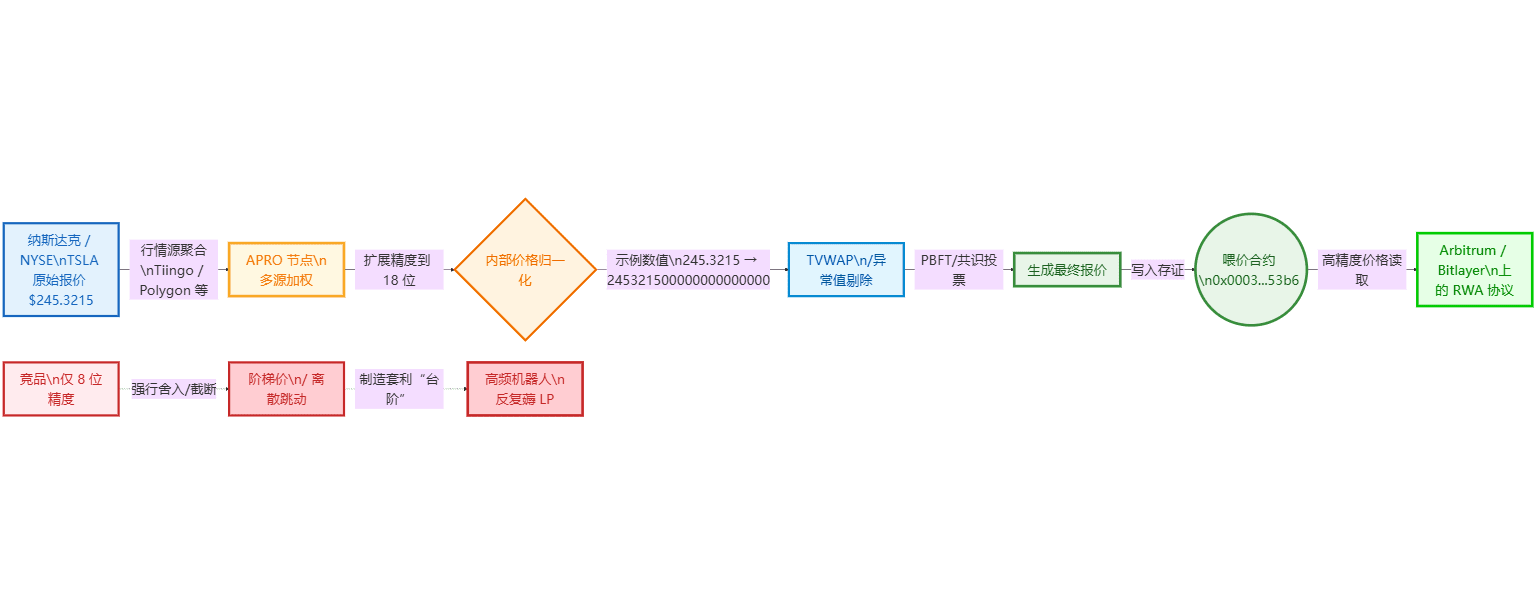
Among several details, these are the places APRO deliberately makes 'heavy':
Multi-source weighting + TVWAP
do not trust any single exchange's data,
eliminate noise during periods of extremely low liquidity through time-weighted average price.
Expand to 18 decimal places off-chain before computation
All intermediate calculations are completed in high precision space,
to avoid precision loss from 'first sacrificing then calculating'.
What ultimately writes to the chain is a 'super large integer'
unfriendly to humans, extremely friendly to contracts,
For example, 245321500000000000000, is the true RWA price carrier of TSLA.
While at competing products, the story is much rougher:
Only providing 8 decimal places,
prices display a step-like jump during extremely small fluctuations,
each 'step' is a bleeding point for market makers, a cash tree for arbitrageurs.
Liquidity premium: 18 decimal places, directly draining the depth of competing products
Why does precision directly turn into 'liquidity Matthew effect'?
The reason is simple:
Large funds will only place orders where 'they won't be exploited'.
When RWA trading platforms connect to APRO's TSLA.US price feed:
Market makers can precisely control positions and Delta based on 18 decimal prices,
the price curves in AMM / orderbook are smoother,
large orders will not be forced to cross 'price steps'.
The result is:
Thicker orders, deeper depth
Narrower spreads, smoother transactions
High-frequency robots are also more willing to run strategies here, rather than exploit LP
Conversely, what happens when using a platform that feeds prices with 8 decimal places?
Market makers would rather reduce their quoting scale,
or simply exit the market, turning to high-precision venues,
users will only see one result:
'Why is it so hard to trade TSLA.US here, and always facing slippage.'
APRO has made the precision heavier,
which means on the big pie of RWA liquidity, it has first scraped off the thickest layer of cream.
RWA does not forgive roughness: APRO uses precision to break US stocks into every wallet
In the world of MEME coins, decimal places can be played with freely:
6 digits, 9 digits, 12 digits, as long as 'it looks good, it's good for storytelling'.
But in RWA, especially for tokenized US stocks like TSLA / AAPL / GOOGL / MSFT,
Every single decimal is a minefield for accountants and risk control.
APRO's choice is:
All US stock RWA prices are aligned to 18 decimal places,
only exposing one standard to upstream exchanges and downstream DeFi protocols,
allowing all 'DeFi Legos' to be freely assembled on the same precision plane.
What this brings is not only:
Allowing you to buy 0.0000001 shares of TSLA on-chain,
Allow structured protocols to seamlessly mix TSLA prices with on-chain interest rates, volatility, and other RWAs,
More importantly:
Regulation, auditing, institutional risk control look at 'whether it can match the accounts'.
When on-chain price precision can align with Nasdaq clearing data,
RWA truly qualifies to enter institutional asset allocation tables.
APRO uses TSLA.US to firmly set this threshold.
Written at the end: APRO uses a string of 18 decimal places to fight for 'trusted price rights' for RWA
The narrative of RWA has been very heated in the past two years:
Someone is watching the quotas, who cooperated with which bank;
Someone is watching the yield, which company's coupon rate is higher.
But what really determines 'which chain, which protocol can hold large amounts of capital' is
often these overlooked underlying details:
How precise is the oracle?
How fast is the update frequency?
Are there price steps and arbitrage black holes under extreme market conditions?
APRO on pricing for TSLA.US / AAPL / GOOGL / MSFT and other RWAs,
uses 18 decimal places + multi-source aggregation + on-chain certification
what is achieved is one thing:
Who will be responsible for the 'real price' on-chain.
When Web3 starts competing on the same stage as Wall Street,
the winner won't be the protocol that tells the best stories,
but those oracles that are willing to be accountable for every single decimal.
I am like a boat trying to find a sword,
in the 18 decimal places of TSLA.US, I see the true liquidity premium of RWA—
that is between 'good enough' and 'every detail matters',
belonging to APRO's moat.

