
You can imagine the entire system as an intelligent reservoir system, whose sole purpose is to keep the water level (USDD price) permanently stable at the '1 dollar' line.
Step one: Build a strong official waterway (PSM)
First, the reservoir management office built an official waterway directly to the main river (USDT/USDC) and established strict rules:
Through this waterway, the water from this reservoir and the water from the main river will always exchange 1 liter for 1 liter, free of charge.
This establishes the value benchmark: the water level of USDD has an absolutely reliable reference and outlet.
Step 2: Introduce 'smart water vendors' (arbitrageurs)
Having only waterways is not enough; there must also be someone to automatically adjust based on market water level differences. At this point, arbitrageurs come into play, acting like 'smart water vendors' traversing between the reservoir and surrounding water markets, driven solely by the desire to profit from price differences.
When the market price is low (0.98 dollars):
1. Action: Water vendors immediately purchase USDD at the price of 0.98 yuan/liter in nearby water markets (exchanges).
2. Exchange: Then, through official waterways (PSM), exchange for USDT worth 1 yuan/liter for free at a 1:1 rate.
3. Result: Net profit of 0.02 yuan per liter. They continue to purchase, leading to a decrease in the supply of USDD in the market, and the price gradually returns to 1 dollar.
When the market price is high (1.02 dollars):
1. Action: Water vendors exchange USDD through official waterways using USDT.
2. Sale: Immediately sell at a high price of 1.02 yuan/liter in nearby water markets.
3. Result: Net profit of 0.02 yuan per liter. They continue to sell, leading to a flood of USDD in the market, increasing supply, and the price is driven back to 1 dollar.
Key point: Arbitrageurs are not volunteers; they are profit-seeking. But it is this 'selfishness' that makes them tireless automatic balancers, constantly pulling market prices back to the official waterway's pegged price.
Step 3: Ensure that the waterways never run dry (sufficient liquidity)
The mechanism above must continue to operate under a fatal premise: there must always be enough 'water' available in the official waterways to exchange.
If an arbitrageur wants to exchange 100 million USDD, but there are only 100,000 left in the waterways, then the remaining 90 million can only be bought at high prices in the market, causing the price to immediately go out of control.
The strategy for USDD is: to pre-store tens of millions of dollars in USDT/USDC in PSM pools across multiple chains like TRON and Ethereum. This is like connecting the official waterways to a huge reservoir, ensuring that 'water vendors' can exchange fully at any time without causing the system to stall due to lack of water.
Step 4: Add a foundation stone for the entire reservoir to prevent collapse (over-collateralization)
Finally, to cope with extreme 'drought' (market volatility) or panic 'water rush' (bank runs), the reservoir has laid the strongest foundation stone:
For every liter of water released (issuing 1 USDD), the bottom of the reservoir must be collateralized with assets worth more than 1.2 yuan (such as TRX, BTC, etc.).
This means:
1. Confidence backing: Users know that even if all previous mechanisms are temporarily under pressure, the hard assets at the bottom of the reservoir are sufficient to redeem their USDD.
2. System collapse prevention: If the value of the collateral falls, the system will automatically replenish or liquidate to ensure that the collateral ratio is always above 100%. This fundamentally eliminates the risk of algorithmic stablecoins relying solely on confidence with 'empty bottoms'.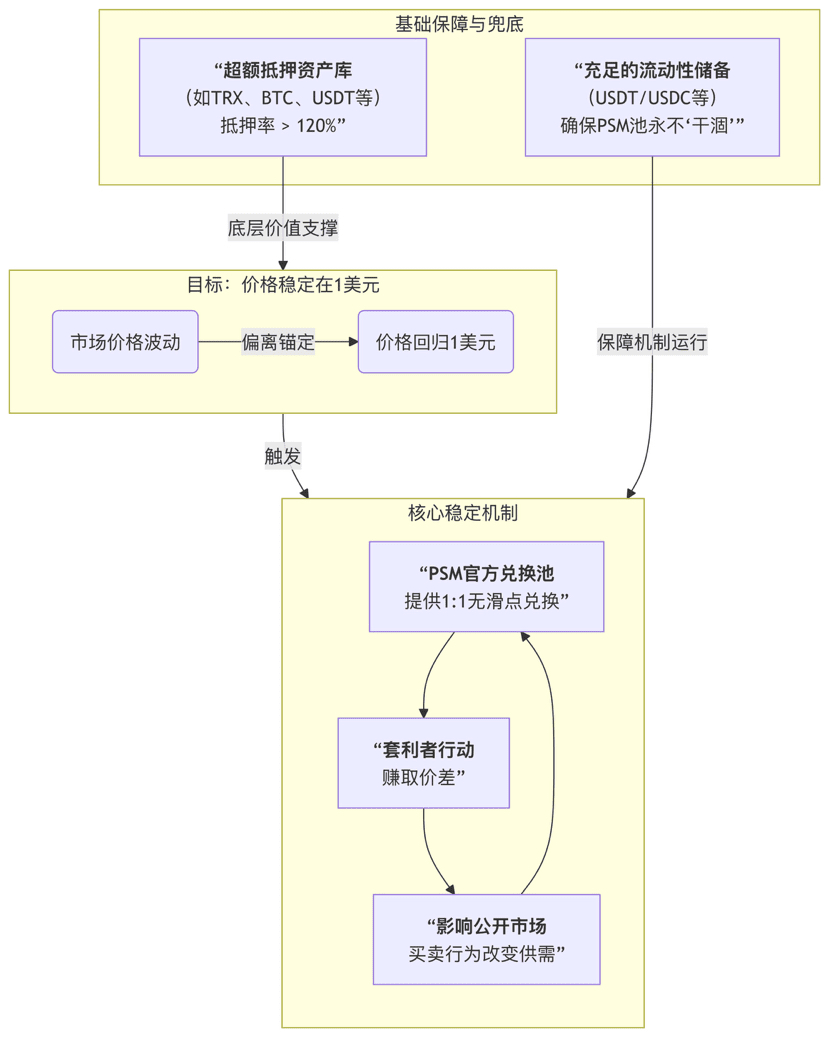
Panoramic view: How is the closed loop formed?
Now, let's connect to see this perfect closed loop:
1. PSM (official waterways) established a price peg (1:1 exchange).
2. Arbitrageurs (smart water vendors) exploit the price differences between market prices and the officially pegged price, and their actions themselves become the driving force for price correction.
3. Sufficient liquidity (reservoir) provides the fuel guarantee for arbitrage actions, ensuring that the repair mechanism can continue to operate.
4. Over-collateralization (foundation stone against collapse) injects ultimate credit and pressure resistance into the entire system, preventing a death spiral.
In simple terms: Pegging (PSM) provides the target, arbitrage provides the motivation to reach the target, liquidity ensures the uninterrupted flow of motivation, and over-collateralization stabilizes the vessel in turbulent waters. All four are essential and together constitute the core logic for USDD's stability in a volatile market.

