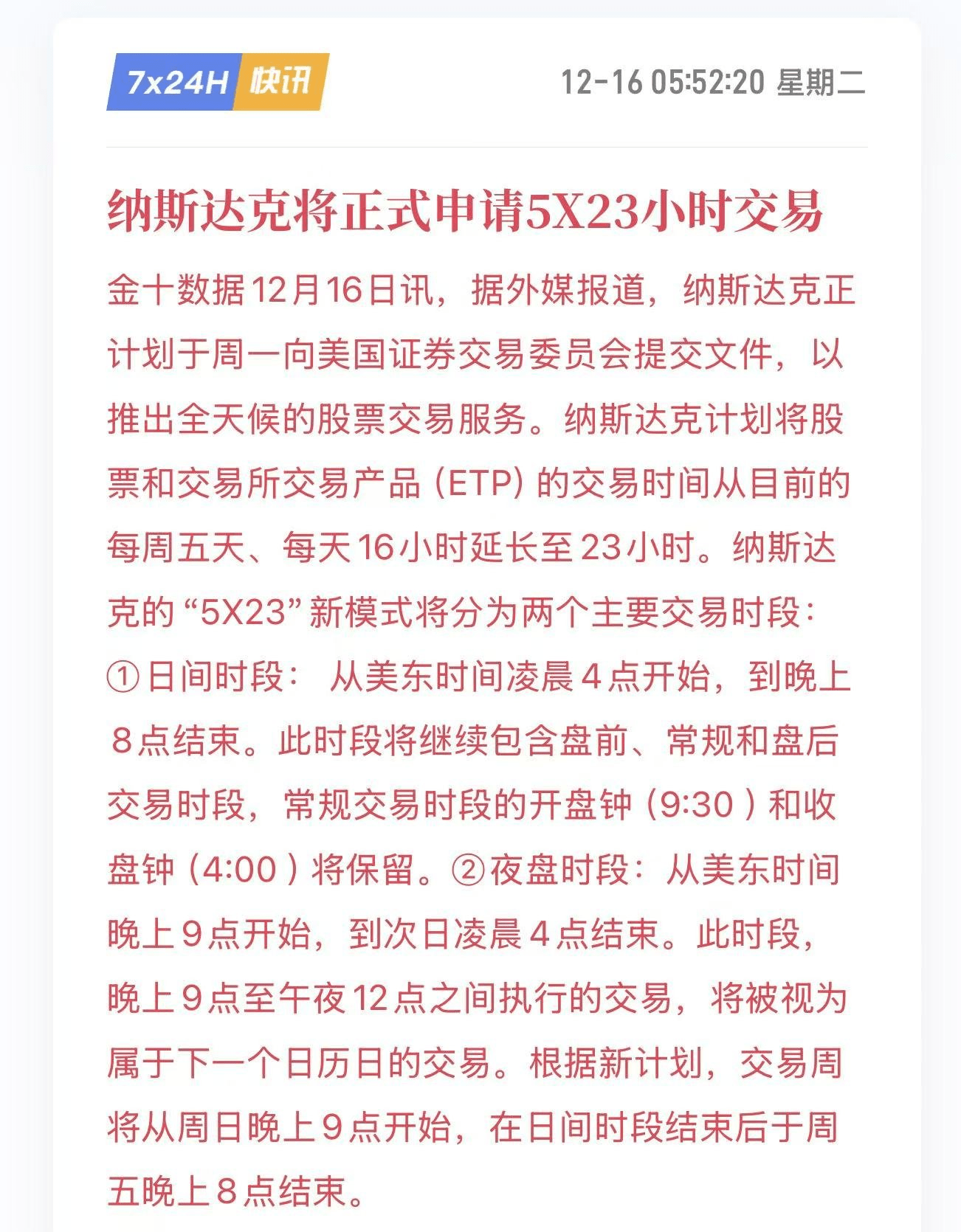
On December 15, 2025, Nasdaq formally submitted an application to the U.S. Securities and Exchange Commission (SEC), proposing to extend the trading hours of stocks and exchange-traded products (ETPs) from the current approximately 16 hours per day to 23 hours per day, five days a week (5×23 model). The new model is divided into daytime hours (4:00 AM to 8:00 PM Eastern Time) and nighttime hours (9:00 PM to 4:00 AM the next day), with a 1-hour break for system maintenance. If approved, implementation is expected in the second half of 2026.
This initiative stems from the surge in demand from global investors for U.S. stocks, particularly investors in time zones like Asia, as well as the appeal of 24/7 trading in the cryptocurrency market. Nasdaq aims to compete for these capital order flows and lay the groundwork for future markets for digital assets such as tokenized securities. As asset tokenization accelerates, on-chain trading of traditional securities will inevitably become the norm.
The advantages of round-the-clock (or nearly round-the-clock) trading
1. Enhancing Market Liquidity and Trading Activity:
The trading volume during non-traditional hours in the US stock market has significantly increased (from an average of 700 million shares per day in 2021 to over 1.7 billion shares at the beginning of 2025). After extending the hours, the overall trading volume is expected to rise further, especially during sudden events (such as geopolitical conflicts, economic data releases), allowing investors to respond instantly, reducing the 'overnight gap' risk, and improving price discovery efficiency.
2. Creating a Global Continuous Market:
Covering investors across multiple time zones facilitates overseas capital participation, enhancing the 'capital siphoning' effect in the US stock market. Global investors can trade US assets during local working hours, attracting more international order flow.
3. Convenience and Instant Response:
Ordinary investors can trade according to their personal schedules, while institutions and high-frequency traders can seize opportunities more quickly, making the overall market more aligned with global realities.
The disadvantages of round-the-clock (or nearly round-the-clock) trading
1. Volatility Amplification: The longer the trading time, the greater the market fluctuations. The cryptocurrency market trades for 168 hours a week, leading to high volatility; in contrast, the US stock market currently trades for only about 30 hours a week. After extension, similar effects may occur, accumulating more 'trading history' but also amplifying risks.
2. Liquidity Differentiation and Rising Trading Costs: Nighttime trading volumes are usually much lower than daytime, leading to wider spreads and insufficient liquidity. Nasdaq executives also acknowledge that manipulation (such as pump and dump) is more likely to occur during low liquidity periods, increasing slippage and execution risk.
3. Higher Requirements for Ordinary Investors: Under the current system, non-trading hours can mean 'market closure'; in a round-the-clock model, investors must continuously monitor, facing psychological pressure and information overload from an 'always awake market.' This is more beneficial for algorithm-equipped high-frequency institutions, while ordinary retail investors may be at a disadvantage, with increased decision-making burdens.
Overall, the 5×23 model is a key step for the US stock market's transition toward globalization and digitization, providing short-term benefits for liquidity and convenience, but also amplifying volatility and differentiation risks. If it moves further towards a true 7×24-hour model in the future, stronger regulatory, clearing infrastructure, and investor education will be needed. For ordinary investors, it is recommended to focus on long-term holdings and avoid frequent participation in low liquidity period trading.