
$FORM The dealer is secretly happy at this moment: retail investors are starting to collectively fantasize about the main upward wave again, the chips are almost ready, and it can be smashed.
FORM The core keywords of this line are just two: chip divergence + inducement risk. On the surface, the market looks 'bullish', but this kind of bullishness is more like an emotional bullishness—prices can be pushed up, and the K-line can look very good, but once 'the chips are diverging', it means that every upward move above is more like completing some kind of 'handover', rather than making a real trend push. The most dangerous point is: what you see is 'rising', what they see is 'selling'. Therefore, the next probability is not a one-sided move, but rather to first stir up the long and short emotions, creating an illusion with several fast-paced rises/falls, and finally harvesting the most common mistakes people make (chasing up, adding positions, all-in).

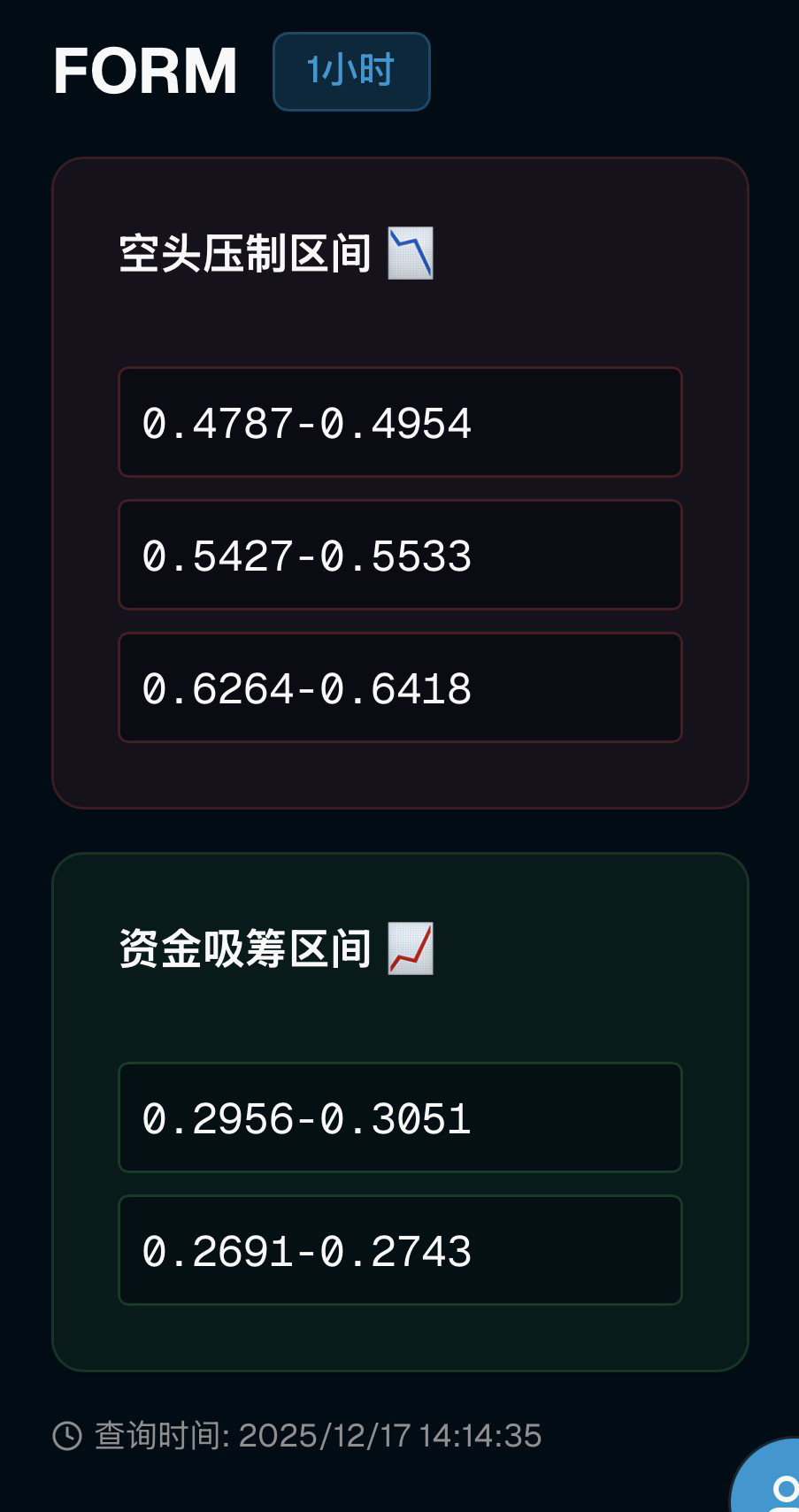
First, clarify the key areas: the upper short-selling pressure zone is densely distributed in
0.4787–0.4954
0.5427–0.5533
0.6264–0.6418
This 'layered pressure' has two layers of meaning: first, each advance at the upper level requires new incremental funds to relay; otherwise, it will be stuck by the sell orders at the upper level; second, the main force loves to make moves in such areas—because it is easiest to create the illusion for retail investors that 'it has broken through and is about to soar', and when emotions heat up, the chasing orders come in, and once the chasing orders come in, the conditions for smashing the market are met.
The funding accumulation zone below is
0.2956–0.3051
0.2691–0.2743
Pay attention to the structure of these two segments: it is not a single point, but a 'range', which is more like a 'working area' where funds are willing to repeatedly take stock and frequently turnover. In other words, the place that can truly stabilize the price again may not be in front of you, but in the lower accumulation zones. By comparing these two sets of ranges, you can understand why it is advised to 'stay flat for risk avoidance, and not recommended to enter the market'—the upper side has dense pressure, and the lower side is the accumulation working area, while the space in between is the easiest to enact the drama of 'luring the bulls → sharp decline → re-accumulation'.
Next, let's break down the most common scenarios clearly to avoid being led by the rhythm:
The first scenario: lure the bulls to rise to the first pressure zone and then crash. Usually, a period of unreasonable rise will be used to boost market sentiment, often targeting a position like 0.4787–0.4954 that 'looks like it is about to break out'. When it reaches the upper edge of the range, there will be two false appearances in the market: one is a slow grind, making you think it is about to break out; the other is a sudden spike, giving you the illusion of a 'breakout confirmation'. Then comes the most classic cut—rapid retreat, breaking through the stop losses and leveraged positions of those chasing the rise, causing the price to return downward to a more favorable accumulation area. The key of this scenario is not whether it can rise to pressure, but whether it can stabilize after rising to pressure. An unstable rise is essentially just providing liquidity for selling.
The second scenario: no more performance, directly retreat to the accumulation zone. When the divergence of chips becomes more obvious and the upper relay is insufficient, the market may not provide any 'comfortable entry opportunities' and will directly push the price towards the accumulation zone of 0.2956–0.3051. When it reaches the accumulation zone, phenomena such as 'unable to fall further', 'more lower shadows', and 'repeated pullbacks' will appear—because this is where buyers are willing to take on the stock. This scenario is the cruelest for retail investors: you will constantly think about bottom-fishing during the decline, only to get trapped every time you try, until you have no bullets left when you actually reach the accumulation zone.
The third scenario: a mixed battle between bulls and bears, going up first and then down, or going down first and then up. This is also a typical form of 'creating a mixed battle between bulls and bears': first, a surge gives bulls hope, then suddenly retreats and shatters the bulls' confidence; or first, a sudden drop scares people away, then pulls back to let you chase highs. Its only purpose is to make you lose your rhythm. Once you trade with emotions, you will constantly add positions, stop losses, reverse, and then reverse again at the wrong places, ultimately giving away your chips.
So how to respond? The core is summarized in one sentence: now is not the stage to compete in technology, but the stage to compete in discipline.
If you are flat: the optimal solution is to continue being flat, waiting for the market to provide evidence of 'stabilization' on its own. The so-called evidence is not 'it has risen', but 'after rising, it can stabilize above the pressure zone, retest without breaking, and then strengthen again'. Before seeing this structure, all rises can be understood as 'part of the lure'.
If you are holding a position: do not rely on 'faith' to bear fluctuations. During the divergence of chips, it is most likely to happen that 'it looks like it can still rise, but suddenly a large bearish candle wipes out all profits'. A more rational handling is: do not let yourself fall into passivity—either reduce pressure in advance (lower position), or set a clear bottom line of 'leave if it breaks down', do not wait until emotions collapse to handle it.
If you must participate: only use the method of 'small position + clear stop loss + no adding positions or averaging down', and it is more suitable for making quick and fast trades, rather than fantasizing about taking the main rise all at once. Because when the upper pressure is distributed in steps, each step may become a 'final destination'.
Lastly, engrave this sentence in your mind: when chips diverge, a rise is not a good sign; a rise is a dangerous signal. Because the smoother the rise, the more people chase it, and the easier it is for the main force to complete the turnover at high levels; and once the turnover is completed, the decline often defies reason. Real opportunities usually do not occur at the moment when 'everyone thinks it will break out', but at the moment when 'panic selling is over, the price returns to the accumulation zone, and the market starts to stabilize'.
For reference only, not constituting any investment advice. When trading becomes overwhelming, pause first; surviving is more important than getting one call right.
