
The big one is coming! The rationale for the Federal Reserve's preventive rate cut in December has strengthened, and the likelihood of a rate cut has greatly increased. This has directly altered interest rate expectations, lowering the real yield on U.S. Treasuries, which gives cryptocurrencies, sensitive to U.S. dollar liquidity, upward momentum in their valuation models as the discount rate decreases. At the same time, the expectation of a rate cut puts pressure on the U.S. dollar, and the weakening dollar makes dollar-denominated assets like Bitcoin more attractive to international investors, potentially leading to capital inflows. Moreover, since CPI did not show any unexpected results, it has removed short-term uncertainties, shifting funds from safe-haven assets to risk assets, driving a rebound in cryptocurrency prices.

However, we cannot only look at the short term. Although a rate cut in December is basically certain, the core CPI year-on-year is still far above the target, and the Federal Reserve will be very cautious. The market's optimistic expectation for rapid rate cuts in 2025 may need to be adjusted. The short-term rate cut in December may bring a liquidity-driven rebound, but in the medium to long term, unless inflation drops significantly, it will be difficult to replicate the super bull market of 2020 - 2021; the market may enter a structural consolidation or slow bull market.
This CPI data is also a test of Bitcoin's dual attributes. With moderate inflation and interest rate cut expectations dominating, Bitcoin's risk asset attributes are more evident, moving in tandem with tech stocks. However, if stagflation occurs in the future, Bitcoin's performance will be difficult to predict.
For altcoins, during the initial macro benefits, funds first flow into Bitcoin, benefiting Ethereum as well, while other mid and small-cap altcoins rely on the performance of Bitcoin and Ethereum, as well as their own ecological development for rebounds. Moreover, market funds may concentrate on top assets, making altcoins more volatile and risky.
Currently, the market is in a stage of transition from 'expectation trading' to 'fact trading.' The CPI data has made the expectation of a rate cut in December more certain, but the market has partially digested this news. The true price direction will depend on the statements made during the December FOMC meeting regarding 2025; hawkish hints may end the rebound.
The resonance of technical and macro perspectives is also crucial. Taking Bitcoin as an example, when the macro environment improves, we need to see if it can break through and stabilize in the key resistance area of $100,000 - $105,000. If it succeeds, there will be significant upward space; if it fails, it may return to consolidation.
For investors, in a situation where the interest rate cut cycle is starting but at a moderate pace, cryptocurrencies are suitable as high-risk, high-volatility satellite allocations. It is recommended to dollar-cost average or build positions in batches for major assets like Bitcoin and Ethereum to smooth costs and avoid chasing highs and cutting losses. Leveraged traders should be cautious, as market volatility is high before and after macro data releases, with a high risk of liquidation.
In summary, the US November CPI data brings short-term benefits to the cryptocurrency market, but the subsequent development depends on the Federal Reserve's balance between combating inflation and preventing recession. Investors should take a rational view, make strategic plans, and respond cautiously to market changes.
Now let's talk about the recent $ZEC trend: ZEC is currently in a weak consolidation recovery phase within a bearish trend, and the overall market structure is bearish. The price is operating below key moving averages; although short-term downward momentum has weakened, it is attempting to build a temporary consolidation platform near 390, but the subsequent trend remains uncertain.
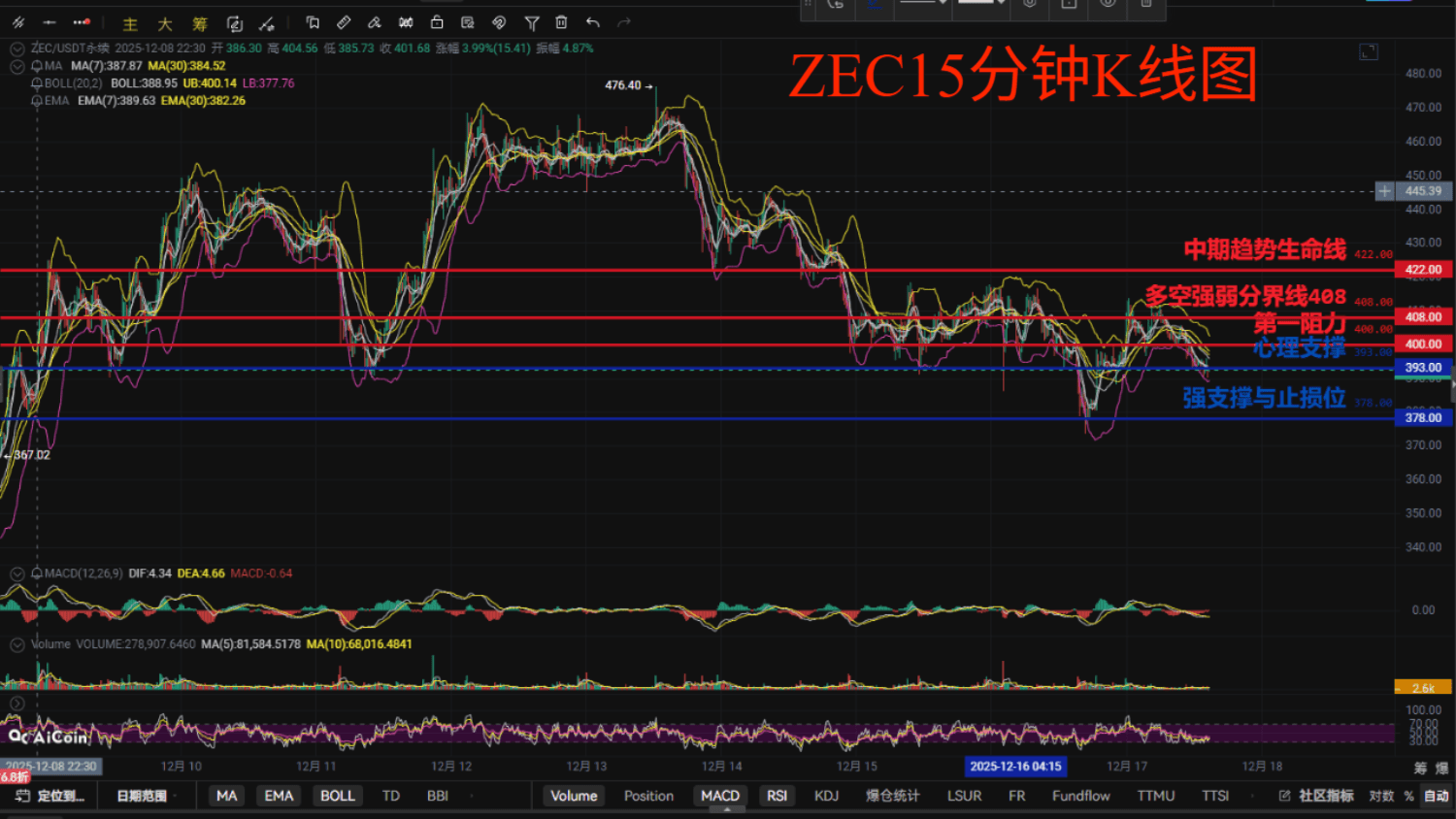
From a technical indicator perspective, the price has risen to near the short-term 7-period moving average, which is the first resistance level. Whether it can stabilize here will determine if the short-term rebound can continue. The 30-period moving average is the medium-term bull-bear dividing line, and the price is far from it, making it a strong resistance zone. In terms of Bollinger Bands, the price is weakly operating between the middle and lower bands, with the lower band at 375 being strong support; once it breaks, the downside space will open up. The middle band at 406 is an important checkpoint on the rebound path. The MACD indicator shows a bearish trend, but the green bars are relatively short, and the DIF is showing signs of turning closer to DEA, indicating a potential exhaustion of short-term downward momentum and a low-level golden cross. However, the trading volume has severely shrunk, and the rebound lacks new bullish funds to drive it, making the foundation unstable.
Based on these circumstances, there are three possible future trends. One is a weak rebound followed by continued decline, with a probability of 50%. The price fluctuates in the 390 - 400 range with reduced volume; if it cannot break through 406, it may turn and drop below 375, challenging the previous low of 300.78. The second is a consolidation seeking a breakthrough, with a probability of 35%. The price fluctuates widely in the 375 - 406 range, with the MACD forming a golden cross below the zero axis, waiting for external catalysts to break through strong resistance zones and reverse the decline. The third is a direct volume reversal, with a probability of 15%. Major positive news or a shift in market sentiment occurs, along with a massive breakthrough of MA30 forming a V-shaped reversal.
For investors, different situations require different strategies. If holders have high costs, they can reduce their positions in batches as the price rebounds to around 398 and 406, with 375 as the stop-loss bottom line. For those observing with cash, aggressive types can try a light long position when the price pulls back to around 375 without breaking and shows a 15-minute level bottom divergence, targeting 398, with a stop-loss set below 372; conservative types should patiently wait for the price to break above 406 with volume and not break on the pullback before entering, targeting 420.
Overall, $ZEC the current downtrend is slowing but has not shown signs of reversal, and a volume-less rebound is a hidden danger. If you are still confused about how to operate? Click on the avatar to follow me, this round of the market will explode more 100x coins, guessing is not as good as the chat room to grasp!


