


GT Radar Weekly Report 12/17
Market Dynamics
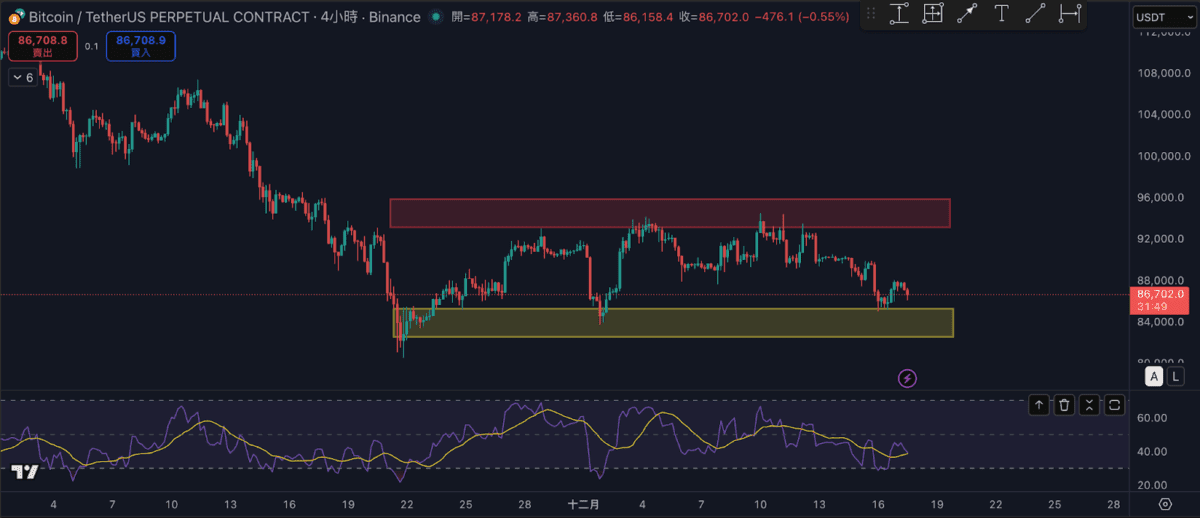 Bitcoin continues to oscillate: price fluctuations, optimistic sentiment, and the breakthrough before the holiday is still to be observed.
The current Bitcoin trend has entered a typical high-level sideways oscillation pattern. Since early December, the price has tested the upper pressure zone (93,000–94,000 USD) multiple times without success, while finding support around 82,000 – 85,000 USD, forming a clear range oscillation structure.
The RSI indicator has shown a phenomenon of rebounding after multiple touches of the oversold edge. It is currently in a neutral to low range, indicating that the market has not yet entered a state of extreme panic, but the bullish momentum is also weak, lacking the strength to push prices upward and break out. Overall, this sideways structure is a typical 'bottoming consolidation period', with prices testing back and forth between significant support and resistance, waiting for future catalysts to emerge to choose the direction for the next trend.
Recent U.S. policy initiatives regarding 'incorporating Bitcoin into national strategic assets' and exploring measures to allow payment of federal taxes in BTC are seen as important long-term positives, boosting investor confidence in Bitcoin's standing in the macro financial system. Therefore, from the perspective of social sentiment, the current market atmosphere leans towards optimism, with many community discussions focusing on the potential driving effect of policy positives. Additionally, the inflow of funds and seasonal rebound expectations during the year-end festive period have led many community opinion leaders (KOLs) to believe that there is still an opportunity to break through the upper resistance before the end of the year.
In summary of technical and sentiment analysis, the strategy suggests adopting a range trading mindset for Bitcoin: around 85,000 can serve as a defensive reference for a phase low. If it can break and stabilize above the 93,000 - 94,000 USD resistance zone with significant volume, it is expected to open up new upward space. If the resistance cannot be successfully broken, then the short-term strategy remains to buy low and sell high, avoiding chasing highs. Overall, Bitcoin is currently in a volatile consolidation phase with no clear trend breakout on the technical front, and although social sentiment is slightly bullish, there is no real catalyst to ignite it.
Deribit options data shows that the market has entered a 'range defense' state.
From the latest options data of Deribit, the Bitcoin market currently does not show strong bets on 'big rises or big falls'; the overall structure is closer to a defensive configuration centered on range stability and convergence of volatility. Whether looking at strike price distribution, expiration structure, or volume changes, market sentiment still leans towards waiting and observing, with directional consensus yet to form.
First of all, in the 'open interest based on strike price distribution,' it can be seen that the overall Put/Call Ratio is about 0.54, indicating that call options still dominate, but not extremely bullish. A large amount of open interest in calls is concentrated in the high strike price range above $100,000, showing that the market has not given up on long-term upward expectations, but these positions are mostly medium to long-term configurations rather than short-term breakout bets. Conversely, the concentration of puts is mainly in the $75,000 to $85,000 range, reflecting that investors are more inclined to hedge against downside risks rather than betting on deep crashes.

From a transaction volume perspective, recent options trading is still dominated by weekly and monthly options, with daily options having a low proportion, indicating limited market willingness for short-term speculation. Even when some trading days see increased transaction volume, it does not accompany a simultaneous expansion of open interest, showing more of an adjustment and hedging of existing positions rather than new risk exposure.
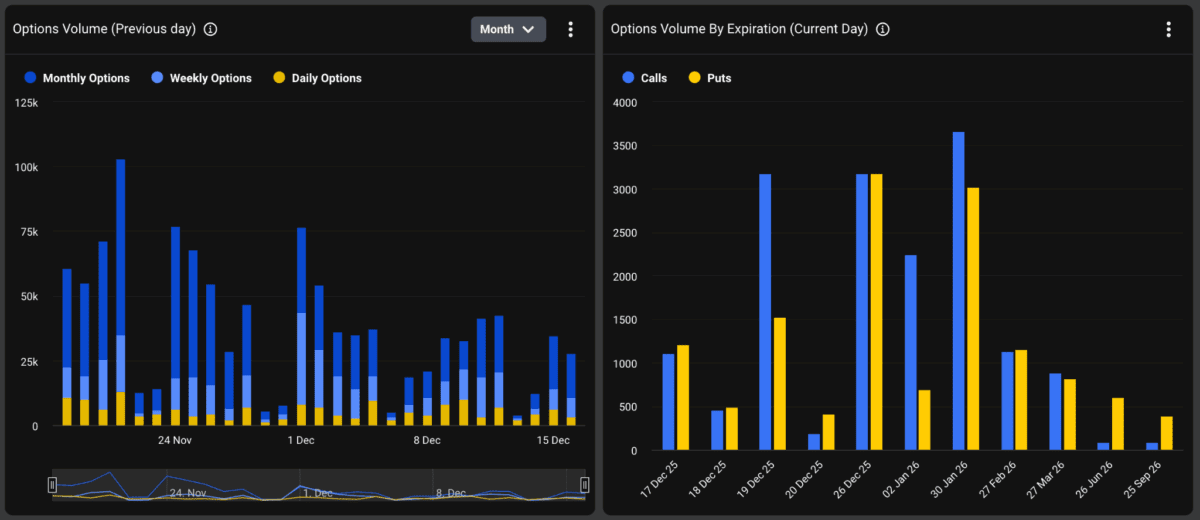
In summary, the Deribit options market currently shows a typical 'range consolidation' structure: a defensive zone established by puts below, while calls suppress short-term chasing momentum above. Investors mainly respond to uncertainty through selling volatility, protective positions, and medium to long-term options. Before clear macro catalysts (such as policy shifts, liquidity changes, or regulatory breakthroughs) emerge, the market is more likely to maintain a state of oscillation rather than quickly moving into a trend.
U.S. employment and consumption data released, short-term noise rises but fundamentals remain stable.
The U.S. November official employment report and October retail sales data were recently released, showing slightly weak overall data, sparking renewed discussions in the market about economic slowdown. However, a deeper breakdown reveals that the labor market and consumer momentum have not structurally deteriorated, and the data fluctuations more reflect one-off policy factors rather than a comprehensive weakening of demand.
In November, non-farm payrolls increased by 64,000, slightly above the market expectation of 50,000; however, the previous value was significantly revised down to a decrease of 105,000, and the total for August and September was further revised down by 33,000, making the average employment growth over the past three months negative. Overall, since the second half of the year, U.S. employment growth has clearly slowed, showing an almost stagnant state.
However, further observation of the employment structure reveals that the main reason for the significant decline in non-farm employment in October was a monthly reduction of 157,000 in government employment, marking the largest drop since the pandemic began. This phenomenon mainly stems from the federal government’s voluntary departure program initiated at the beginning of the year, which is now reflected in the data and is a policy-related, one-time adjustment. Excluding the impact of the government sector, private sector employment has still increased by about 60,000 on average over the past two months, indicating that labor demand from businesses has not shown systematic deterioration.
Regarding the unemployment rate, it rose to 4.6% in November, reaching a new high since September 2021. However, this increase is not due to a reduction in private sector employment, but rather an increase in labor participation rate and more government separations. Since September, the number of unemployed has increased by 228,000, while the labor force has increased by 323,000, reflecting that more people are returning to the labor market, rather than being due to recession-type unemployment.
After the data release, the market expects about 2 basis points of rate cut space in 2026 through the FedWatch tool, with the timing falling in April and July. In the context of the Federal Reserve having initiated rate cuts and continuously providing liquidity support, the current market's baseline scenario for the U.S. economy remains moderate growth, rather than a rapid transition into recession.
Overall, while recent employment and consumption data have increased short-term volatility, it is still insufficient to shake the judgment of medium-term economic stability. The market is likely to continue pricing within the framework of 'slowing growth but not stalling'.
Binance trading analysis
GTRadar - BULL
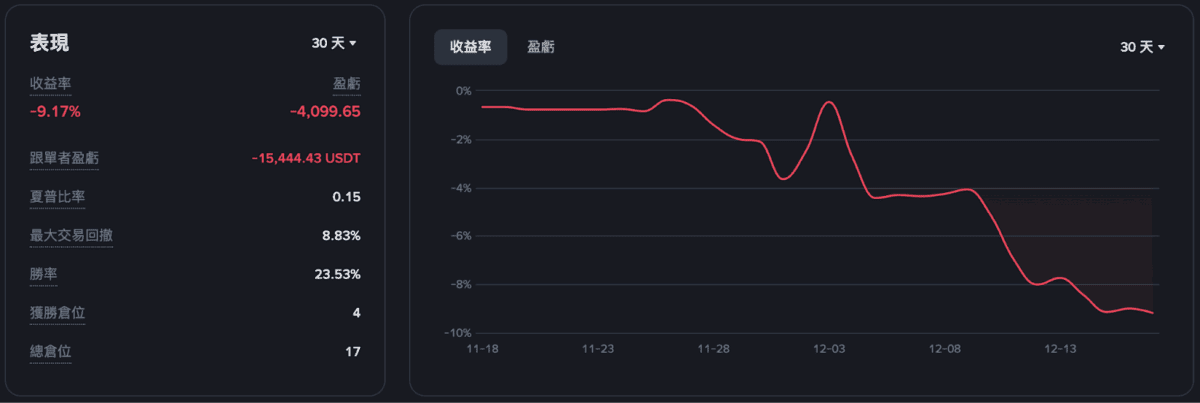
Trading link
GTRadar - BALANCED
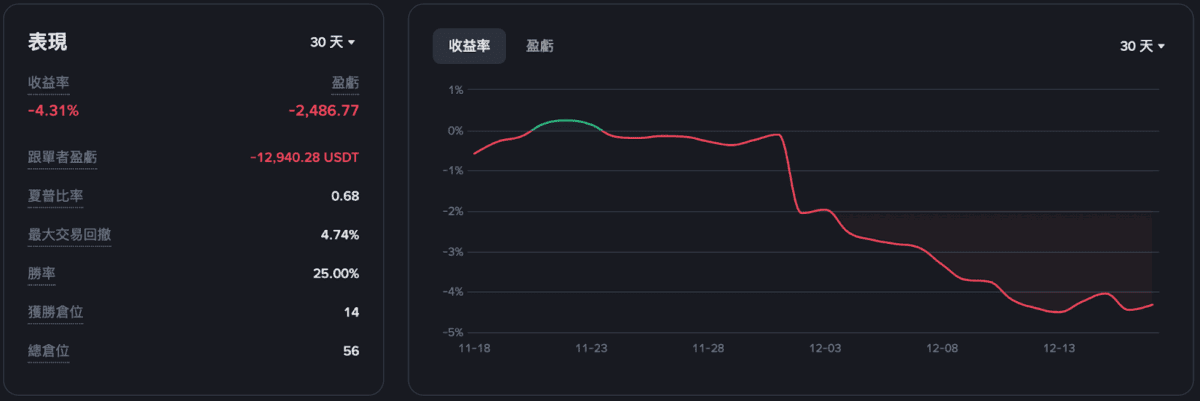
Trading link
'GTRadar - BULL' and 'GTRadar - BALANCED' yields over the past 7 days were -4.19% and -0.57%, respectively, while over the past 30 days, they were -9.17% and -4.31%.
Currently, 'GTRadar - BULL' holds a net long position of about 5%, primarily in SOL and BNB.
Currently, 'GTRadar - BALANCED' holds a net short position of about 10%, mainly in AVAX and ETC.
Investors who frequently change their trading portfolios tend to have lower long-term returns than those who consistently follow one portfolio. Do not easily end a trade due to short-term drawdowns; from the curve chart, a drawdown is actually a good time to start trading. Frequent entry and exit can significantly reduce returns.
Focus news
Alliance DAO co-founder comments on tech industry moats: L1 public chains lack defensive power.
Alliance DAO co-founder Qiao Wang shared his ratings of the strength of 'moats' for various tech companies and blockchain projects last week, sparking widespread discussion in the crypto and tech industries. A moat is typically seen as a company's or protocol's ability to withstand competition and maintain long-term competitive advantages.
Powell's post-meeting comments dampen rate cut expectations! Bitcoin spikes then falls back.
The Federal Reserve announced last Wednesday that it would cut interest rates by 25 basis points for the third time this year, in line with market expectations, adjusting the federal funds rate range to 3.5% to 3.75%. However, Chair Jerome Powell simultaneously released both dovish and hawkish signals during the post-meeting press conference, causing the market sentiment to flip rapidly, and Bitcoin (BTC) also experienced violent fluctuations.
State Street Bank and Galaxy will launch a tokenized liquidity fund on Solana in 2026.
Large financial institutions State Street Bank and Digital Asset Management Company announced last Wednesday that they plan to jointly launch a tokenized liquidity fund in early 2026, utilizing stablecoins to achieve 24/7 uninterrupted investor fund inflows and outflows, thereby expanding the application of public blockchains in institutional cash management.
Crypto researcher Hasu criticizes token governance chaos: 90% of projects should not issue tokens.
Well-known crypto researcher and Lido strategic advisor Hasu has issued a strong warning regarding the phenomenon of 'token governance and investor intervention' in the current crypto space, pointing out that many startups are ultimately constrained by market forces due to premature token issuance and misjudged capital costs, harming the long-term value of their businesses. He bluntly stated that 90% of crypto projects should not issue tokens at all.
Binance quietly lays out 'stock perpetual contract' products.
According to Binance's updated derivatives API document on December 11, the exchange seems to be quietly laying out 'perpetual contracts linked to stocks' products.
JPMorgan assists Galaxy in issuing $50 million on-chain commercial paper on Solana.
JPMorgan announced last Thursday that it has assisted a subsidiary of Galaxy Digital in issuing a $50 million on-chain U.S. commercial paper (USCP) on the Solana blockchain. This is the first case of a commercial paper issued on a public blockchain in the U.S., symbolizing the acceleration of traditional finance's embrace of tokenization.
Bitcoin reserve companies are showing a polarized state.
In the fourth quarter of 2025, the adoption rate of Bitcoin as a corporate reserve tool has significantly slowed, although the largest institutional holders continue to increase their holdings, smaller and medium-sized enterprises are clearly pulling back, indicating that the market has entered a new phase of divergence.
The SEC permits DTCC to launch tokenized services, paving the way for the transformation of the securities market.
The U.S. Securities Depository and Clearing Corporation (DTCC) announced last Thursday that the U.S. Securities and Exchange Commission (SEC) has issued a 'no-action letter' to its subsidiary, the Depository Trust Company (DTC), allowing the company to launch a new service to tokenize real-world assets (RWA) held by the DTC in a 'controlled operating environment.'
Latin America's largest private bank suggests that investors should consider allocating 1-3% to Bitcoin.
The asset management partner of Brazil's Itaú Unibanco, the largest private bank in Latin America, recently urged investors to consider allocating some Bitcoin in their portfolios, which would both diversify their portfolios and provide currency risk protection.
Barclays Bank of the UK predicts: a crypto bear market in 2026.
Barclays Bank of the UK predicts that as trading volumes continue to decline and investor enthusiasm wanes, the cryptocurrency market will show a weaker pattern in 2026.
Vanguard executives view Bitcoin as 'digital Labubu'.
The world's second-largest asset management company Vanguard now allows clients to trade Bitcoin spot ETFs, but a senior investment executive at the company stated that Vanguard's fundamental view on cryptocurrencies remains unchanged. John Ameriks, global head of Vanguard's quantitative equity division, believes that Bitcoin (BTC) is better understood as a speculative collectible—similar to a popular plush toy—rather than a productive asset.
Strategy retains its position in the Nasdaq 100.
Bitcoin reserve company Strategy (formerly MicroStrategy) successfully retained its position in this year's Nasdaq 100 index rebalancing, marking the first time the company has passed the component adjustment test since being included in the index in December last year.
Strategy announced spending $980 million to increase holdings of 10,645 bitcoins.
Strategy announced on Monday that it spent approximately $980 million last week to increase its holdings of 10,645 bitcoins, with an average purchase price of about $92,098. As of December 14, the company holds a total of 671,268 bitcoins, with an average purchase price of about $74,972. Based on the current price of about $89,500, these holdings are worth approximately $60 billion.
Circle acquires Axelar development team Interop Labs and IP, token rights dispute comes to the forefront.
Stablecoin issuer Circle announced the acquisition of the development team Interop Labs and its intellectual property from cross-chain protocol Axelar, to strengthen its cross-chain infrastructure strategy. This acquisition has sparked dissatisfaction among some community members, as it only involves development talent and technology, but does not include the Axelar project itself or its token AXL.
Ark Invest increases exposure to crypto concept stocks against the trend.
Despite the recent weakening of the cryptocurrency market, 'the queen of stocks' Cathie Wood's Ark Invest still chooses to double down, expanding its layout in multiple crypto-related stocks on Monday, entering the market at a low during a significant pullback.
JPMorgan launches its first tokenized money market fund on Ethereum.
JPMorgan's asset management division is launching its first tokenized money market fund on the Ethereum blockchain, further expanding its footprint in blockchain finance.
The above content does not constitute any financial investment advice, all data comes from the GT Radar official website announcement, and each user may experience slight differences due to varying entry and exit prices. Past performance does not guarantee future results!
Source


