
As 2025 draws to a close, financial influencer Pro launches the 'Looking Back at 2025' series of articles during this transitional period. Reflecting on the progress of the crypto industry over the year, may the industry usher in a bright new year after the long winter.
In 2025, the crypto market once flourished, reaching an all-time high, then returned to calm, ushering in a period of fluctuation and bottoming out. This article reviews the performance of the crypto market this year.
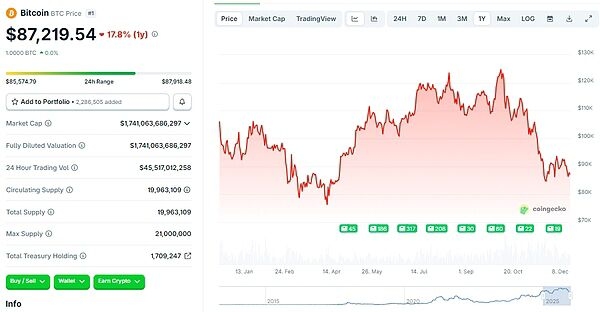
BTC price chart for 2025
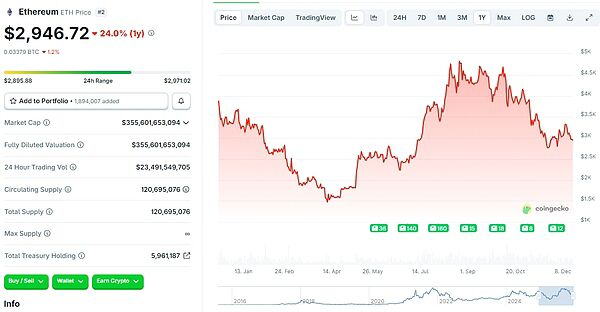
ETH price chart for 2025
1. January-February: Loose signals + Trump's return to the White House boosts BTC to $100,000
On January 1, 2025, BTC's price was reported at $93,507.88, after which BTC's price gradually rose, lingering above $100,000 until early February. The year started with a promising market, and the entire industry was in high spirits, with investors generally holding a bullish view on the crypto market for the year.
The Federal Reserve kept interest rates unchanged in its meetings in January and February but signaled a 'cautious wait-and-see, easing is expected' stance, prompting the market to prepare for a liquidity dividend in advance. From the end of January to early February, the target range for the federal funds rate was stabilized between 4.25% and 4.5% in both meetings. From a policy signal perspective, the January meeting statement removed the previous wording about 'progress in bringing inflation back to the 2% target' and added a focus on 're-inflation risks.' Fed Chair Powell clearly stated that interest rate cuts would only be considered once 'inflation shows real progress or the labor market weakens,' but emphasized that the 'threshold for reversing rate hikes is extremely high,' ruling out the possibility of restarting rate hikes. The minutes of the February meeting further revealed that officials unanimously believed that the current restrictive monetary policy allows time to assess the economy while expressing concerns that Trump's tariff policy could raise inflation, but generally recognized that 'interest rate cuts in 2025 remain the broader direction,' with institutions like Goldman Sachs and Barclays predicting two cuts of 25 basis points within the year based on this.
Additionally, former U.S. President Trump returned to the White House on January 20, becoming the first 'crypto president' in U.S. history, resonating with the Federal Reserve's expectations of easing, together catalyzing the rise of the crypto market.
II. March-April: Tariffs + slowdown of the Federal Reserve's easing led to BTC's correction.
Since Trump's confirmation to return to the White House, the market has actually been digesting the expectation of his high-handed tariff policies.
At the end of February, Trump announced that the previously planned tariffs on Canada and Mexico would take effect next month after being postponed—granting the two countries additional time to address border security issues; the tariffs would officially take effect after March 4.
The U.S. officially advanced its expectation of imposing tariffs on Canada and Mexico, leading the market to reassess the global trade environment. The anticipated effectiveness of the tariff measures on March 4 raised concerns about global trade friction, and the risk-averse sentiment heated up, causing funds to withdraw from risk assets, with short-term funds favoring the dollar and cash-like assets.
On March 23, the Federal Reserve's interest rate meeting concluded, maintaining the interest rate unchanged but raising inflation expectations, signaling that the pace of easing might slow down, breaking the market's previous optimistic expectations for rapid rate cuts. A series of negative factors combined led to a short-term sell-off in the crypto market.
III. May-October: Favorable policies + renewed interest rate cuts support BTC's double top at new highs.
The U.S. crypto regulatory policy and interest rate cuts have indeed ushered in a 'crypto summer' for the crypto market. As a result, BTC's price surged, reaching a historic high of $123,561 on August 14, and then reaching another historic high of $124,774 on October 7.
From July 14-18, the U.S. 'Crypto Week' kicked off, with three major crypto regulatory bills being enacted.
On June 17, the U.S. Senate passed the (Guidance and Establishment of a National Innovation Act for U.S. Stablecoins) (GENIUS Act), advancing the U.S. federal government's regulatory efforts on stablecoins and pressuring the House to plan the next phase of national regulatory efforts for digital assets. The bill was signed into effect by Trump on July 18. The implementation of this law marks the first formal establishment of a regulatory framework for digital stablecoins in the U.S.
On July 17, the House passed the (Anti-CBDC Surveillance National Act) with 219 votes in favor and 210 against.
On June 23, the House Financial Services Committee and the Agriculture Committee submitted the (Digital Asset Market Clarity Act) (CLARITY Act), which defines digital commodities as digital assets whose value is 'intrinsically linked' to the use of blockchain. Passed by the House on July 17.
On September 18, the Federal Reserve announced a 25 basis point interest rate cut, lowering the federal funds rate to 4%-4.25%, and liquidity easing expectations returned; at the same time, central banks in several countries globally began to include small amounts of BTC in their foreign exchange reserve diversification, with the Dutch central bank disclosing holdings of BTC assets worth $1.5 billion, enhancing market confidence.
On October 1, the U.S. federal government entered a 43-day 'shutdown' due to depleted funds, raising investor concerns about economic uncertainty and increasing demand for safe-haven assets. BTC became a favored asset for both institutional and retail investors, thus surging to a historic high again on October 7. Although its trend weakened afterward, BTC's price generally remained above $110,000 in October.
Moreover, news such as Circle's IPO on June 5, the Hong Kong (Stablecoin Regulation Draft) effective on August 1, the Trump family's WLFI transaction on September 1, and major companies announcing crypto reserves have also periodically become catalysts for market rises.
Just as the market was on an upward trajectory, a crisis was also lurking within, as BTC began to slowly decline from its historic high of over $120,000 in October, sparking widespread discussions about whether it had already entered a bear market in the last two months of the year.
IV. November-December: Concerns about the future economy weaken BTC's upward momentum.
On November 1, BTC's price was reported at $109,574, after which it entered a downward mode. On November 23, BTC recorded a low of $84,682, down 22.71% from the beginning of the month. Although it oscillated above $90,000 for most of the time thereafter, the upward trend was weak, prompting various speculations within the industry.
The U.S. government shutdown resulted in the absence of key economic data, leading to market concerns about the economic fundamentals and future interest rate trends, negatively impacting the performance of risk assets.
Additionally, although there had already been expectations that the Federal Reserve would continue to cut interest rates, before the actual cuts, the Fed sent cautious signals, leading to differences in the market's expectations for future liquidity. On December 10, the Federal Reserve conducted its third interest rate cut of the year, but the market interpreted it as a 'recessionary cut' in response to economic weakness, which instead exacerbated pessimistic expectations. Investors are re-evaluating macro variables such as the global interest rate path and fiscal health, leaning towards more robust asset allocation amid uncertainty.
As the crypto market's downturn continues, many DAT companies find it hard to survive, and the increase in liquidations due to drastic market changes will further push the market down.
Currently, the market is looking forward to a wave of 'Christmas rally,' which may be this year's 'hope for the whole village.'
Summary
The curtain rises on 2025 with an almost 'certain' optimism, as Trump's ascent fills the industry with expectations. After experiencing tariffs and a slowdown in the Federal Reserve's easing pace, the market erupts again after a period of dormancy: favorable policies, renewed interest rate cuts, IPOs of crypto companies like Circle, hype around Trump family projects, and a surge of DAT companies all contribute to BTC breaking through the $120,000 mark twice. However, influenced by macroeconomic expectations, BTC struggles to avoid a volatile bottoming pattern by the end of the year.
From the perspective of the entire year's crypto market trends, the correlation between BTC and traditional financial markets has significantly strengthened, and the improvement of regulatory frameworks and the Federal Reserve's policy rhythm may continue to be key variables affecting BTC price trends in 2026.#美国非农数据超预期 #巨鲸动向 #加密市场观察


