
A long bearish candle has pierced the psychological barrier of $85,000. The unexpected tightening by the Bank of Japan has led to a global liquidity squeeze, prompting Bitcoin to perform a 'Heaven and Earth Needle' market move on Thursday, bringing the market back to the critical line of bulls and bears.
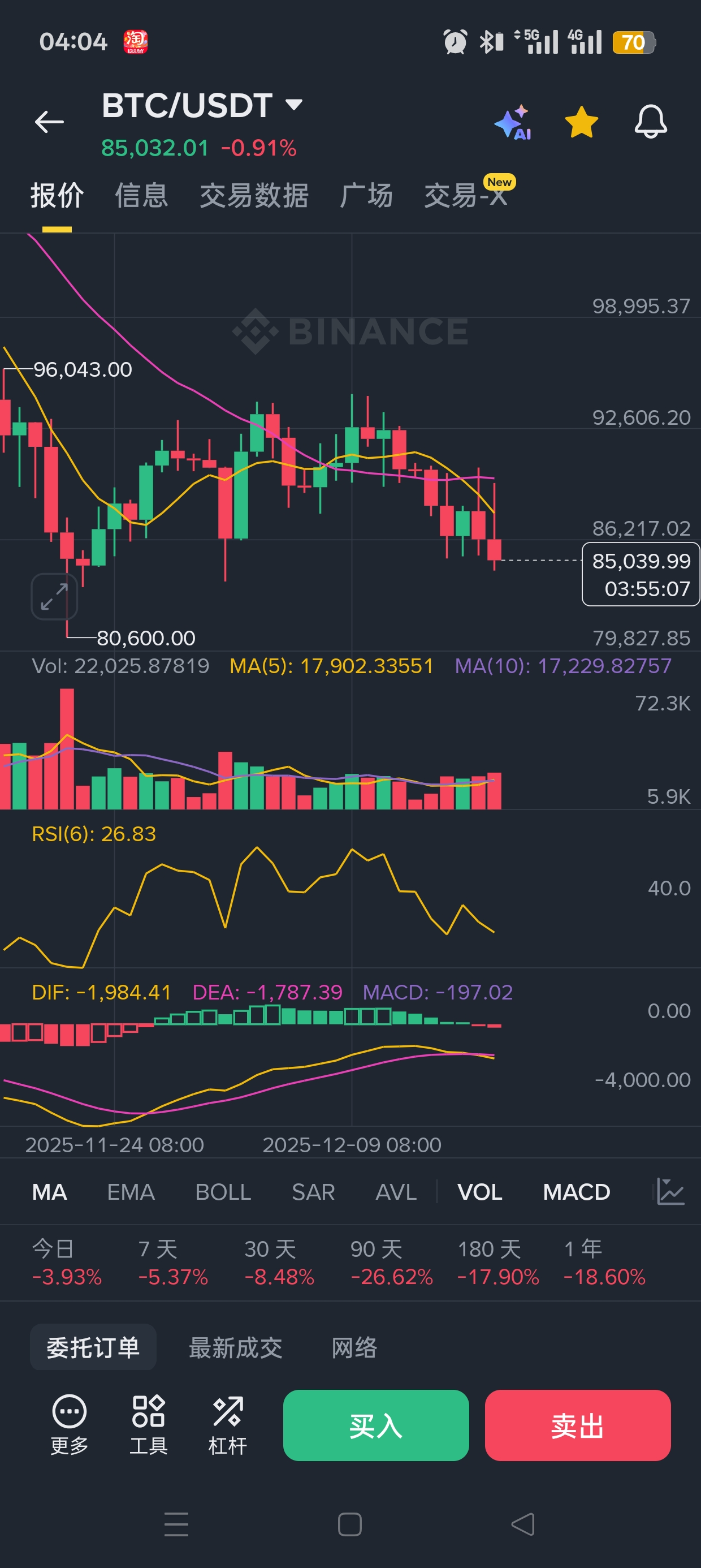
On December 19th, Beijing time, Bitcoin's daily closing price effectively fell below the key support of $85,000, dipping to a low of $84,450, and ultimately closing around $84,988. This breakdown occurred under the global tightening shockwave following the Bank of Japan's interest rate hike, leading to a sharp increase in market volatility.
01 Japan's interest rate hike: The last straw that broke the camel's back?
The core driver of today's market is the decision by the Bank of Japan to end the negative interest rate era. As the last major central bank in the world to shift away from an ultra-loose monetary policy, it has directly triggered a rapid unwinding of global carry trades.
A large amount of low-cost yen borrowed and invested in high-yield risk assets (including cryptocurrencies) is forced to flow back, creating instant selling pressure. This is the root cause of the liquidity that led to the appearance of 'Heaven and Earth Needle' (rapid rise followed by a crash) during the session.
The impact of this event is structural. It marks the beginning of the collapse of an important pillar of the global 'cheap money' era, exerting mid-term pressure on all assets that rely on liquidity premium, including Bitcoin.
02 Technical Breakout: Support Turns to Resistance
From the latest technical charts, the breakout signal has become very clear.
· Price: The daily candlestick confirmed a close below $85,000, which is the lower boundary of the oscillation range over the past month.
· Moving Average System: The price has moved far from the 7-day moving average (87,743) and is firmly suppressed by the 25-day moving average (89,744), showing a standard bearish arrangement.
· Key Indicator: RSI(6) is still in the oversold area of 26.83, and the MACD green bars have slightly shortened, indicating that the downward momentum may weaken in the short term, but the trend remains downward.
$85,000, previously a strong support, has now turned into an important resistance level. Any rebound that fails to effectively reclaim this position will be seen as a technical retracement, representing an opportunity to reduce rather than increase positions.
03 December 20 Market Simulation: Two Scenarios
Based on the current breakout facts and macro shocks, the following two scenarios may occur tomorrow (December 20):
Scenario One (Probability 60%): Inertia Downward, Seeking New Balance
· Trend: The market will continue to digest the impact of Japan's interest rate hike, and in the early trading session, it may continue to test the support strength in the 84,000-84,500 dollar area.
· Logic: After breaking out, the sentiment is bearish, and the next technical support needs to be tested. Since the RSI is deeply oversold, the probability of a direct continuous crash is small; it is more likely to form a new oscillation range at a low level (for example, 84,000-86,000).
· Key Point: Observe whether 84,000 can form effective defense, and whether the rebound can reach 86,000.
Scenario Two (Probability 40%): Rebound After All Bad News is Out
· Trend: The market sees Japan's interest rate hike as a short-term bearish signal that has run its course, combined with the oversold RSI, it may lead to a technical rebound, confirming the resistance area of 85,500-86,000 dollars.
· Logic: The interest rate cut expectations brought by the favorable U.S. CPI have not disappeared, forming a hedge against Japan's tightening. Shorts have partially taken profits during today's sharp fluctuations, providing space for a rebound.
· Key Point: The strength of the rebound and trading volume are crucial. A rebound without volume near 86,000 is an excellent opportunity to reduce positions or short.
Overall Strategy: The current market has entered the confirmation phase after the breakout, and operations should focus on defense. Bulls should not blindly 'catch the bottom' but wait for clear stabilization signals (such as long lower shadows, hourly chart divergence) at lower price levels (around 84,000). Bears can pay attention to the weakness performance when the price retraces to the resistance area of 85,500-86,000.
The market balance has tilted due to Japan's interest rate hike, and Bitcoin needs time to find a new pivot point in the new liquidity environment. Losing $85,000 means that the market has entered a more complex stage that requires more patience.

