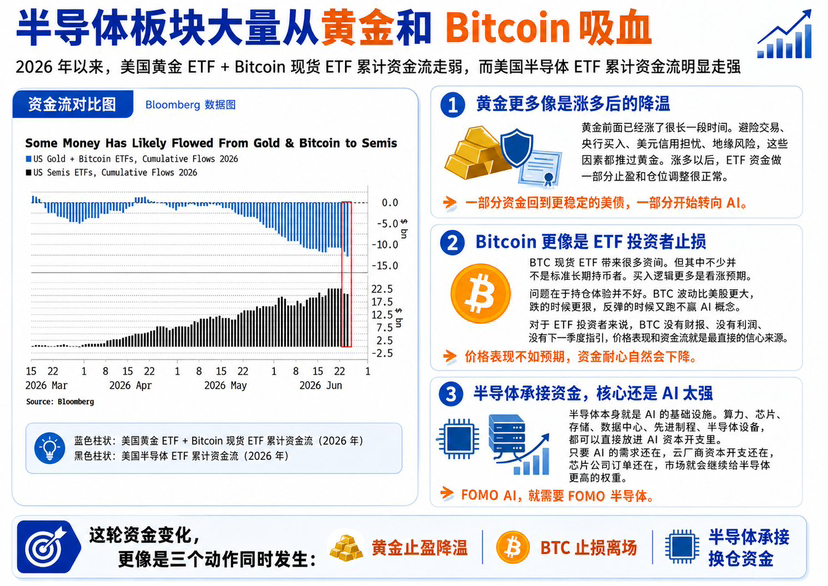
Since 2026, cumulative fund flows into U.S. gold ETFs combined with Bitcoin spot ETFs have overall weakened, while cumulative fund flows into U.S. semiconductor ETFs have clearly strengthened.
Share my personal perspective:
1. The outflow from gold is more like a cooling-off after a big run.
Gold has been rising for a long time already. Factors such as safe-haven trading, central bank buying, concerns about the dollar’s creditworthiness, and geopolitical risks have all supported gold. After it has run up a lot, it’s normal for ETF flows to take some profit and adjust positions. The long-term thesis for gold hasn’t disappeared; however, the cost-effectiveness of continuing to chase it higher in the short term has declined.
2. BTC outflows are more like stop-loss and disappointment after ETF investors incur losses.
Spot BTC ETFs bring in a lot of money, and that money isn’t from standard long-term coin holders, nor from native users of the crypto community. The logic for these funds to buy spot BTC ETFs is very straightforward: they likely believe that once ETFs are established, incremental capital will come in, and BTC will keep rising.
But the problem now is that many ETF investors don’t have a good holding experience. BTC is more volatile than the U.S. stock market—when it falls, it falls harder, and when it rebounds, it can’t outperform AI concepts. Also, for ETF investors, BTC has no earnings reports, no profits, and no next-quarter guidance. In the short term, what can support confidence is just price performance and fund flows.
If price performance doesn’t meet expectations and fund flows don’t keep improving, then this batch of capital’s patience naturally drops.
3. Semiconductors absorb the capital—the core reason is that the AI line is simply too strong.
Semiconductors are the infrastructure for AI. Compute power, chips, storage, data centers, advanced processes, and semiconductor equipment can all be directly placed by the market into AI capital expenditures. As long as AI demand is still there, cloud providers’ capex is still there, and chip companies’ orders are still there, the market will continue to give semiconductors higher weighting.
Moreover, for many funds, AI already has a new defensive quality.
This kind of defense is different from gold. Gold is a traditional safe haven; AI is more like, in an uncertain market, capital is willing to stay in the strongest main theme—with performance that’s validated and consensus that’s strong. Semiconductors have had longer rallies, the logic is smoother, and earnings reports are easier to verify—so capital naturally feels that this line is safer than many other assets.
So, when I look at this change in capital, I’m more willing to understand it as three actions happening at the same time.
Gold is used to take profits and cool down after a big run-up. Given the market’s high uncertainty around the Federal Reserve, you can clearly see that investors either choose more stable U.S. Treasuries or choose the more FOMO-driven AI.
As for BTC, it’s more like a stop-loss move after ETF investors lose money. The shift of funds from BTC to semiconductors in AI is very similar to moving from meme coins to mainstream coins: if the meme season never arrives and liquidity in meme coins is poor, better to go directly to mainstream coins.
After the AI main theme keeps being strengthened, semiconductors have absorbed the capital that was rotated out. As the strongest-demand sector among the hottest AI concepts right now, FOMO in AI needs FOMO in semiconductors.
This also explains why the cumulative fund flows into spot gold and BTC ETFs are flowing out, while the cumulative fund flows into semiconductor ETFs are strengthening.