

Written by: Messari
Translated by: Glendon, Techub News
In the realm of mainstream cryptocurrency assets, few assets can provoke widespread and profound debate like Ethereum. Bitcoin, as the leader of the cryptocurrency market, has essentially established its dominant position with little controversy. However, Ethereum's role is far from having a unified understanding. For some, Ethereum is the only credible non-sovereign currency asset aside from Bitcoin; but in the eyes of others, it is merely a business facing declining revenue and shrinking profit margins, constantly contending with faster and cheaper Layer 1 (L1) blockchains.
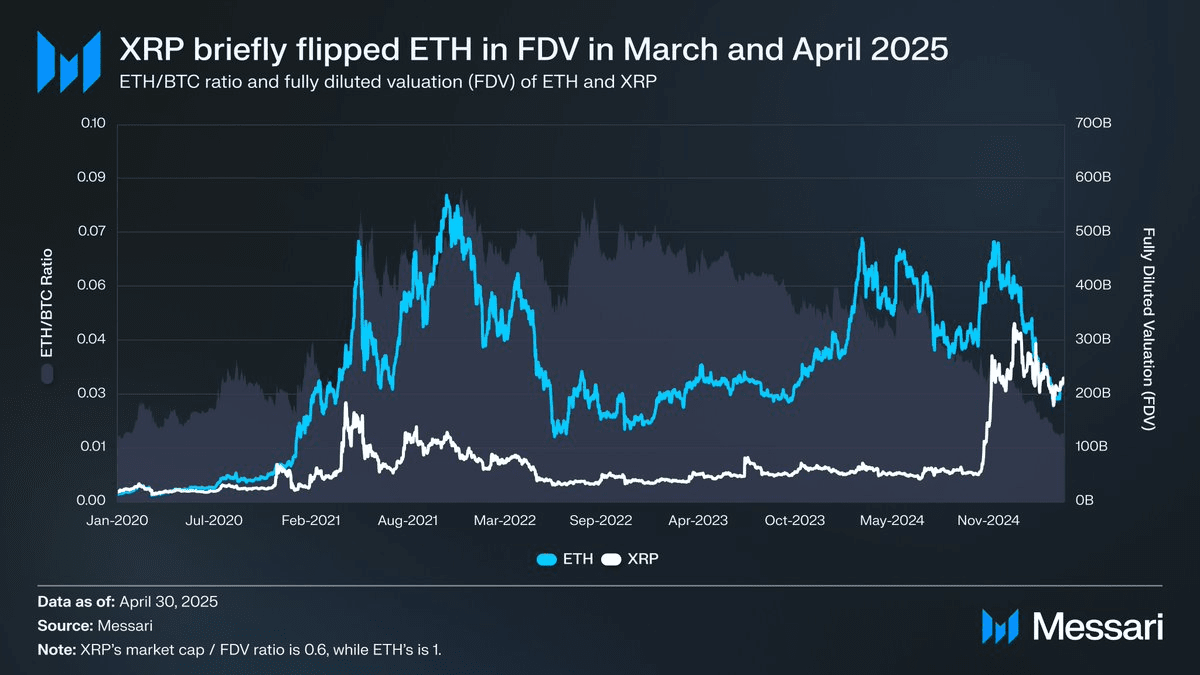
This intense debate seems to have reached a climax in the first half of this year. In March, XRP's fully diluted valuation (FDV) briefly surpassed that of Ethereum (notably, Ethereum was in full circulation while XRP's circulation was only about 60%). Data from March 16 showed that Ethereum's FDV was $227.65 billion, while XRP's FDV reached $239.23 billion, a result that few could have predicted a year ago. Subsequently, on April 8, 2025, the ETH/BTC ratio fell below 0.02 for the first time since February 2020. This means that the excess performance accumulated by Ethereum relative to Bitcoin in the last cycle has completely reversed. At that time, market sentiment towards Ethereum fell to a multi-year low.
Worse yet, the price trends are only part of Ethereum's problems. With the rise of competing ecosystems, Ethereum's share of L1 transaction fees has also been continuously declining. Solana regained its footing in 2024, and Hyperliquid emerged in 2025. Together, these two factors have pulled Ethereum's fee share down to 17%, ranking it fourth among L1 trading platforms, a stark drop from its previous top position a year ago. Although transaction fees are not the only metric for evaluating a blockchain ecosystem, they clearly reflect the direction of economic activity, and the competitive landscape Ethereum faces today is the most intense in its history.
However, historical experience shows that significant reversals in cryptocurrencies often begin when sentiment is most pessimistic. When Ethereum was viewed as a failed asset and discarded by the market, most of its so-called 'failure factors' had already been digested by the market.
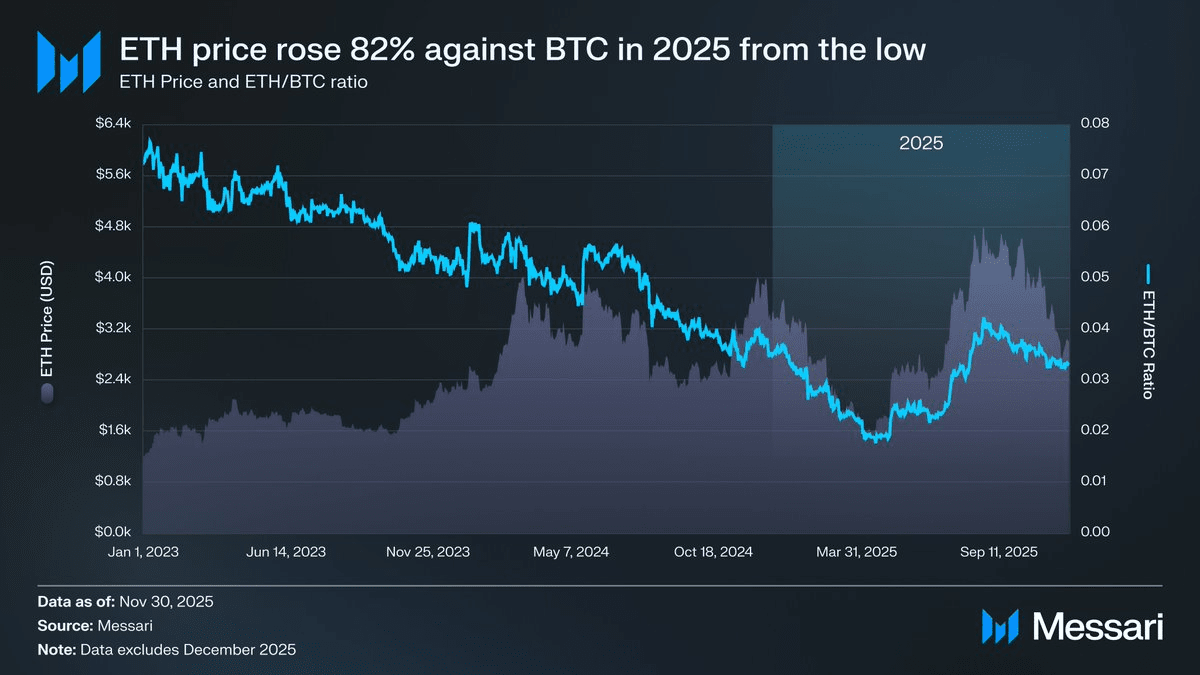
In May 2025, optimistic signs began to emerge in the market. During this period, both the ETH/BTC exchange rate and the dollar price of ETH began to show a significant reversal. The ETH/BTC exchange rate surged from a low of 0.017 in April to 0.042 in August, an increase of 139%; while ETH itself also rose by 191% during the same period, from $1,646 to $4,793. This upward momentum peaked on August 24, when the price of ETH reached $4,946, setting a new historical high.
Following this repricing, Ethereum's overall trend has significantly shifted towards a strong recovery. The changes in the leadership of the Ethereum Foundation and the launch of the Digital Asset Treasury (DAT) focused on Ethereum have brought the certainty that was missing for most of the previous year to the market.
Before the bullish trend began, the differences in performances of Bitcoin and Ethereum in their respective ETF markets were particularly pronounced. In July 2024, when the spot Ethereum ETF was launched, the inflow of funds was weak. In the initial six months, it raised only $2.41 billion, which is undoubtedly disappointing compared to Bitcoin ETF's record inflow performance.
However, with the recovery of Ethereum, the market's concerns about ETF fund flows have completely reversed. Over the past year, the inflow of funds into Ethereum spot ETFs reached $9.72 billion, while the inflow for Bitcoin ETFs soared to $21.78 billion. Considering that Bitcoin's market capitalization is nearly five times that of Ethereum, the gap in fund inflows between the two is only 2.2 times, far below the market's previous expectations. In other words, after market cap adjustments, the demand for Ethereum ETFs has exceeded that of Bitcoin, which contradicts earlier claims about institutional investors' lack of interest in Ethereum. At certain stages, Ethereum even completely surpassed Bitcoin. From May 26 to August 25, the inflow of funds into Ethereum ETFs was $10.2 billion, surpassing Bitcoin's $9.79 billion during the same period, marking the first clear tilt of institutional investor demand towards Ethereum.

From the perspective of ETF issuers, BlackRock has further solidified its dominance in the ETF market. By the end of 2025, BlackRock's holdings of ETH reached 3.7 million, accounting for as much as 60% of the total share in the spot ETH ETF market. This figure represents a significant increase from 1.1 million ETH at the end of 2024, a growth rate of 241%, placing it first among all issuers in annual growth rate. Overall, the holdings of the ETH spot ETF by the end of 2025 amounted to 6.2 million ETH, approximately 5% of the total supply of ETH.
A key development behind Ethereum's rapid recovery is the rise of Digital Asset Treasuries (DAT) focused on Ethereum. DAT has created a stable and continuous demand source for ETH that has never existed before, anchoring ETH in a unique way that no market narrative or speculation can match. If the price trend of ETH is regarded as a clear turning point, then the accumulation of DAT represents a deeper structural transformation driving this turning point.
These DATs have had a significant impact on the price of ETH. During 2025, they cumulatively purchased 4.8 million ETH, accounting for 4% of the total supply of ETH. Among them, Tom Lee's Bitmine (code: BMNR) performed particularly well. This company, which originated as a Bitcoin mining operation, began converting its treasury and capital into ETH in July 2025. Between July and November, Bitmine purchased 3.63 million ETH, becoming the absolute leader in market share for DATs, accounting for approximately 75% of all DAT holdings.
Despite the strong rebound momentum of ETH, the upward trend eventually cooled down. As of November 30, Ethereum's price had fallen to $2,991 from its August peak, significantly below the historical high set in the previous cycle. Although Ethereum's current situation is far better than in April, this recovery has not entirely eliminated the structural concerns that initially triggered bearish viewpoints. In fact, if anything is different, it is that the debate surrounding Ethereum is more intense than ever before.
On one hand, Ethereum exhibits many characteristics similar to those of Bitcoin in the process of emerging as a monetary asset. ETF fund inflows are no longer weak, and digital asset treasuries have become a sustained demand driver. Moreover, more critically, an increasing number of market participants view Ethereum as distinctly different from other L1 tokens, with some markets now classifying it alongside Bitcoin under the same monetary framework.
On the other hand, the adverse factors that caused Ethereum's price to drop earlier this year have not yet been alleviated. Ethereum's core fundamentals have also not fully recovered. Its share of L1 transaction fees continues to be squeezed by strong competitors like Solana and Hyperliquid. The underlying transaction activity remains far below the peak levels of the previous cycle. Even during the months when Ethereum's price was experiencing the strongest upward momentum, a considerable portion of holders viewed this price increase as an opportunity to sell for liquidity rather than a validation of its long-term monetary theory.
The core focus of this debate is not whether Ethereum possesses value, but rather how the asset ETH can draw value from the success of Ethereum.
In the previous cycle, the prevailing view was that the value of ETH would directly derive from the success of Ethereum. This is the argument of 'Ultrasound Money': Ethereum will possess such high utility that it will destroy a large amount of ETH, thus providing a clear and mechanically enforced source of value for the asset.
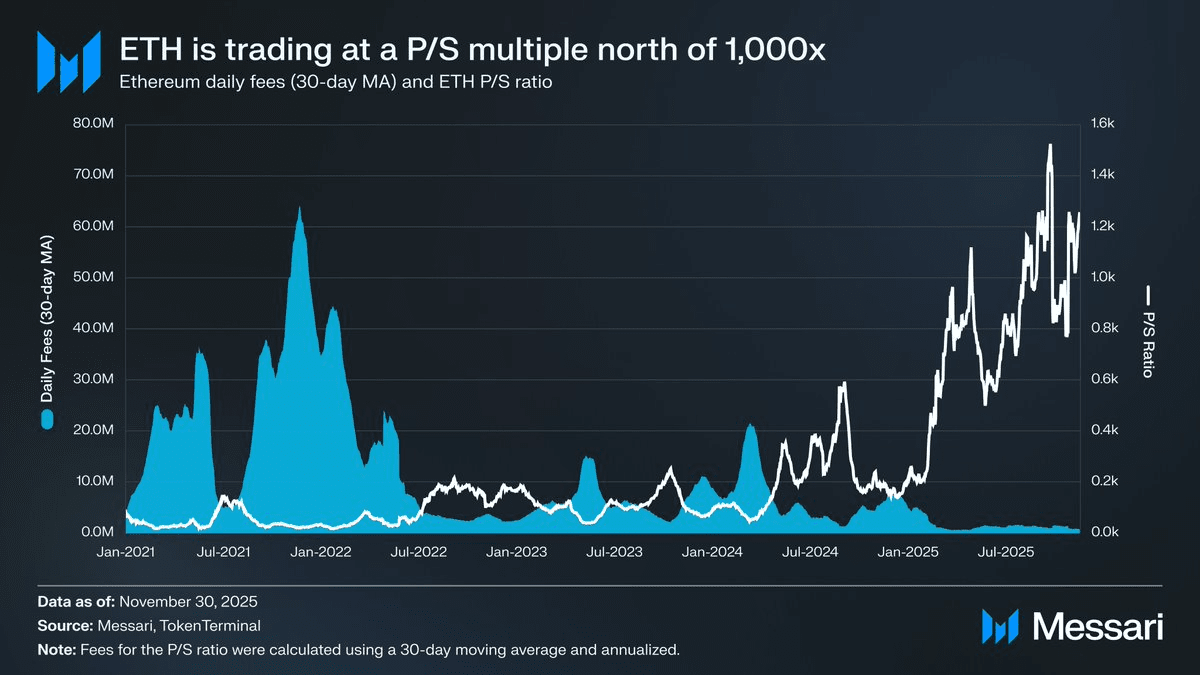
Currently, we can reasonably conclude that the previously expected situation will not materialize. Ethereum's transaction fees have shown a cliff-like decline, and there are currently no signs of recovery. Its two key growth engines—Real World Assets (RWA) and institutional investors—primarily use the dollar as their base currency asset rather than Ethereum's native assets.
In this scenario, the value direction of ETH will depend on its ability to indirectly derive value from Ethereum's success. However, this mode of indirect benefits is filled with uncertainty. It relies on the hope that as the importance of the Ethereum system increases, more users and capital will regard ETH as a cryptocurrency and a means of value storage.
Unlike the direct and mechanical accumulation of value, this phenomenon of indirect benefits does not occur with certainty. It entirely relies on social preferences and collective beliefs for support. This is not a major flaw in itself; after all, Bitcoin's value accumulation is also based on such factors. However, it indeed means that the appreciation of ETH is no longer tangibly linked to Ethereum's economic activity in a deterministic way.
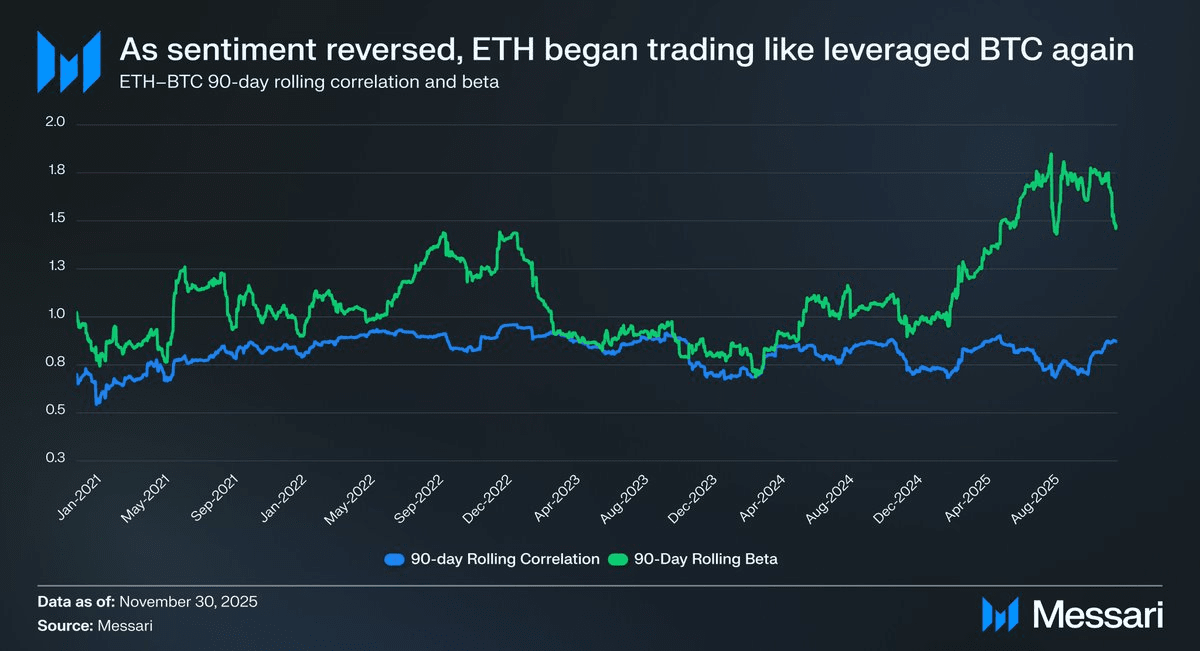
All of these circumstances have brought the focus of controversy regarding Ethereum back to its core contradictions. ETH may indeed be accumulating a certain monetary premium, but this premium is always lower than that of Bitcoin. The market once again views ETH as a leveraged extension of BTC's monetary theory rather than an independent monetary asset. Throughout 2025, the 90-day rolling correlation between ETH and BTC has consistently fluctuated between 0.7 and 0.9, while its rolling beta coefficient has surged to multi-year highs, at times even exceeding 1.8. This indicates that ETH's price movements are more aggressive than BTC's, yet still highly dependent on BTC's performance. (Techub News note: A higher beta value of Ethereum relative to Bitcoin means greater sensitivity of its price fluctuations to Bitcoin, which may lead to increased risk transmission. As the market benchmark, Bitcoin's price fluctuations will significantly translate to Ethereum.)
This is a subtle yet crucial distinction. The monetary correlation exhibited by Ethereum today is rooted in Bitcoin's monetary narrative still being solid. As long as the market firmly believes that Bitcoin is a non-sovereign store of value, there will inevitably be some market participants willing to extend this belief to Ethereum. If Bitcoin maintains a strong performance in 2026, Ethereum has every opportunity to follow along a relatively straightforward path.
Moreover, currently, the Ethereum DAT market is still in the early stages of its lifecycle. So far, these DATs have primarily driven the accumulation of ETH through common stock issuance. However, in the context of another cryptocurrency bull market, these entities can draw on strategies that expand Bitcoin exposure to explore additional capital formation pathways, such as convertible bonds and preferred stock.
Taking DATs like BitMine as an example, they can raise a series of low-interest convertible debt and high-yield preferred capital, using the funds directly to purchase ETH, which are then staked for continuous returns. Under reasonable assumptions, staking income can partially offset fixed interest and dividend expenses, allowing the treasury to continuously accumulate ETH in a favorable market environment while increasing balance sheet leverage. Assuming a full recovery of the Bitcoin bull market, this potential 'second life' of Ethereum DATs is expected to become an additional boost to maintain a higher beta value of ETH relative to BTC in 2026.
Summary
Ultimately, the market still closely associates Ethereum's monetary premium with Bitcoin's monetary premium. At present, Ethereum has not yet become an autonomous monetary asset with an independent macro foundation; on the contrary, it is gradually becoming a secondary beneficiary of Bitcoin's monetary consensus. Its recent recovery trend merely reflects that a small number of investors are willing to treat Ethereum as a substitute for Bitcoin rather than as a typical L1 token. Nevertheless, even if Ethereum shows relative strength, market confidence in Ethereum is inextricably linked to the sustained strength of Bitcoin's own narrative.
In short, the monetization narrative of ETH is no longer fragmented, but it is also far from a definitive conclusion. Given the current market structure and considering the increased beta value of ETH relative to BTC, if the core logic of BTC continues to play out, ETH may experience meaningful appreciation, and the structural demand from DATs and corporate treasuries provides real upside potential. Ultimately, however, Ethereum's monetary trajectory in the foreseeable future still depends on Bitcoin. Unless Ethereum can demonstrate lower correlation and beta values (which it has never achieved over a longer time horizon), its premium will continue to fluctuate in Bitcoin's shadow.


