

The least risky execution idea: split the purchase into 3–5 installments within the “entry area” instead of a single point.
Let's dive deep and in a practical way “long-term investment” (12–24 months) with entry areas + logical stop loss + multiple targets ✅📈
Important alert ⚠️: This is educational content and not financial advice. Crypto is highly risky. It is best to apply DCA (buying in installments) and use a weekly close to activate the stop loss instead of the tails.
1) How do I think about 'entry/stop/targets' professionally? 🧠
✅ Entry
In long-term investment, you rarely buy 'one point'. The best:
1. Entry range + buy in 3–5 payments.
2. Or 'confirmatory entry' after regaining an important level (Break & Retest).
🛑 Stop loss (Stop Loss)
For the long-term, the best stop is often:
Weekly close below a major support level (Weekly Close)
Because it reduces stop hits due to daily volatility.
🎯 Targets
I usually provide 3 scenarios:
1. Target wallets (realistic with a stable market)
2. Fundamental target (if momentum returns in 2026)
3. Optimistic target (if we enter a strong upward wave)
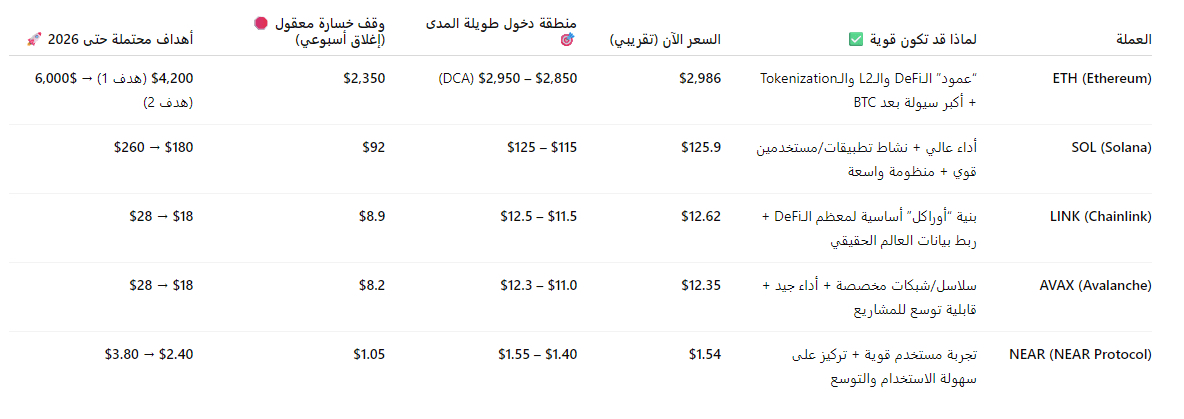
2) Current prices (approximately) + why I chose these 5? 💎
Current prices according to market feed at the time of writing the response:
ETH ≈ $2,9841
SOL ≈ $125.8
LINK ≈ $12.62
AVAX ≈ $12.35
NEAR ≈ $1.54
My selection was based on: (liquidity + actual use + technical/adoption catalysts + relatively lower risk compared to meme/small coins).
3) The five in deep detail 🔍
(1) Ethereum (ETH) 🟣
Why is ETH strong for long-term investment?
Ethereum bets on 'expansion via L2' (Arbitrum/Optimism/Base...), and with Proto-Danksharding / EIP-4844, storing rollup data became cheaper, and the ultimate goal is to significantly reduce fees and increase capacity.
This means: Increased use of layer 2 networks → often increases ETH ecosystem activity as a whole.
Potential catalysts until 2026 🚀
Continued data improvements for rollups (danksharding path) to reduce fees and increase capacity.
Expansion of 'Tokenization / RWAs' and DeFi (depending on the market wave of course).
Risks ⚠️
Competition from L1s (like SOL/AVAX)
Any regulatory recession/global liquidity pressures the entire market
L1 fees may rise again if there is strong pressure without sufficient expansion.
Long-term entry plan (makes sense)
Buying range (DCA): $2,850 – $2,950
Payment division example:
30% inside the range
30% if it drops ~7–10% additional
40% upon 'confirmation' (like regaining an important weekly resistance level)
Long-term stop loss 🛑
$2,350 (weekly close)
Logical reason: this gives room for volatility, but protects you if the direction actually changes.
Targets 🎯
Wallets: $4,200
Fundamental: $6,000
Optimistic: $7,500 – $9,000 (requires a strong upward wave + general liquidity)
The idea: ETH is often the 'backbone' of altcoins — relatively less risky than the rest.
(2) Solana (SOL) 🟩
Why is SOL strong?
SOL bets on 'speed + user experience + intensive applications' (DeFi/consumer/meme...)
Pivotal point: Firedancer (new validator client) aims to increase performance and raise 'client diversity' and reduce single-client risks.
Why is Firedancer important for investors?
If the network has:
Higher performance + higher stability + client diversity
This reduces 'network risks' and increases institutional and developer confidence over time.
Risks ⚠️
SOL moves violently (up/down) — must have a relatively wide long-term stop.
Any technical issues/congestion if usage suddenly increases
Entry plan (DCA)
Buying range: $115 – $125
Payments:
40% inside the range
30% if it drops towards $108–$112
30% upon confirmation of direction (weekly close above clear resistance)
Stop loss 🛑
$92 (weekly close)
This is often a 'dividing line' between normal volatility and a long-term structural break.
Targets 🎯
Wallets: $180
Fundamental: $260
Optimistic: $320 – $380 (requires a strong alt season)
(3) Chainlink (LINK) 🔗
Why is LINK 'important'?
Chainlink is infrastructure: Oracles + messages/transfers across chains.
And the big growth driver here is CCIP: A protocol that enables the secure transfer of tokens/messages across different networks for developers.
Strong catalyst: CCIP adoption
Chainlink documents clarify that CCIP is designed to transfer Tokens + Messages across different networks. Chainlink
And in the news: Coinbase chose CCIP as the connection infrastructure for its wrapped assets across networks (this type of news, if it continues, reflects positively on LINK's 'story').
Risks ⚠️
LINK sometimes 'lags' and then catches up late (not the fastest coin in movement)
It heavily relies on the wave of infrastructure adoption + actual demand.
Entry (DCA)
$11.5 – $12.5
Payments:
50% inside the range
25% if it touches ~$10.8
25% upon confirmation of an upward movement (weekly close above a pivotal level)
Stop 🛑
$8.9 (weekly close)
Targets 🎯
Wallets: $18
Fundamental: $28
Optimistic: $35 – $45 (if the 'Interoperability' wave increases significantly)

(4) Avalanche (AVAX) ❄️
Why AVAX?
Avalanche strongly promotes the concept of dedicated networks/chains (now often referred to as Avalanche L1s after changes/developments in the ecosystem).
Official documents explain the idea of Avalanche L1s and how they are built (Subnet-EVM/building tools... etc.).
And AvaCloud explains the shift towards Avalanche L1s after 'Etna' and what it means for building, verifying, and costs.
Where is the investment strength here?
If the trend of 'application/institution chains' increases — AVAX benefits because its core story is: specialization + performance + building ecosystem.
Risks ⚠️
Fierce competition (L2s on ETH + other chains)
Market cycles hit it sometimes more than ETH.
Entry (DCA)
$11.0 – $12.3
Payments:
40% inside the range
30% if it drops ~$10.2
30% upon confirmation of a weekly reversal
Stop 🛑
$8.2 (weekly close)
Targets 🎯
Wallets: $18
Fundamental: $28
Optimistic: $40 – $55

(5) NEAR Protocol (NEAR) 🌐
Why NEAR?
NEAR is one of the clearest projects of 'real expansion' through Nightshade (Sharding).
NEAR itself talks about Nightshade within its history/roadmap.
The Nightshade 2.0 announcement on the NEAR blog explains the development path (including ideas related to verification/scalability).
And even in the Nightshade Design paper (technical reference), there's an explanation for the sharding approach.
Why is this important investment-wise?
Because any wave of 'user applications' needs:
Low fees + performance + easier experience
And NEAR tries to build that from the ground up.
Risks ⚠️
Higher competitive risks than ETH
Moves strongly up and down (must manage positions strictly)
Its success depends on 'products/adoption' and not just technology.
Entry (DCA)
$1.40 – $1.55
Payments:
45% inside the range
30% if it drops ~$1.30
25% upon confirmation of a weekly upward movement
Stop 🛑
$1.05 (weekly close)
Targets 🎯
Wallets: $2.40
Fundamental: $3.80
Optimistic: $5.50 – $7.00
4) 'Execution plan' ready (reduces regret) ✅
Simple DCA model (works for any coin)
1. Payment 1 (30–40%) inside the entry range
2. Payment 2 (20–30%) if the price drops 8–12%
3. Payment 3 (20–30%) if it drops 15–22%
4. Payment 4 (10–20%) on 'direction confirmation' (strong weekly close)
Risk management (golden rule) 🧯
1. Don't risk more than 1–2% of capital on 'one idea' (depending on the stop proximity).
2. If your target is long: you could use a weekly stop instead of a daily to mitigate random hits.


