


Blockstream CEO Adam Back recently criticized Nic Carter — co-founder of Castle Island Ventures — for raising concerns about the risk of quantum computers to Bitcoin.

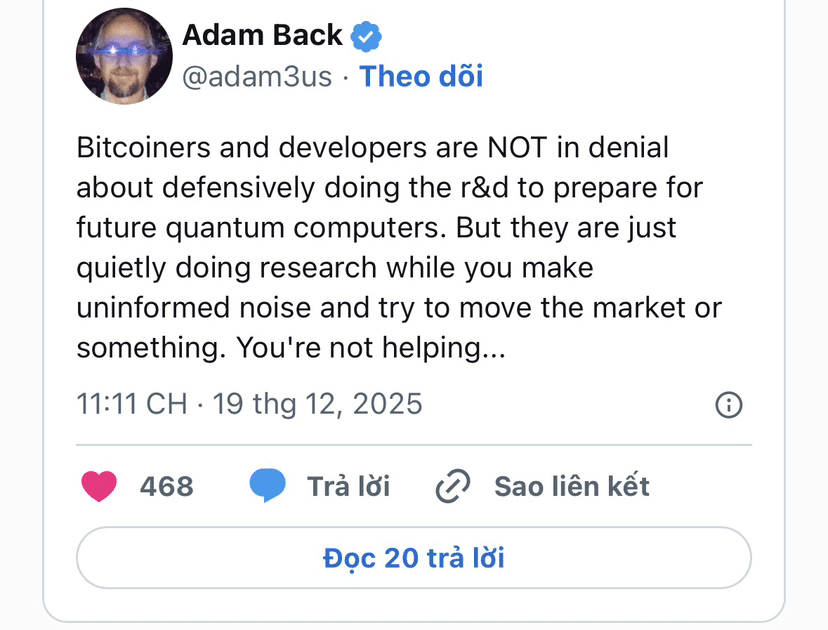
"You are just spreading misinformed information, intentionally disrupting the market or for some purpose. This brings no value at all," Back commented on the X platform on Friday, after Carter explained the reason Castle Island Ventures decided to invest in Project Eleven — a startup specializing in developing solutions to protect Bitcoin and cryptocurrency assets from the threat of quantum computers.
Back emphasized that the Bitcoin community does not deny the necessity of researching and developing defensive measures against the risks posed by quantum computers; in fact, these activities are still quietly ongoing. However, Carter rebutted this view, arguing that most Bitcoin developers still "completely deny" the risks that quantum computers may pose to the Bitcoin network.

Although Castle Island Ventures' investment was only recently mentioned on social media within the Bitcoin community, in fact, Carter has publicly disclosed this information since October 20 in a post on Substack. "I mentioned this issue right in the first sentence of the main article on quantum. It couldn't be more transparent," Carter affirmed.
"Convinced by quantum"
Carter stated that the investment decision stemmed from Alex Pruden — CEO of Project Eleven — having "convinced" him about the real risks of quantum computers. "I became extremely concerned about the quantum threat to blockchains. I always use capital to protect my beliefs," he shared.

"I understand that there will be a lot of unkind criticism, so I have been very careful to be absolutely transparent about the financial implications," Carter added.
Carter also pointed out several reasons why quantum computers pose a risk to Bitcoin, such as governments preparing for a post-quantum world, the nature of Bitcoin being a 'reward target' for quantum supremacy, and the increase in investment in quantum technology companies.
Carter is not the only figure in the Bitcoin community who has recently publicly warned about the potential threat from quantum computers to Bitcoin.
The risk could emerge within the next two years
Charles Edwards, the founder of Capriole Investments, warned in a post on X on Thursday that quantum computers could pose a real threat to Bitcoin in the next two to nine years, unless the network is soon upgraded to quantum-resistant encryption algorithms.

However, there are still more optimistic opinions.
Millionaire entrepreneur Kevin O'Leary recently shared with Cointelegraph Magazine that using quantum computers to break Bitcoin's security is not the optimal way to leverage this technology, as it would bring much greater value in fields such as medical research utilizing artificial intelligence.
Meanwhile, Back recently argued that Bitcoin being "ready for quantum" is a good thing, but it will not pose a threat for several decades, as this technology is still "in its infancy" and faces many research and development issues.